Analysis | Putin warns of collapse of international system; dangerous consequences of US unilateralism
-
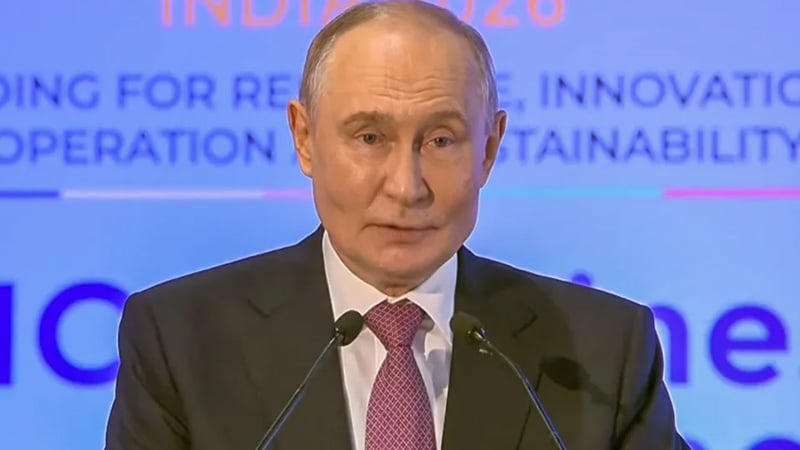
Russian President Vladimir Putin
Pars Today- Russian President Vladimir Putin has warned that the entire system of international relations is collapsing.
According to Pars Today, Russian President Vladimir Putin said on Saturday at the 18th BRICS Summit in New Delhi that the entire system of international relations is collapsing because of Western countries’ efforts to resist a multipolar world and their use of methods such as blackmail and ruthless coercion.
Referring to international developments, he said: “It seems that the formation of a multipolar world is not easily within reach; rather, its realization is facing resistance from those who are accustomed to thinking essentially in colonial terms, dividing the world into a flourishing garden and a wild jungle, and living at the expense of others.” He stressed: “These people are unwilling to accept the changing reality and are trying to contain rising competitors by any means possible.”
Putin stressed: “They use all means, including tariff wars, illegitimate sanctions, attempts at economic dictatorship, blackmail, interference in internal affairs and ruthless coercion.”
Putin warned: “As a result of the actions of countries supporting the trend toward unilateralism, longstanding tensions are flaring up again, and they are provoking new conflicts and disputes. As a result, the entire system of international relations is breaking down, and the effectiveness of a number of multilateral structures and institutions has declined.”
Vladimir Putin’s remarks that the entire system of international relations is on the verge of collapse should be assessed as more than an ordinary political position. What we are witnessing today on the global stage are clear signs of the gradual erosion of the rules, institutions and mechanisms that were established after World War II to prevent the recurrence of large-scale wars, regulate relations among countries and create a degree of stability in the international system. The most important feature of this situation is the growing gap between the principles proclaimed by international law and the behavior of major powers—a gap that, if it widens, could seriously undermine the credibility of the entire international system.
In this regard, the role of the United States, as the most powerful actor in the international system over the past several decades, is highly significant. Since the end of the Cold War, Washington has repeatedly sought to make its political, economic and military dominance the main pillar of the global order. The widespread use of unilateral sanctions, economic pressure on countries that oppose US policies, interference in the political crises of other countries, withdrawal from or threats to withdraw from certain international agreements, and the use of military force outside the framework of international consensus are among the actions that have contributed to weakening the principle of the sovereign equality of states.
The fundamental problem arises when a major power invokes international rules when they are consistent with its interests, but ignores their legitimacy when those same rules constrain the behavior of that power itself. Such an approach reinforces the perception that the international system is governed less by law than by the balance of power. The natural consequence of this situation is declining trust in international institutions and a growing tendency among countries to establish parallel mechanisms to safeguard their security and economic interests.
US unilateral sanctions are a clear example of this trend. Washington has used the position of the dollar, the banking network and its economic capabilities in an effort to influence the domestic and foreign policies of other countries. From the US perspective, these tools are a means of exerting pressure without directly entering a war, but from the perspective of many independent countries, they amount to imposing political will through economic power. The growing use of these tools has also prompted a number of countries to seek to reduce their dependence on the dollar, establish alternative payment mechanisms and expand financial cooperation outside structures under Western influence.
Under such circumstances, regional wars and crises are not merely the result of local disputes; they have also become arenas for competition among major powers. The Ukraine crisis, developments in West Asia, and the intensifying US-China rivalry in the economic, technological and military spheres are all signs that the world has entered a stage in which the former unipolar structure can no longer explain new realities, while the multipolar order has yet to develop into an institutionalized and stable framework. This transitional situation is inherently dangerous, as a power vacuum and the weakening of common rules can increase the risk of miscalculation, conflict and an arms race.
Iran’s position in this regard is based on defending genuine multilateralism and opposing unilateralism. The Islamic Republic of Iran has repeatedly stressed the need to respect the sovereignty of states, implement international law impartially, oppose unilateral sanctions and preserve the role of the United Nations. Tehran also views the emergence of a multipolar world as an opportunity to reduce the dominance of a single power or a limited group of powers over global affairs. From Iran’s perspective, multipolarity can lead to stability only if it is accompanied by respect for the independence of states and the rules of international law, rather than merely replacing one hegemony with another.
Within this framework, Iran’s expanding relations with Asian countries, Russia, China and BRICS members can be viewed as part of Tehran’s efforts to strengthen multilateral diplomacy and reduce its vulnerability to unilateral pressure. Iran believes that the future global order should be structured in a way that gives developing countries and emerging powers a greater role in global decision-making, and that institutions such as the UN Security Council, the International Monetary Fund, the World Bank and the World Trade Organization should be reformed in line with the new realities of the international system.
However, the main danger under the current circumstances is that the erosion of the existing order could reach an irreversible stage before an alternative order takes shape. If major powers increasingly abandon common rules and place their national interests above their international commitments, the world could move from an imperfect but relatively predictable order to an unstable environment shaped by shifting balances of power. Under such circumstances, even institutions such as the United Nations could face an even deeper crisis of legitimacy and effectiveness.
Therefore, Putin’s warning should be seen as a sign of a broader concern about the future of the global system. Today’s crisis is not merely a crisis between Russia and the West or between the United States and its rivals; it is a crisis of the very concept of international order and the credibility of common rules. Because of its special position, the United States bears greater responsibility for preventing this trend from escalating. Accepting the reality of a multipolar world, ending the excessive use of unilateral sanctions and pressure, and returning to genuine multilateralism could slow the erosion of the international system. Otherwise, the world may enter a period in which there is neither a stable unipolar order nor an established multipolar order; instead, a collection of rival powers, shifting alliances and cascading crises could shape the future of international relations.