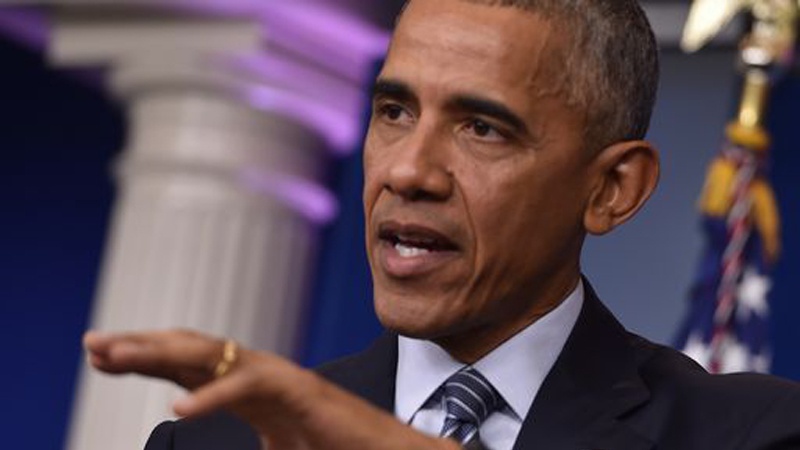
Obama defeatedly uses the ‘sanctions muscle’ against Russia
Dec 30, 2016 05:29 UTC
It seems hardly a coincidence that the US out-going president announced fresh sanctions on Russia just when the later was busy discussing a deal on Syria with Turkey and Iran in Moscow.
Far from being just a sort of coincidence, the act is an apt reflection of the increasing American anger over its failure in Syria against Russia. Salman Rafi Sheikh, a researcher and analyst of International Relations and Pakistan’s foreign and domestic affairs, has written a thought-provoking article on the failed agenda pursued by the US president vis-à-vis the developments in the Middle East, the Syria crisis in particular as follows:
According to Wall Street Journal, the Obama administration added on Tuesday, December 20, 2016, to its sanctions list Yevgeny Prigozhin, a Russian restaurateur who, according to Washington, has links to Russia’s Vladimir Putin and is the financial backer of ‘pro-Russian propaganda’ machinery. Obama’s sanctions prohibit Prigozhin from entering the US and conducting business with any American individuals or organizations. This act has come alongside new US Treasury sanctions imposed upon a number of other Russian individuals with connections to a bank US officials have said has ‘ties’ to Putin’s inner circle. As it seems, the Obama administration is busy casting Putin as a die-hard villain in its version of political and military history.
Besides the fact that it is an expression of frustration, it is also a fact that Washington has run out of ways to hit at Putin and time is running out for the lame duck president – almost three weeks left before Obama retires. Without doubt, the Obama administration feels humiliated that Russia, Turkey and Iran have formed a platform to discuss a Syrian settlement, which excludes the US. Even if it is not a defeating humiliation, the situation developing within and outside Syria regarding a US-exclusive peace settlement is politically deeply damaging for the US both domestically and internationally.
Nothing perhaps could explain the damage the Obama administration has done to the US due to its dual policies with regard to Syria and the larger issue of terrorism than Senator John McCain’s recent statement in which he said that what is unfolding is “the predictable consequence of President Obama’s reckless policy of disengagement from the Middle East. And it is ironic that after touting the power of diplomacy for years, President Obama’s refusal to back diplomacy with strength has left the United States without even a seat at the diplomatic table.”
However, Senator McCain’s view represents the view of a hawkish club that exists within the United States. Neither was the US disengaged from the Middle East during all these years nor was the Obama administration oblivious to the importance of bringing havoc to Syria, in the name of democracy, through proxy groups, some of which continue to receive support.
Yet, the situation now emerging out of the trilateral settlement among Russia, Iran and Turkey marks a direct opposite of what the US and its allies have been seeking in Syria for last five years or so. While the joint statement of the trilateral meeting has formalized a growing convergence between Moscow, Ankara and Tehran, the bottom line and what angers the US the most is their unequivocal support for a Syria that is not only sovereign, independent and united with its territorial integrity intact, but also is “multi-ethnic, multi-religious, non-sectarian, and democratic.”
At the core is all parties’ willingness to facilitate an intra-Syria dialogue and to be the guarantors of a prospective agreement between the Syrian government and the opposition. Following the Moscow meeting, at a joint press conference with his Turkish and Iranian colleagues, Russian Foreign Minister Sergey Lavrov made it clear that the new trilateral format will be the “most effective” charioteer henceforth in the intra-Syrian peace talks.
He said Russia, Turkey and Iran are “probably better prepared than others to contribute to the settlement of the Syrian crisis with real actions, not just words”.
The three countries have as such tactfully got rid of the US mentorship in Geneva by agreeing to hold the talks in Astana, Kazakhstan. Hence, the brewing domestic anger over the Obama administration and the consequent sanctions.
While Obama may just be able to pacify its supporters through these sanctions, he cannot certainly turn bind to the danger Europe is facing. This widening of American sanctions against Russia at a time when the bloody attacks in Ankara and Berlin should bring reasonable people together to fight the terrorist threat shows that Washington has completely lost its grip on reality and deliberately decided to turn blind to it. Yet the threat exists and continues to pose a major challenge to Europe’s security situation. The Obama administration’s stubbornness with regard to indiscriminately fighting the so-called 'terrorism' and its undue insistence on the elected Syrian President Bashar al-Assad’s exit are contributing, in one way or another, to the persistence of this threat and even its territorial expansion into other continents. To an extent, the US’ dualism has even cost it its erstwhile allies.
The US is losing its traditional grip over the Middle East and the Arab world. This is evident from the way Turkey, despite being a NATO member, has weaned itself away from the US-led block and adopted an alternative course of action. The Moscow meeting has clearly shown that Turkey has decided to bury its past Syria policies and expressed its willingness to chalk out a scheme that caters to the interests of all the actors involved. In the joint statement with Russia and Iran, Turkey implicitly accepts, notwithstanding the bargain that might have taken place among all the parties involved, that the toppling of the Assad regime is no longer the agenda in Syria.
While Turkey has finally come to terms, the US and its European and Arab allies continue to cling to the old agenda. In their calculations, they seem to continue to ignore the fact that Assad does enjoy significant local support. Had it not been for this support, he might have been toppled long before Russia entered the scene.
Even the Syrian minorities have backed him and fought for him out of sheer self-preservation. Having seen what happened to the Yazidis in Iraq when they were captured by brutal ISIS terrorists, they know they are fighting for the lives, their homes and their wives and daughters. This is an element in Assad`s support that, thus far, has gone unrecognized in the West.
With President Assad strong enough to claim its office, with Russia and Iran standing in Syria and with Turkey sliding over to Russia and Iran, the US’ credibility as a reliable security partner has been damaged to a great extent. Fresh sanctions on Russia are just yet another indication of the fact that the US is too weak to achieve its objectives through other means—something that is causing certain Arab states to re-think their traditional reliance on the US for their so-called 'national security'.
As against the Arab states’ current standing, Russian influence in the region is increasing and a number of other countries, such as Egypt, have shown their willingness to extend co-operation with Russia against terrorism. Importantly, this co-operation against terrorism is not mere co-operation’; it also signifies a potential rejection of the US version of terrorism according to which a terror group becomes ‘terrorist’ only when it starts hurting interests of the US and those of its allies’.
EA/ME
Tags