Path towards Enlightenment (978)
Nov 22, 2022 13:56 UTC
Salaam and welcome to another episode of our weekly series titled “Path towards Enlightenment” which is an endeavour to make you and us familiar with an easy and fluent explanation of God’s Final Scripture to all mankind, the holy Qur’an that was revealed to the Last and Greatest of all Messengers, Prophet Mohammad (blessings of God upon him and his progeny).
As you know, last week we completed explanation of “Surah Qamar” and from this Friday onwards we embark on explanation of the next Surah, that is, “Surah Rahman”, which is number 55 in the serial order of compilation of the holy Qur’an.
It has 78 Ayahs and is considered the crown of the Holy Qur’an since it opens with the word “Ar-Rahman” or the “All-Beneficent”, thus proclaiming one of the most beautiful attributes of the Almighty Creator. This Surah highlights the All-Merciful Lord’s wonders of creation, describes the end of the material world, and paints an evocative picture of the delights of Paradise. Hell is briefly contrasted in Ayah 43 with the joys that await the righteous. The refrain فبای آلاء ربکما تکذبان which means “So which of your Lord’s bounties will you both (mankind and jinn) deny?” runs throughout the Surah, which divides mankind and jinn into three classes: the disbelievers (in Ayah 41), the best of believers (in Ayah 46), and the ordinary believers (in Ayah 62).
A hadith from the Prophet about the benefits of Surah Rahman says: “Whoever recites it Allah will have mercy on his weakness and regard it as expression of gratitude.”
According to the Prophet’s 6th Infallible Heir, Imam Ja’far Sadeq (AS), on the Day of Judgement, this Surah will assume the form of a handsome human with wondrous fragrance and will be told by God Almighty to point out those of the believers who used to recite it. It will then be allowed to beseech God for the forgiveness of its reciters whom the All-Merciful will pardon.
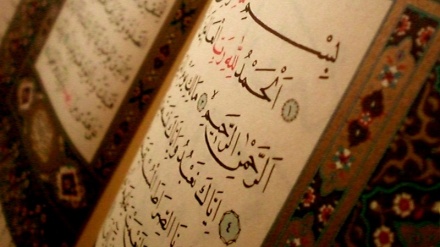
Let us start with recitation of Ayahs 1, 2, 3, and 4 of Surah Rahman:
“In the Name of Allah, the All-Beneficent, the All-Merciful – The All-Beneficent
“Has taught the Qur’an;
“He created man,
“(and) Taught him articulate speech.”
The opening of the Surah with the God’s wondrous attribute “Ar-Rahman” or the All-Beneficent is indicative of Divine Blessings which are all-encompassing and benefit both believers and disbelievers in the transient life of the mortal world, even if they fail to realize these or express gratitude.
The next Ayah means to say that God taught and revealed the Holy Qur’an as the final Heavenly Scripture for the guidance of all mankind to His Last and Greatest Messenger, Prophet Mohammad (blessings of God upon him and his progeny).
Ayah 3 and 4 refer to the creation of mankind as the most wondrous creature in the world of existence, and the gift of speech, coupled with intellect, given to human beings in order to ensure steady progress through proper expression of words and development of the art of writing, without which we would never have been able to record events, transmit knowledge to future generations and explore the various vistas of science.
From these Ayahs we learn that:
- The All-Merciful God Whose compassion is all-encompassing showers his benefits on all creatures in the transient life of the mortal world, whether they believe in Him and His commandments or not, so that there is no excuse or blame for the consequences of afterlife and the Day of Judgement where reward and punishment will be meted out as per our deeds.
- The Holy Qur’an with its unmatched eloquence and timeless wisdom is the source of guidance and infinite blessings.
- Mankind is the best of creation and it is the Almighty Creator Who is the real Teacher of mankind by granting the gift of intellect and the power of speech.
- The ever-increasing vocabulary in the various languages spoken, along with the development of writing ensure the progress of human societies and their mastering of science and technology, along with firmness of faith, as part of the mercy of the All-Beneficent Lord.
Now we invite you to listen to ayahs 5 and 6 of the same Surah:
“The sun and the moon are disposed calculatedly.
“And the herb and the trees prostrate to Allah.”
These Ayahs refer to some more of the Divine Blessings, such as the sun and the moon which follow their fixed courses with measured out calculation. The existence of the sun is one of the greatest Divine Blessings bestowed upon man, since life would be unimaginable in the solar system without its light and heat. The moon, for its part, plays a key role in human life. It is the light of the dark nights, while its gravity is the source of ebb and flow in oceans that results in life in the seas and the flowing of rivers. Besides, the fixed course of the orbit of the moon around the earth and the orbit of the earth around the sun while rotating on its axis, result in the orderly functioning of nights and days, years, months, and seasons.
Consequently, the growth of different forms of vegetation including trees, all of which provide provision to mankind and ensure coolness through the blowing of pleasant winds, are part of Divine Blessings. Without such order, human life and its progress could never be possible.
An important point to note is the appropriate distance of the celestial bodies from each other, which means the orbit of Earth and its distance from the Sun are all well calculated, without which great disruptions would occur in the solar system and consequently in human life.
These Ayahs teach us that:
- The solar system at the centre of which is the Sun and includes human life on Planet Earth exists as per precise calculations and functions in the most orderly manner.
- The entire universe has been created in a way to provide the best services to the best of creation, the human beings, most of whom, unfortunately, are ungrateful to God and destroyers of the world of nature, without realizing these wondrous Divine Blessings.
- The entire creation, including the celestial bodies as well as herbs and trees, have been created for a purpose, and are obedient to the One and Only Creator.
RM/AS/SS
Tags