Syrian situation: The foreign-backed war continues
Jun 14, 2016 13:05 UTC
As of the end of May this year, the situation in Syria has, in principle, remained largely unchanged, despite the intense fighting amongst all the parties involved in the conflict, including external participation from Russia and the so-called coalition led by the United States.
Although the zone of influence of the terrorist groups like the Daesh and “Jabhat al-Nusra” has gradually narrowed, no decisive turning point has been reached yet. New militants are joining their ranks to replace those terrorists who have fallen in battle or deserted the group. These new fighters receive financial aid and weapons from rich Arab nations, as well as from Turkey albeit not via official government structures. What follows is taken from an article authored by Alexander Orlov, Political Scientist and Expert Orientalist.
Despite the announcement of May 20, that from May 25 Moscow intended to begin targeting and taking out the terrorists who have continued fighting and have not dissociated themselves from Jabhat al-Nusra, and the US refusal to accede to these air strikes, Russia still hopes to reach an amicable agreement with Washington on this crucial matter. However, America is trying to independently organize the Syrian armed opposition into offensive units against the positions held by the Daesh in Aleppo, in an obvious attempt to prevent the recovery of control by the government troops. Against this background, during the week, both Russian aircraft and Syrian Air Force aircraft attacked the positions of Daesh and “Jabhat al-Nusra” terrorists that are not covered in the cease-fire agreement, in the provinces of Aleppo and Homs, Hama, Deir ez-Zor, and Raqqa. On May 25 and 28, there was a joint air strike by aircraft of the Russian Aerospace Forces and Syrian Air Force on a convoy of oil tankers in the eastern province of Homs.
On May 22, 29 terrorist groups, and in particular, the Jaish al-Islam and Failak ar-Rahman warring factions, presented an ultimatum to Washington and Moscow, and demanded that they stop the offensive led by Syrian troops that had commenced on May 14 on the town of Darayya, 10 km south-west of Damascus, and in Eastern Guta, in Damascus Province, within the next 48 hours. From midnight on May 24, at the initiative of the Russian Center for Reconciliation of the warring parties in Syria, RCR, a 72 hour ceasefire was introduced in the region of Eastern Guta and in the town of Darayya, in Damascus province. On May 27, the Russian Defense Ministry announced a 48-hour extension of the ceasefire in Eastern Guta and in the town of Darayya. According to the RCR, 40 cases of ceasefire violations were reported from the side of the foreign-backed terrorists in the provinces of Aleppo, Damascus and Latakia during the last week of May, which was slightly lower than in the previous period.
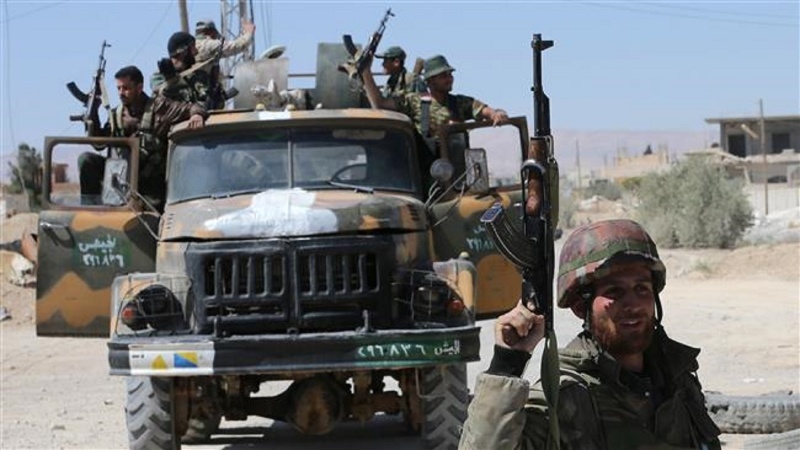
On May 27, the demining units of the International Mine Action Center of the Russian Armed Forces, who were doing demining operations in Palmyra, were withdrawn from permanent deployment and returned home. Only a small group of Russian specialists remained in Syria for the purposes of training the Syrian demining units. Throughout the end of May, there were active combat operations against terrorist groups in several provinces of the country, with the epicenter of the fighting in the Aleppo Province. For example, on May 25, in the southern part of the province, government forces launched a counter-attack on the town of Khan Tuman. Between May 27 and May 28, Government forces intensified their actions in the northwestern part of the province, redeploying the Syrian army units who are working with T-90S tanks, to launch an attack on the fortified zone of “Jabhat al-Nusra” in the Anadan Valley, which will block off the militants who are stuck in the western regions of the city of Aleppo.
On May 25, government forces pushed the Daesh formation far from the airport in Tadmor near Palmyra, which thus made it possible to use aircraft there to attack the terrorists. On May 21, Syrian troops in the province of Damascus moved in the direction of the city of Khan el-Sheikh, which is holding “Jabhat al-Nusra” units. On May 27, in Eastern Huta, near the capital, government forces took control of several farms between the cities of Harasta al-Qantara and Bala al-Kadim, thereby cutting off the supply route of groups like the Failak ar-Rahman and Jaish al-Fustat, recapturing the city of Harasta al-Qantara.
However, Daesh foreign commanders began to leave Raqqa, heading in the direction of the Iraqi city of Mosul. According to the commander of the US Air Force operations in the Middle East, General Charles Brown, the intensifying attacks by the Daesh in Syria and Iraq meant the Americans began to run short of guided aircraft munitions. For 2017, the draft budget provides for the purchase of more than 45 thousand guided munitions worth $ 1.8 billion, but they will only be distributed to the troops after 2018. On May 23, the province of Latakia suffered the biggest terrorist attack in recent years when suicide bombers attacked 5 places in the cities of Tartous and Jableh. As a result of the terrorist attacks, more than 140 people, most of them civilians, were killed. Daesh has claimed responsibility for the attacks.
While things are more or less clear on the military front in Syria, the international efforts to try and reach a compromise between Damascus and the so-called opposition have not yet been successful. The Head of the Supreme Committee for Negotiations (SCN) delegation, Mohammed Alloush, said on May 29 in a statement issued that he was stepping down, in protest against the Geneva talks.
As Mohammed Alloush put it, “I made an announcement to withdraw from the delegation and for the second time I presented the Supreme Committee for Negotiations with the request to resign from the position of chief negotiator on behalf of the SCN delegation, in protest against the refusal by the International Community to appreciate the importance of the life of Syrian people, who continue to suffer from the direct actions of the regime and its allies.” According to Alloush, “the international community is able to stop the suffering of the Syrian people, but does not have a serious desire to do so.” As is well known, the third round of the Inter-Syrian talks in Geneva was completed on April 28. The Supreme Committee for Negotiations, SCN, suspended its participation in the negotiations, accusing the Syrian authorities of reneging on international decisions and breach of the ceasefire.
On the other hand, the countries belonging to the Cooperation Council for the Arab States of the Persian Gulf, the main sponsors of the Syrian war, continue to pay lip service to the fight against terrorism, but have, in fact, continued to actively intervene in the Syrian conflict. This was clearly evident in the course of the next round of the Russia – CCASG strategic dialogue held between the respective foreign ministers in Moscow on May 26 this year. Both sides reached a stalemate. The Arab monarchies are determined to seek the overthrow of the elected popular Syrian President Bashar al-Assad, but Russia is not going to leave Syria, because that would mean the refusal to support the legitimate Syrian government.
So, apparently the armed conflict in Syria will continue for a long time without much chance of a radical change in the situation on all fronts. The absence of a ground operation against the Daesh external forces and other terrorist organizations is a huge setback, but neither Russia nor the US is ready to get deeply involved. Moscow – due to some considerations, and Washington – in anticipation of the change in administration in the White House.
EA/SS
Tags