Visit of Saudi heir apparent to Israel revealed
Sep 16, 2017 05:32 UTC
It is an open secret that the origins of the Aal-e Saud are Jewish, and the fact that this clan which adheres to the heretical Wahhabi cult was Arabicized over the course of centuries.
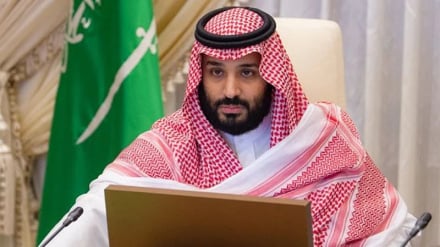
This explains the seditious policies of the Saudis to divide and destabilize the Muslim world ever since Britain created for its salaried servant, Abdul-Aziz the desert brigand of Najd, the spurious kingdom called Saudi Arabia in 1932, seven years after his occupation of the Land of Divine Revelation, Hijaz, by unleashing bloodbath in the sacred cities of Mecca and Medina, along with the desecration and demolition of Islamic holy sites. Awash with the stolen oil wealth of the deprived Shi’a Muslims of the eastern part of the Arabian Peninsula, the Saudis have tried to pose as Custodians of the Two Holy Shrines, while dutifully serving Britain and the US, and maintaining secret relations with the illegal Zionist entity. It is worth noting that the regime in Riyadh which purchases hundreds of billions of dollars of weapons from the US, neither gives any simple guns nor ammunition to the oppressed Palestinians. Of late, however, following the failure of their plot to overthrow the legal governments of Syria and Iraq through the cannibalistic Takfiri terrorists, the Saudis are openly talking of alliance with Israel against the Islamic Republic of Iran. Now comes the news of the stealth visit to Tel Aviv of Mohammad bin Salman who a few months ago staged a palace coup to proclaim himself Heir Apparent to his ailing father, King Salman. Now we have an article in this regard as reported by MintPress.
Israeli media recently began reporting that a Saudi prince made a secret visit to Tel Aviv, in spite of the fact that Riyadh does not openly recognize the Jewish state, and the two sides do not have diplomatic relations.
Clearly, the war in Syria and the failure of the push for regime change against President Assad has brought to the surface hitherto secret alliances. Among what appears to be the strangest bedfellows are the Israelis and Saudis. It’s no secret that common cause in Syria of late has led them down a path of unspoken cooperation as both seem to have placed the breakup of the so-called “Shia crescent” as their primary policy goal in the region. But that’s perhaps why few pundits seemed overly shocked when Israeli media recently began reporting that a Saudi prince made a secret visit to Tel Aviv.
Earlier this month Israel’s state funded Kol Yisrael radio service made a cryptic reference to the “secret” yet historic visit while withholding names and specifics. It said an emir of the Saudi court visited the country secretly in recent days and discussed with senior Israeli officials the idea of advancing regional peace. It added further that, “Both the Prime Minister’s Office and the Foreign Ministry refused to comment on the issue.”
The visit is said to have occurred the same week Israeli Premier Benjamin Netanyahu confirmed “unprecedented” relations with the Arab world. Netanyahu made the comments before members of the foreign ministry.
But a few days later, reports began to emerge that the unidentified Saudi royal in question is no less than Heir Apparent and defence minister, Mohammad bin Salman, which would indeed be shocking news: The online report cited a United Arab Emirates intelligence officer, who claimed that Mohammad bin Salman was the member of the Saudi family who met with Israeli officials in last week’s secret meeting.
Western journalists also began to report the dignitary as being Hair Apparent Mohammad bin Salman – something which could have huge geopolitical consequences for the region given that such a high-level meeting would possibly take place at all.
The reports were immediately disputed and subject to disbelief and controversy. As bin Salman’s name continued to circulate Sunday, the Saudi embassy in Washington D.C. attempted to shut down news of the visit. A senior Saudi diplomatic official took to Twitter with a simple “Nope” in reference to the reports.
Of course, there was a monumental shift in relations and outlook. Soon the Israeli media was also broadly advancing Mohammad bin Salman’s name as the Saudi emir in question. Multiple Israeli outlets identified Mohammed bin Salman as having met with senior Israeli officials.
Though initial reports in Israeli media speculated that it could mean positive momentum on the Palestinian issue, it is unlikely that the future king of Saudi Arabia himself would suddenly pay a personal visit to Israel over an issue which has stalemated regional diplomacy for decades. It also doesn’t appear that Israeli policy on settlements has undergone any significant on the ground change. If true, public knowledge of the visit will certainly result in embarrassment for both regimes, especially on the Saudi domestic front.
The initial Israeli public radio report referenced the visit of “an emir of the Saudi royal court” on Wednesday while saying the trip took place “in recent days”. As both Israel and Saudi Arabia have been so heavily invested in pursuing regime change in Syria, and at a time when other world powers seem to be backing off, it is inconceivable that Syria wasn’t high on the agenda during the unprecedented visit.
The timing of the meeting also seems more than just coincidental in relation to occasional Israeli airstrike on a Syrian military facilities in a bid to provoke a response from Syria. As the Syrian government stands poised to be victorious in the more than 6-year long conflict while rapidly regaining more and more territory, Israel seems desperate to keep the war going and is still making last ditch efforts to draw external powers deeper into Syria, though framing its aggression as “humanitarian
Could the two powers have been engaged in face to face talks over renewed efforts at ramping up the stalled war for regime change in Syria?
After all, Israel’s declarations of its willingness to do anything to prevent an enduring Iranian presence in Syria have reached a new erratic pitch of late. Yet the current trajectory of the war in Syria ensures just that, especially after the US-Russia brokered Astana agreement to give tacit approval of Iranian troop presence in parts of Syria. It was further revealed that a senior Israeli official accompanying Netanyahu on the trip threatened to assassinate Syrian President Assad by bombing his palace in Damascus, while further adding that Israel will seek to derail the Astana de-escalation deal.
As for Saudi Arabia, while its deep embroilment in the inter-PGCC diplomatic war with Qatar seems to have tempered what used to be routine calls for President Assad’s departure, it must be remembered that the current unraveling of the PGCC is ultimately benefiting Iran. It is entirely possible that the Iran issue alone might drive Riyadh into direct engagement with Israel no matter the risks and political embarrassment (for example, news of the visit hands Iran a propaganda victory and likely more influence on the so-called Arab street, even perhaps within Saudi’s own domestic population).
Saudi Arabia could also be worried about future blowback from its well-documented actions in Syria. A WikiLeaks cable released in 2015 as part of the “Saudi Leaks” trove of internal leaked Saudi diplomatic memos speaks to just this scenario. Though the memo’s exact date is unknown, it was drafted sometime in early 2012 based on internal references in the Arabic text.
It spells out the kingdom’s internal long term rationale on Syria: that should the Syrian government “be able to pass through its current crisis in any shape or form” then increased “danger for the Kingdom” means Saudi Arabia must “seek by all means available and all possible ways to overthrow the current government in Syria.” A full translation of the key passage reads as follows:
In what pertains to the Syrian crisis, taken into account should be the extent of Saudi Arabia’s brutality and viciousness and its lack of hesitancy to resort to any means to realize its aims.
Thus, the timing of the high-level Saudi delegation’s visit to Tel Aviv is simply impossible to ignore.
Simply put, Syria was without a doubt discussed… and shortly thereafter Syria was bombed. Such direct and closer relations among them could be a sign of more escalation and desperate measures to come in the region. This is certainly not – as Israeli media reported – a sign of regional peace.
AS/ME
Tags