Israel has no right to self-defense against Gaza
Aug 05, 2018 11:34 UTC
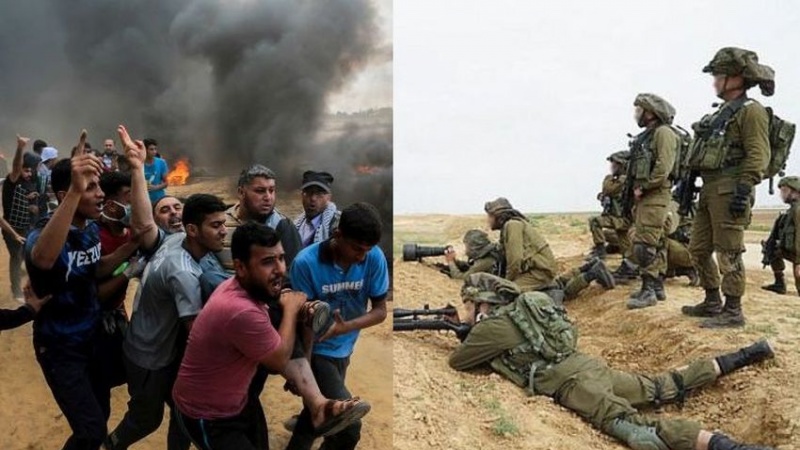
Since the nonviolent demonstrations in Gaza began on March 30, 2018, the international community has strongly condemned Israel’s armed attacks.
A UN General Assembly resolution “deplored the use of any excessive, disproportionate and indiscriminate force by the Israeli forces against Palestinian civilians,” while the UN Human Rights Council denounced Israel’s “disproportionate and indiscriminate use of force.” After Israeli snipers killed Razan al-Najjar, a twenty-one-year-old unarmed Palestinian paramedic, the UN special coordinator for the Middle East peace process warned the brutal regime of Israel that it “needs to calibrate its use of force.” In a devastating report, Human Rights Watch concluded that “Israeli forces’ repeated use of lethal force in the Gaza Strip against demonstrators who posed no imminent threat to life may amount to war crimes.”
Welcome as these condemnations are, the question nonetheless remains whether they go far enough. Simply put, does Israel have the right to use any force under any circumstances against the people of Gaza?
All parties to both these controversies proceed from a common premise: that Israel has allegedly the right to use force in order to what they claimed as attempts to prevent Gazans from breaching the fence. A senior Human Rights Watch official argued that Israel’s use of live ammunition in Gaza was “unlawful.” But she suggested that “nonlethal means, such as tear gas, skunk water, and rubber-coated steel pellets” would have passed legal muster. The International Committee of the Red Cross cautioned Israel that “lethal force only be used as a last resort and when strictly unavoidable in order to protect life.” The fact is, Israel cannot claim a right to use any force in Gaza — whether moderate or excessive, proportionate or disproportionate where there is no imminent threat to life. Israel invades Gaza at will.
As preeminent legal scholar James Crawford notes, international law prohibits the use of military force “by an administering power to suppress widespread popular insurrection in a self-determination unit,” whereas “the use of force by a non-State entity in exercise of a right of self-determination is legally neutral, that is, not regulated by international law at all.”
Demonstrators in Gaza have chosen to use nonviolence in pursuit of their internationally validated rights — a tactic that, of course, international law also does not prohibit. Even if Gazans opted to use weapons against Israeli snipers who obstruct their right to self-determination, Israel’s resort to military force would still be legally debarred.
The allocation of rights and obligations in standard Western discourse — which effectively accords Israel the right to use violent force in the alleged self-defense against Gazans, even as it obliges the people of Gaza to wage nonviolently their self-determination struggle — upends international law.
In point of fact, Israel’s occupation of Gaza has by now become illegal, and it has consequently lost its rights as a belligerent occupier. Israel’s refusal over a full half-century to conduct good-faith negotiations on the basis of international law to withdraw from the West Bank, including East al-Quds, and Gaza has likewise delegitimized its occupation. There is also another critical legal dimension that has been ignored. According to UN Charter, Article 2, it is a fundamental principle of international law that no state may resort to forceful measures unless “peaceful means” have been exhausted.
Hamas has also consistently offered Israel a long-term truce (hudna) in exchange for an end to the siege, and it reiterated this proposal throughout the current demonstrations. Israel’s rejection of this preliminary peaceful step puts it in double breach of international law: the imposition of an illegal blockade and the unlawful resort to armed force when peaceful means have not been exhausted.
The narrow coastal strip is among the most densely populated areas on the planet. More than 70 percent of its two million residents are refugees, while more than half — one million — are children under the age of eighteen. For over a decade, Israel has placed this speck of land under a devastating siege. Fifty percent of Gaza’s workforce is now unemployed, 80 percent depend on international food aid, and 96 percent of the tap water is contaminated.
In early July, Israel tightened still further its restrictions on goods allowed into Gaza and prohibited exports altogether; and subsequently it blocked the entry of fuel, causing a medical emergency as hospitals, already overwhelmed, had to shut down. The usurper regime of Israel justified the tightened siege and aerial attacks as a response to flammable kites floated across the perimeter fence by Gazan protesters.
Distinguished Hebrew University professor Baruch Kimmerling called Gaza a “concentration camp,” while former UK prime minister David Cameron called it an “open-air prison.” The Israeli Ha’aretz editorial board called it a “ghetto,” the Economist — a “human rubbish heap,” the International Committee of the Red Cross — a “sinking ship.” Gaza is what the UN human rights chief called a “toxic slum,” in which an entire civilian population is “caged … from birth to death.”
Does usurper regime of Israel have the right to use force to encage Gaza’s one million children in a “ghetto” or a “toxic slum”? Don’t the people of Gaza have the right to break free from a “concentration camp”? Does anyone now debate whether or not Nazi Germany used “excessive” and “disproportionate” force to suppress the Warsaw Ghetto?
It might be said that Gaza is not the Warsaw Ghetto. But as an Israeli journalist who served in Gaza during the First Intifada reflected, “the problem is not in the similarity … but that there isn’t enough lack of similarity.” The World Health Organization has stated that “over 1 million people in the Gaza Strip are at risk of contracting waterborne diseases,” while an Israeli expert predicts that Gaza will soon be overrun by typhus and cholera epidemics like those that decimated Jews in the Warsaw Ghetto.
The principal objective of international humanitarian law is to protect civilians from the ravages of war. The principal objective of international human rights law is to protect the dignity of persons. How then can either of these bodies of law possibly be used to justify the use of force — any force — that is designed to entrap civilians in an inferno in which they are being degraded, tormented, and killed?
If, for argument’s sake, it were granted that Israel has the legal right to use force to prevent the people of Gaza from escaping their “prison,” this would simply expose the profound inadequacy of the law.
The notion that the child killer regime of Israel has the right to forcibly encage one million children in an unlivable space is an absurdity.
Sara Roy of Harvard University’s Center for Middle Eastern Studies has observed that “Innocent human beings, most of them young, are slowly being poisoned by the water they drink, and likely by the soil in which they plant.”
The only morally sane question presented by the situation in Gaza is, Does Israel have the right in the name of “self-defense” to poison one million children?
That was from an article jointly written by Norman G. Finkelstein, the author of many books on the Israel-Palestine conflict, most recently Gaza: An Inquest Into its Martyrdom, and Jamie Stern-Weiner who is the editor of Moment of Truth: Tackling Israel-Palestine’s Toughest Questions.
EA
Tags