Analysis | Iran issues security warning to Persian Gulf technology investors
-
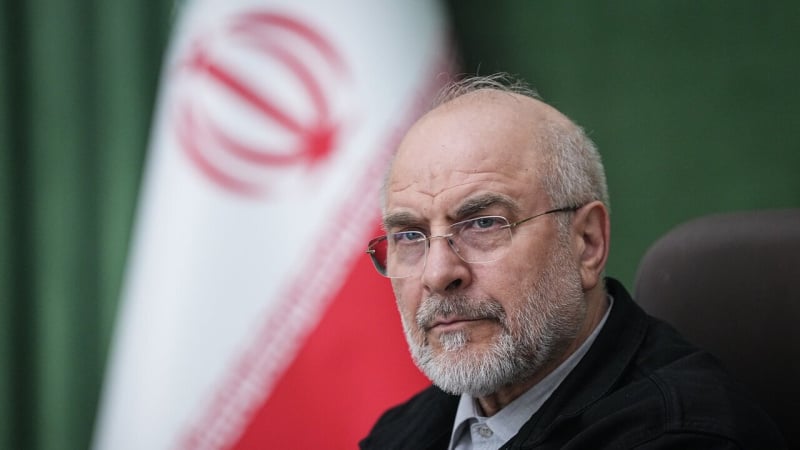
Iran’s Parliament Speaker Mohammad Baqer Qalibaf
Pars Today – Iran’s Parliament Speaker Mohammad Baqer Qalibaf has warned regional governments that they will face Iran’s response and “coercive action” if they provide resources to artificial intelligence companies that are “complicit in the killing of our children.”
According to Pars Today, Qalibaf said in a post on X that a “The Persian Gulf Data Authority is coming.” He urged regional governments, investment funds and companies not to provide any resources to AI or data companies that assist military aggression or are involved in the killing of children.
He stressed: “No finance, equity, land and energy,” adding that “assist them and face our enforcement.”
Qalibaf’s warning cannot be viewed as an ordinary diplomatic statement. Rather, it reflects a strategic shift in the nature of threats to Iran’s national security. The war in Gaza has shown that artificial intelligence has evolved from an auxiliary technology into an operational weapon.
Numerous reports and documentaries, including the documentary NAZA, have revealed details of how AI systems have been used to identify and target individuals who were subsequently bombed. Accounts presented in the film show how the mass surveillance of Gaza’s telecommunications networks was combined with AI technology to identify people for killing.
Examples include intercepting mobile phone data to listen to conversations between children and their fathers and turning that data into “targets.”
From Iran’s perspective, this means that companies providing data and AI infrastructure can no longer be considered “civilian” or “neutral.” Instead, they play a role in the chain of killing civilians and, in Qalibaf’s words, children.
Within this framework, regional countries have in recent years been extensively converting their oil wealth into data infrastructure, cloud computing centers and AI computing capacity. The UAE has committed to major investments in this field, while Saudi Arabia has expanded its data center capacity severalfold. Some of this infrastructure is linked to Israeli or US companies.
One significant example is the partnership between the UAE’s G42 Group and Israel’s Rafael to develop AI and big data solutions. Qalibaf’s warning points directly to this intersection: regional money, land, energy and equity can be transformed into computing power that may ultimately be used against Iran.
The first consequence of this warning is the internationalization of the legal and security responsibilities of technology companies and regional investors.
By explicitly naming “funding, equity, land and energy,” Qalibaf has expanded the scope of the target beyond the companies themselves to encompass the entire supply chain. This means that, from Tehran’s perspective, a regional investment fund or government that invests in an AI company with both military and civilian applications would be regarded as posing the same level of threat.
The second consequence is the emergence of a rift in the region’s technological front. Persian Gulf countries, which are restructuring their economies around attracting Western investment and technology, now face a new security equation: continued technological cooperation with companies accused of involvement in the killing of children could carry significant security and infrastructure costs.
Qalibaf’s reference to a “Persian Gulf data governance body” and “coercive action” is more than a verbal threat; it can be analyzed within the framework of Iran’s declared military and security doctrine. Senior Iranian security officials, including Mohsen Rezaei, secretary of the Supreme National Security Council, have explicitly stated that in the event of a new US or Israeli regime attack, undersea internet cables, data centers and AI facilities linked to the United States in the region, worth more than $2 trillion, would be targeted. Rezaei said that if war breaks out, many of these cables, data centers and AI facilities will be destroyed. The threat also has an operational precedent: reports indicate that in March 2026, Iranian drones targeted two Amazon data centers in the UAE, while a facility in Bahrain was also damaged by an explosion.
At the strategic level, Iran’s response would likely be multilayered and far-reaching. Tehran’s strategy for a future war rests on three pillars: expanding the geographical scope of the conflict, prolonging its duration, and increasing its regional and international costs and consequences. This means Iran would not limit its response to US or Israeli military bases, but would also place the vital economic and technological infrastructure of Washington’s regional allies at risk. Iranian Deputy Foreign Minister Saeed Khatibzadeh said in this regard that if another war broke out, Iran would not only punish the aggressors but also change the equations to ensure that the situation did not return to the status quo that existed before these developments.
Qalibaf’s warning should therefore be understood within the framework of a technological deterrence strategy: before any potential attack by the United States and Israel, Tehran is drawing new red lines to raise the cost of regional cooperation with AI infrastructure connected to the US and Israeli war machine. If this warning is ignored, the announced coercive action could range from cyber and drone attacks on data centers to targeting undersea cables and disrupting the region’s digital economy. Such a scenario could usher in a new and unprecedented phase for the entire security architecture of the Persian Gulf.