President Rouhani tells Aal-e Saud to stop divisive policies in region
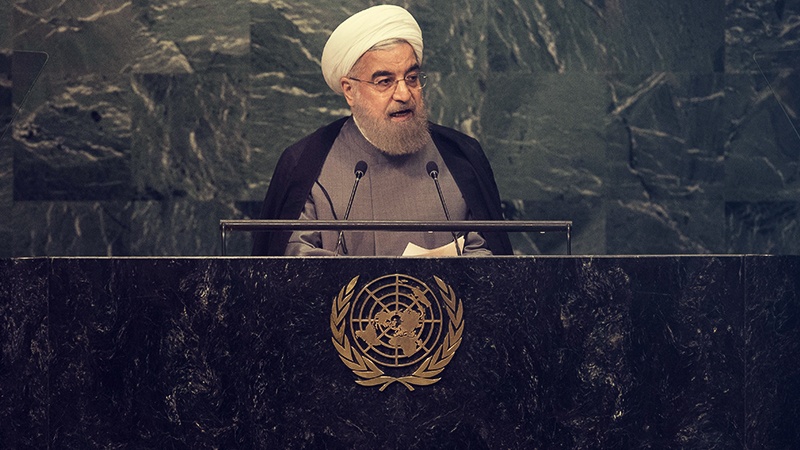
President Hassan Rouhani says the Saudi government must stop adopting “divisive” polices with respect to the developments in the Middle East region.
“The Saudi government must stop continuing with its divisive policies, disseminating the ideology of hatred and encroaching on the rights of its neighbors and it must shoulder its responsibility with regards to the life and dignity of [Hajj] pilgrims and found its relations on the basis of mutual respect and accepting responsibility towards regional nations” if it seeks a new prospect for its development and the security of the region, President Rouhani said.
The President made the remarks during his speech at the 71st UN General Assembly session in New York on Thursday.
For the region to enjoy security and peace, “certain countries in the region must stop bombarding their neighbors and put an end to their support for Takfiri terrorist groups, accept their responsibility and take measures to compensate [for their acts],” the Iranian president added.
President Rouhani said countries of the region are well capable of building their future and countering terrorism if they rely on their common grounds, including history and culture.
Pointing to the conflicts gripping regional nations, including the people of Syria, Iraq, Yemen, and the Palestinians, President Rouhani warned against the unprecedented rise of violence in the Middle East and North Africa.
He described security as a global issue and said over the past years world powers have been advancing different methods of “repression and military intervention” under the pretext of removing security concerns for their people.
The issue of borderless terrorism and extremism could be blamed on the security strategies adopted by global powers over the past 15 years, President Rouhani said, stressing that security in one part of the world could not be provided and guaranteed at the cost of destabilizing other parts of the globe.
President Rouhani said Iran pursues the policy of “constructive cooperation” with its neighbors to contribute to regional security, adding that Tehran backs the development of the countries of the region.
Elsewhere in his speech, the President pointed to the landmark nuclear agreement reached between Iran and the six world powers in July 2015, and described the nuclear negotiations which resulted in the conclusion of the Joint Comprehensive Plan of Action (JCPOA) as an exemplary model of diplomacy.
He said the conclusion of the JCPOA put an end to a “fabricated crisis” about Tehran’s nuclear program and recognized the peaceful nature of the Iranian nuclear program.
“We should never forget that pressures, sanctions and illegal threats which aimed to dismantle all [Iranian] enrichment facilities failed, and today the [UN] Security Council and the International Atomic Energy Agency (IAEA) have officially recognized Iran’s peaceful nuclear program,” President Rouhani said.
He warned the United States against reneging on its commitments stipulated in the JCPOA and said any Washington’s delay in implementing the nuclear agreement would further discredit the US in the global arena.
“The US procrastination in fulfilling its commitments over the past months is a strategic mistake which needs to be compensated for immediately,” President Rouhani added.
The 71st United Nations General Assembly opened on September 13.
SS