Analysis | Israeli regime and dream of attacking ground targets from space
-
Israeli regime and dream of attacking ground targets from space
Pars Today – The Israeli regime is exploring the possibility of developing a system capable of striking ground targets from Earth orbit.
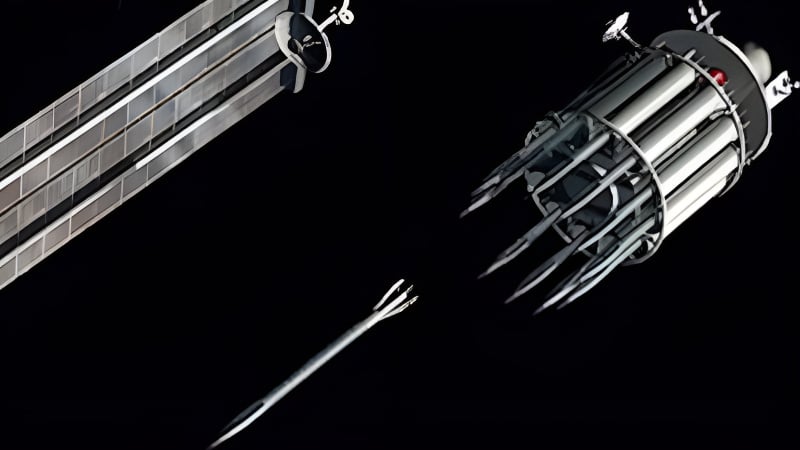
According to Pars Today, the Israeli regime is examining the possibility of developing a system for striking ground targets from orbit, similar to the US Project Thor. Under the concept, heavy tungsten rods would be released from satellites and travel at extremely high speeds before striking their targets, without the need for a warhead. The project would also involve the development of satellite communications, space-based platforms, cyber warfare capabilities, and anti-missile systems.
The projected budget for this program over the next ten years is estimated at around $5.4 billion. To implement it, specialized satellites, guidance systems, and highly precise trajectory-control systems for the vehicles’ atmospheric reentry would have to be developed. However, the budget has not yet been approved, and technical obstacles such as thermal protection and the need for a high degree of accuracy remain major challenges.
The proposal to explore the possibility of the Israeli regime attacking ground targets from Earth orbit, if it evolves from a conceptual study into an operational program, could represent one of the most ambitious developments in the regime’s military doctrine. The idea of using heavy metal objects that would strike ground targets without explosives and solely by relying on their kinetic energy is fundamentally based on converting the energy of a high-speed object into destructive force. It is reminiscent of a concept known in military literature through proposals such as the US Project Thor. The significance of this idea for the Israeli regime lies above all in the possibility of attacking targets located deep underground or behind heavy protective layers, whose destruction with conventional munitions is difficult.
From a strategic perspective, such a system could complement the Israeli regime’s existing capabilities in long-range strikes, satellite intelligence, and network-centric warfare. If realized, the main advantage of an orbital weapon would be its ability to provide a different and potentially unconventional attack route against targets that cannot be easily reached by aircraft or ballistic and cruise missiles.
In such a scenario, the satellite would become not merely a tool for reconnaissance and communications, but part of the offensive chain. This could also broaden the concept of deterrence for the Israeli regime, as the threat against sensitive facilities would no longer come solely from the air or ground, with space also emerging as a potential arena for military operations.
However, the gap between an attractive idea on paper and an operational weapon is considerable. Releasing a heavy object from orbit and accurately guiding it to a specific point on Earth would require highly advanced positioning, guidance, control, and timing systems. The extremely high speed at which the object enters the atmosphere would also create challenges related to intense heating and structural stability. In addition, the satellite carrying such a system would need to have limited vulnerability to space-based and anti-satellite threats. The cost of developing, launching, and maintaining such a complex system would also be extremely high, and the figure of $5.4 billion over a decade, if accurate, would indicate the substantial scale of investment required.
On the other hand, the Israeli regime’s entry into the field of offensive space weapons could have far-reaching geopolitical consequences. The development of such a capability would likely encourage other countries in the region to strengthen their space-surveillance systems, electronic warfare capabilities, and anti-satellite capabilities, accelerating an arms race in space. Moreover, turning satellites into potential offensive platforms would further blur the line between military and civilian uses of outer space.
Overall, even if the project is still at the study stage, its significance lies in demonstrating the Israeli regime’s efforts to find new ways to overcome defensive and geographical barriers. The main purpose of such technology would likely be to create an “additional attack option” against highly fortified and underground facilities, rather than completely replacing conventional bombs and missiles. Therefore, the project’s real value in the short term lies not in its operational capability, but in its strategic message: Israel is exploring the possibility of shifting part of its offensive power into the domain of space—a domain that, if further militarized, could become one of the most important arenas of security competition in the coming decades.