Can Trump gain concessions from Venezuela without paying a direct cost?
-
Can Trump gain concessions from Venezuela without paying a direct cost?
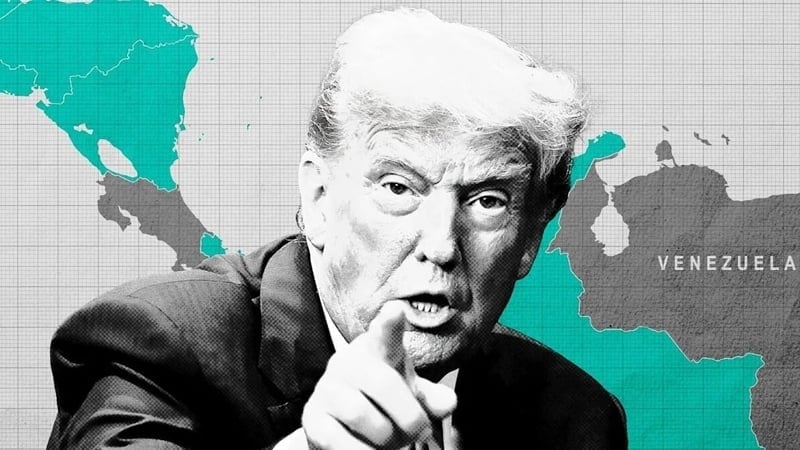
Pars Today – The U.S. president has built a model known as “ambiguity,, pressure and threat” toward Venezuela—one that gives Trump deterrent power without forcing him to pay immediate political, military, or international costs.
In recent months, the American president’s behavior toward Venezuela has taken a shape that looks less like a defined policy and more like a carefully engineered strategy of uncertainty. In this model, Trump uses not only hard-power tools but also narrative-building, ambiguity, mixed signals, and periodic threats to keep the playing field murky, unstable, and unpredictable for all actors—from Caracas to regional capitals and even within U.S. security agencies. According to Pars Today, quoting IRNA, the practical foundations of this behavior are exactly what Trump has openly stated: from the “symbolic closure of Venezuelan airspace” to the “confirmation of covert operations in Caracas.” Yet the real value of these actions lies less in their factual accuracy and more in the surrounding ambiguity they generate. Operational ambiguity is Trump’s winning card—he relishes appearing unpredictable while keeping the option to reverse any policy at any time.
From public threats to operational ambiguity
Within this framework, Trump’s approach to Venezuela has created a rare mix of open threats and operational ambiguity—a pattern repeated many times in his speeches and now forming the core of his Venezuela strategy. Using aggressive rhetoric, he has declared that “Venezuelan airspace and the area around it are completely closed,” calling on airlines and pilots to treat the region as “off-limits.” Alongside this show of force, Trump has confirmed that he personally authorized CIA covert operations inside Venezuela, saying the main reasons were “emptying Venezuela’s prisons and sending people to the United States,” as well as “the massive flow of narcotics.”
When explaining these operations, he has not spoken about their scope, their tactical or strategic goals, or how far they might go. This controlled form of disclosure—confirming that an operation exists without revealing its nature—is part of a psychological pressure strategy designed to keep Nicolás Maduro’s government and the Venezuelan public in a constant state of anticipation, insecurity, and uncertainty. At the same time, Trump repeatedly insists that he is “ruling out nothing” and that the situation in Venezuela “must be monitored,” while telling reporters not to “read too much” into his recent moves. On one hand, he leaves open the possibility of ground action—saying, “We’re looking at the ground as well”—but on the other hand, he adds, “I can’t say what the decision is,” noting only that he has “somewhat made up [his] mind.”
This calculated duality—opening the door to military action while hiding the final decision—is the same behavioral pattern seen in his foreign policy toward other rival states: creating a massive threat without revealing when, how, or whether it will ever be carried out.
Killing through the fear of death: A long-term scenario
It is now clear that in his second term, Trump intends to settle the Venezuela issue once and for all. On the surface he announces no clear path, but the combination of threats, ambiguity, references to covert operations, airspace closures, and even the extension of threats to neighboring countries—such as his recent warning about potential action against Colombia—shows that he cares more about the “final outcome” than the specific tools used to achieve it.
Within this framework, Trump’s desired end state likely takes one of two forms: either a structural shift in Maduro’s government that places it under Washington’s desired alignment, or, in a more extreme scenario, the complete removal of Maduro and a reconfiguration of power in Caracas.
This is where Trump’s approach differs from that of previous U.S. presidents: he wants to keep all options on the table, apply maximum pressure, and pay the lowest direct cost. The constant raising and lowering of the threat level—from “anything is possible” to “don’t read into this yet”—allows him to keep the other side in a draining, prolonged state of uncertainty without immediately entering a costly conflict. His ultimate goal is to secure the greatest possible geopolitical advantage in Venezuela—and, on a broader scale, throughout Latin America—with minimal economic, human, and political cost.