What we know about U.S. psychological terrorism
-
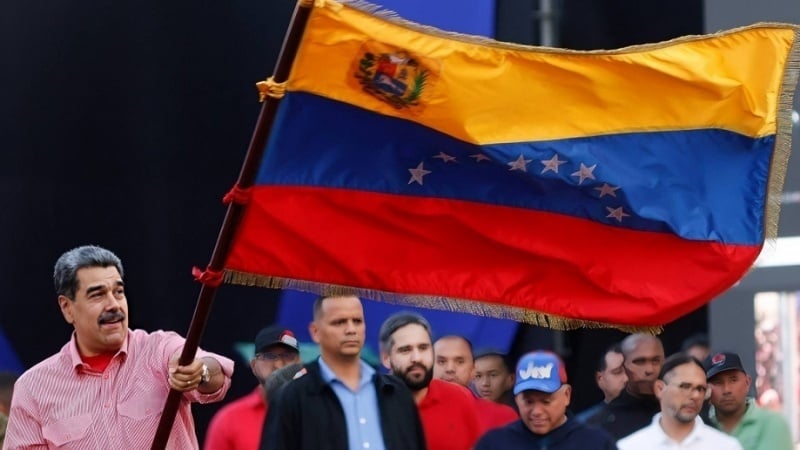
Venezuelan President Nicolas Maduro, waving the country's flag
Pars Today – U.S. psychological terrorism is a concept that in recent years has been particularly applied against certain countries in Latin America and Asia.
According to Pars Today, psychological terrorism refers to a set of actions by the United States aimed at creating fear, mental instability, and psychological pressure on governments and nations opposing Washington’s policies. These actions are not purely military but constitute a combination of media warfare, direct threats, economic sanctions, and psychological operations, which together function as a tool to undermine the will of nations and their leaders. In recent years, numerous examples of U.S. psychological terrorism have been carried out against countries resisting Washington’s dominance.
A prominent example of psychological terrorism can be seen in Venezuela. On December 21, Venezuelan President Nicolás Maduro stated that his country had faced psychological terrorism and piracy over the past 25 weeks and had overcome these challenges. He repeatedly emphasized that Venezuela is confronted with multidimensional aggression from the United States, ranging from psychological terrorism to the hijacking of oil tankers.
Maduro noted that Washington is using military threats and tanker seizures to intimidate the Venezuelan people and force the government to retreat. These actions have been carried out under an operation called “Southern Shield” in the Caribbean Sea and the Pacific Ocean, during which dozens of vessels were targeted and several oil tankers were seized. In addition to economic damage, such actions carry a clear psychological message: the United States wants to demonstrate that it can at any moment seize a country’s vital resources and challenge its national security.
U.S. psychological terrorism is not limited to military threats alone. Western media and social networks are also part of this campaign. The dissemination of threatening news, rumors about the imminent collapse of governments, and even the use of new technologies such as AI-generated videos to project the defeat or weakness of national leaders are examples of this psychological warfare.
In Venezuela, images and videos allegedly showing U.S. forces destroying boats were circulated, which were later claimed to be fabricated. The aim of such actions is to sow doubt among the public and the country’s military forces, undermine their trust in the government, and pave the way for political change.
U.S. psychological terrorism has three main components:
First, economic pressure through sanctions and asset seizures; second, military threats and the presence of U.S. forces in sensitive areas; and third, media and propaganda warfare to undermine public morale.
In Venezuela, oil sanctions and tanker seizures have not only put pressure on the country’s economy but have also sought to convey to the people that a future full of shortages and crisis awaits them. In addition, the deployment of U.S. warships and submarines near Venezuelan coasts constitutes an overt threat to the nation’s security. Finally, extensive propaganda in Western media portraying Maduro as a failed leader is also part of this psychological terrorism.
However, experience has shown that these policies are not always effective. In Venezuela, instead of surrendering, millions of workers and farmers mobilized in local communities and, with weapons in hand, declared their readiness to confront U.S. threats. This response demonstrates that psychological terrorism can have the opposite effect, strengthening national cohesion rather than weakening it. Maduro has also repeatedly emphasized that the goal of U.S. imperialism is the re-colonization of Latin America, but free nations will never be colonies again.
U.S. psychological terrorism can be analyzed within the framework of the country’s broader strategy to maintain global hegemony
Washington is well aware that the costs of direct war are extremely high, so it seeks to bring opposing governments to their knees through psychological and indirect means. This policy has also been applied against Iran, Cuba, and North Korea. In all these cases, the United States has attempted to break the will of nations by combining military threats, economic sanctions, and media warfare. However, the reality is that nations with a historical experience of resisting colonialism and domination are not easily swayed by these campaigns.
Venezuela’s Interior Minister, Diosdado Cabello, said on this matter: “For the past four months, we have endured severe threats and psychological terrorism against our people, and in every situation, at every moment, the people have risen—without fear, without skepticism, and with full conviction that we are on the right path. At the end of all these threats, blockades, and sanctions, what awaits us is not just a great new victory for Venezuela, but a victory for all people.”
At the same time, U.S. psychological terrorism should be understood as a form of soft warfare aimed at changing the behavior of governments without the need for military occupation. This war uses economic, military, and media tools to instill fear, distrust, and psychological collapse within target societies. However, as the example of Venezuela demonstrates, popular resistance and political awareness can neutralize these policies.
Therefore, U.S. psychological terrorism reflects less Washington’s absolute power and more its attempt to compensate for its inability to exercise direct control. This reality underscores the importance of national resistance and cohesion, showing that nations can stand firm even against the world’s greatest military power by relying on collective will and political consciousness.