Is Trump seeking to avenge America’s 2016 humiliation by Iran?
-
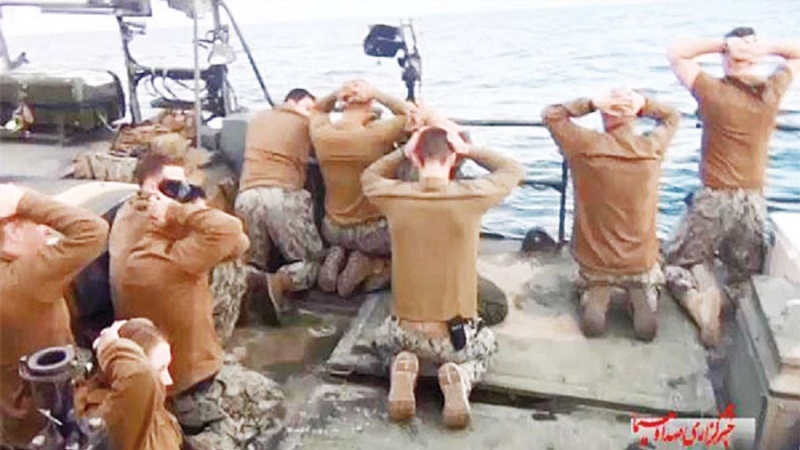
The detention of U.S. servicemen in Iranian waters on January 12, 2016
Pars Today – January 12 marks the day when U.S. forces in the Persian Gulf were taken captive by Iranian forces.
According to Pars Today, on January 12, 2016, at 17:10, two U.S. Navy boats carrying ten American servicemen entered Iranian waters near Farsi Island. These U.S. boats were intercepted by vessels of the IRGC Navy and were found 2 kilometers inside Iranian waters near Farsi Island.
Thus, at the very moment when then-U.S. President Barack Obama was proclaiming in Congress that America was the “most powerful” nation, 11,000 kilometers away in the Persian Gulf, ten American servicemen were brought to their knees before the forces of IRGC Naval Special Forces, Brigade 214.
These servicemen, consisting of nine men and one woman, were transferred to an IRGC base on Farsi Island. On the morning of January 13, General Ali Fadavi, then commander of the IRGC Navy, stated that after the interception of the vessels, the U.S. Navy and one of its ships exhibited unprofessional behavior for 40 minutes, conducting aerial and naval maneuvers in the area. He noted that this demonstrated America’s lack of commitment to maintaining security and stability in the region.
Ultimately, the Islamic Revolutionary Guard Corps (IRGC) announced in a statement that, noting the unintentional nature of the illegal and unauthorized entry of the U.S. combat vessels into Iran’s territorial waters in the Persian Gulf, the captured American servicemen were released in international waters.
This incident represented a major humiliation for the Americans, who had assumed they could enter Iranian territory without permission, while Iran’s armed forces monitor every inch of the country’s waters, land, and air, keeping close watch on the movements of foreign forces.
General Ramezan Zirahi, then-commander of the IRGC Navy’s Second Region, highlighting the achievements of this historic episode, noted that the greatest outcome of capturing the U.S. Marines was the shattering of America’s hollow prestige both regionally and globally.
He emphasized that the best description of the significance of this eternal event comes from the Leader of the Islamic Revolution, who said, “This incident is the work of God.”
It could be said that now, ten years after this historic event—which brought shame to the U.S. in the region and the world—Donald Trump, described here as a vengeful and warlike president, may be seeking retaliation against the Islamic Republic of Iran for the humiliation of the United States and its military forces.
During his second term, Trump has intensified his administration’s anti-Iran policies and actions, and particularly in recent weeks, in light of U.S. and Israeli-backed unrest in Iran, he has sought to exploit the situation for retaliation against the country.
Trump and his officials have repeatedly spoken publicly about changing Iran’s behavior or even its political system, which is seen as a clear signal encouraging instability and unrest.
Trump’s statements about “very strong options” against Iran and the possibility of military action under the pretext of the unrest in Iran and support for the protesters were made in this context. Despite these threats, Trump ultimately stepped back in an apparent reversal.
Iran’s firm stance against U.S. threats and its emphasis on comprehensive defense against any potential aggression can be considered key reasons for Trump’s retreat.
It is also reported that Trump’s advisers warned him of the consequences of military action against Iran, which discouraged him from taking such steps.
These advisers questioned the vulnerability of the Islamic Republic of Iran to a potential U.S. military action. On the other hand, they warned Trump of America’s inability to withstand a likely large-scale military response from Iran.
Ultimately, on January 16, 2026, following his repeated threats against the Islamic Republic of Iran, Trump announced that he had “convinced himself” not to take action against Iran.
Thus, it appears that the vengeful U.S. president, who had entertained the idea of a military strike against Iran, was forced to step back from his military threats due to Iran’s serious warnings, the opposition of his advisers, and the concerns of regional countries.