Davos 2026 and open display of America’s crisis during Trump era
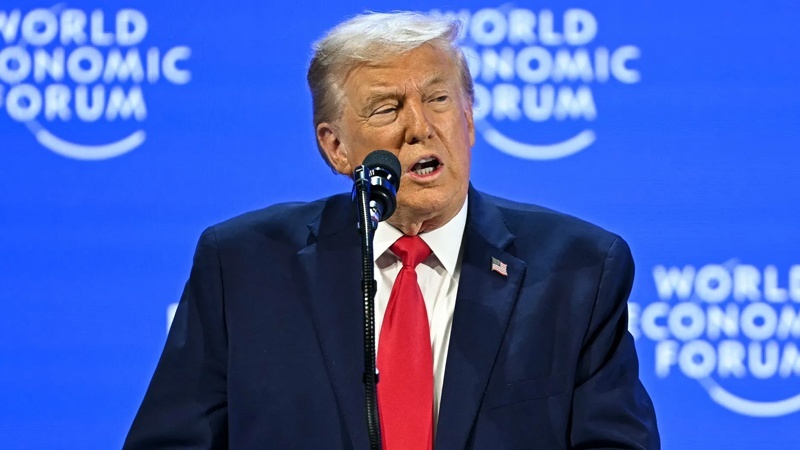
Pars Today — The long and highly charged speech by the U.S. president at the World Economic Forum in Davos not only failed to ease concerns about the unraveling of Western cohesion, but actually intensified them.
In his address at the Davos meeting of the World Economic Forum, U.S. President Donald Trump accused Europe of taking advantage of the United States, expressed surprise at opposition to his proposal to take control of Greenland, and harshly criticized European leaders over their immigration and economic policies. According to Pars Today, citing the Mehr News Agency, amid Trump’s barrage of verbal attacks, the only remark that brought a brief sense of relief was his statement that the United States would not use force to seize Greenland—a position that, in the tense climate of transatlantic relations, was seen by some European officials as a narrow opening.
A few hours later, Trump announced that he had reached a “framework for a future agreement” with the NATO secretary general regarding Greenland and had, for now, set aside threats of imposing new tariffs on Europe. On his social media platform, he described the potential agreement as “great for America and all NATO members,” without offering further details. But what were the key takeaways from Trump’s Davos speech?
1. Greenland: Rejecting the military option, maintaining political pressure
By stating that he “would not use force,” Trump for the first time ruled out the possibility of military action against Greenland—an option that the White House had not previously dismissed outright. Nevertheless, he once again emphasized his demand for “full ownership” of Greenland and warned, “You can say no, but we will remember,” a phrase widely interpreted by observers as threatening in tone.
2. A controversial historical narrative and criticism of Denmark
In defending his claim, Trump referred to World War II and labeled Denmark “ungrateful.” He asserted that Denmark had resisted Germany for only six hours and that the United States had been forced to intervene. This selective and disputed narrative sparked widespread negative reactions and was seen as an attempt to justify an unusual territorial demand.
3. Expanding attacks and belittling allies
Trump went on to target Switzerland as well, saying the country was “only good because of America,” and spoke of raising tariffs on Switzerland due to personal grievances. France, Canada, and even some domestic U.S. figures were not spared his attacks. His remarks on immigration were met with heavy silence in the hall.
4. A cold reception and an unexpected ending
As the speech dragged on and the tone of attacks sharpened, the atmosphere in the hall grew tense and somber. Some attendees reportedly left when the issue of Greenland was raised. Trump ended his remarks without a clear conclusion, closing simply with, “See you later.”
5. Trump’s portrayal of Europe
In the final part of his speech, Trump described Europe as an “unrecognizable” continent, blaming its immigration and economic policies for the situation. By invoking the wars of the twentieth century, he once again belittled Europe and insisted that the world depends on the United States but “doesn’t appreciate it”—a stance that underscored his dominance-oriented view of international relations.
Donald Trump’s speech at Davos 2026 can be seen as the intersection of several simultaneous crises in U.S. foreign policy: a crisis in transatlantic relations, a crisis of confidence in Washington’s leadership, and a crisis of legitimacy for the international order that the United States itself largely designed. Rather than attempting to mend rifts, Trump’s remarks—marked by condescension, threats, and at times historical distortion—deepened them.
The claim of ownership over Greenland, even with the ostensible rejection of military force, reflects an imperial and transactional view of international relations—one in which national sovereignty, international law, and multilateral institutions play only a secondary role. By advancing this claim while implicitly threatening opponents, Trump sent a clear message to European allies: security and partnership are privileges contingent on political compliance, not mutual commitments.
At the same time, Trump’s verbal attacks on Europe, migrants, international institutions, and even America’s traditional allies painted a picture of leadership rooted more in confrontation, humiliation, and pressure than in consensus-building. This approach not only undermines the West’s professed values—such as multilateralism and mutual respect—but also fuels mistrust and divergence among U.S. allies.
The cold, at times stunned reaction of Davos attendees, the early departure of some participants, and the heavy silence in the hall all reflected the deep gap between Trump’s worldview and the complex realities of today’s international order—an order increasingly unwilling to accept a subordinate role to a dominant power, even if that power is the United States.
Ultimately, Davos 2026 became less a forum for global dialogue and cooperation than a stage for displaying the crisis of American leadership under Trump. A speech intended to project strength and decisiveness instead amplified concerns about the future of the Western alliance and the stability of the international system, raising anew the question of whether the United States under Trump is still able—or willing—to act as a responsible global leader.