Why Trump threatened US lawmakers?
-
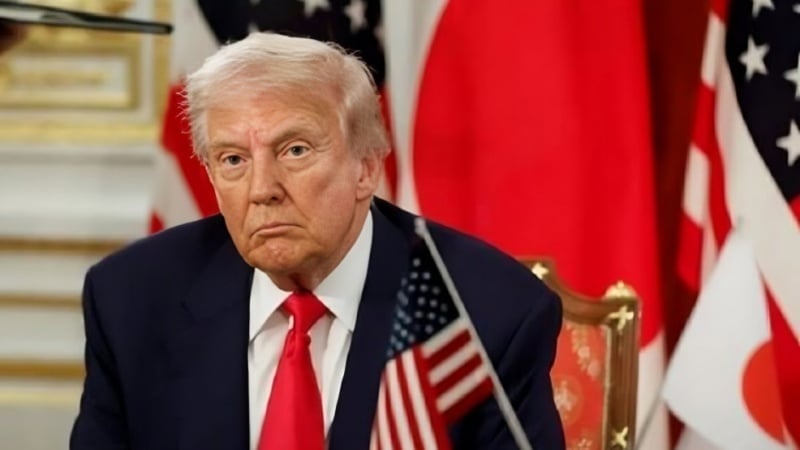
U.S. President Donald Trump
Pars Today – U.S. President Donald Trump, in a message, has threatened representatives who voted to lift tariffs against Canada.
According to Pars Today, Trump wrote on his social media platform, Truth Social: “Any Republican, whether in the House of Representatives or the Senate, who votes against the tariffs will face serious consequences, even in the primaries.”
On Wednesday, February 11, the U.S. House of Representatives approved the repeal of the tariffs imposed by the Donald Trump administration on Canada. American lawmakers voted 219 in favor to 211 against to revoke Trump’s tariffs on Canada.
In another move, on Tuesday, February 10, the U.S. House of Representatives voted to block an effort by Republican leaders to prevent legal challenges to the tariffs imposed by Donald Trump. With the support of several Republicans and all Democrats, the House rejected the measure that would have barred the introduction of bills and resolutions opposing Trump’s trade tariffs. This marked a significant setback for Donald Trump and opened the way for consideration of measures to repeal the tariffs. Lawmakers voted 217 against to 214 in favor of the Republican proposal to prohibit legal challenges to the tariffs. Three Republican representatives joined 214 Democrats in voting against the measure. The proposed restriction had been included in a legislative package intended to allow consideration of three unrelated bills.
Don Bacon, the Republican representative from Nebraska who voted against the proposal, said: “Tariffs have had a net negative impact on the economy and are, in fact, a heavy tax paid by American consumers, manufacturers, and farmers.”
Democrats now hope to bring forward a vote to revoke the national emergency status that Trump used to impose punitive tariffs on Canadian goods. They are also considering introducing resolutions to repeal tariffs imposed on Mexico and other countries. U.S. House Speaker Mike Johnson had previously said he expected the measure to pass and described it as necessary in light of the possibility of a Supreme Court ruling on the legality of the tariffs.
Earlier, in a sudden move, the U.S. president announced a 35 percent tariff on imports of goods from Canada, one of America’s largest trading partners. In a separate social media message, he also threatened Canada with a 100 percent tariff if Ottawa reached a trade agreement with China.
Contrary to the views of Democrats and some Republicans, Trump has claimed numerous successes for his tariff policy. In this regard, the U.S. president asserted: “Our trade deficit has dropped by 78 percent, the Dow Jones has recently reached 50,000 and the S&P has hit 7,000—numbers that were considered impossible just a year ago.” He continued: “In addition, tariffs have brought us great national security, because just mentioning the word causes countries to agree to our strongest demands.” He added: “Tariffs have given us economic and national security, and no Republican should be responsible for destroying this advantage.”
It appears that with Donald Trump’s sharp and threatening reaction to the House’s approval of repealing tariffs on Canada, a new wave of tension has emerged in the U.S. political landscape. This development reflects the deep divide between nationalist economic views and free-trade approaches in American politics. Trump’s threats can be analyzed within the framework of his stated concerns about weakening domestic industries and reducing America’s economic bargaining power.
Trump has consistently supported protectionist policies and the imposition of tariffs to safeguard domestic producers. He believes that removing tariffs—especially against a country like Canada, a key U.S. trading partner—could increase imports and weaken the competitiveness of domestic industries. In his view, such a decision could jeopardize American jobs in sectors such as steel, automotive manufacturing, and agriculture. For this reason, his strong reaction can be understood as part of his broader economic narrative centered on supporting national production and economic independence.
Another factor fueling his reaction is the political dimension of the issue. Trump seeks to portray himself as a defender of American workers and producers and to challenge any action he perceives as benefiting other countries. Threatening lawmakers may also serve as a message to his support base that he remains committed to his previous economic principles and will not remain silent in the face of policies he believes harm the domestic economy. This approach may also be part of internal competition between political factions—Democrats and Republicans—and an effort to influence the direction of economic decision-making.
The consequences of this tension could manifest on several levels. First, it may deepen domestic political divisions and intensify confrontation between the legislative branch and influential political figures, potentially complicating the passage of economic policies and creating instability in decision-making. Second, from a foreign relations perspective, the issue could affect trade relations between the United States and Canada. If the threats lead to practical pressure or attempts to reinstate tariffs, economic cooperation could face growing strain.
Ultimately, this episode highlights the ongoing struggle over the future direction of U.S. economic policy—a contest between advocates of free trade and those who emphasize protecting domestic production. Such disagreements could, in the long term, influence trade policymaking, investor confidence, and even relations with close allies.