Global wave of opposition to continued US-Israeli aggression against Iran
-
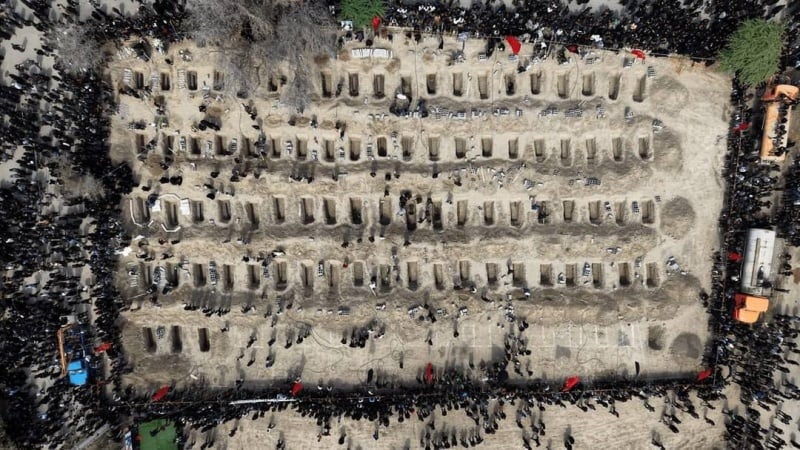
An aerial image shows the graves of schoolgirls in Minab, Ira who were killed by Israeli and American missiles.
Pars Today — As the United States and the Zionist regime continue their attacks on Iran, opposition has spread from Madrid to Beijing and Moscow, and from the United Nations headquarters to the Shanghai bloc and even the U.S. Congress. Warnings about disregard for international law and the risk of the region sliding toward a broader war have also intensified.
According to Pars Today, Spanish Prime Minister Pedro Sánchez in his latest remarks stated that Madrid will not become complicit in actions that would be harmful to the world and contrary to the country’s values and interests. He warned that major human catastrophes begin from such points and said one cannot gamble with the fate of millions of people.
In Beijing, China’s Foreign Ministry also rejected the continuation of the attacks in stronger terms than in previous days. Chinese Foreign Minister Wang Yi, in a phone call with the Israeli side, called for an immediate end to the attacks and emphasized that force does not solve problems and often leaves heavy and long-term consequences.
In New York, the UN Secretary-General described the use of force by the United States and the Zionist regime against Iran as an action that undermines international peace and security. Explicitly recalling the United Nations Charter, he called for an immediate halt to hostilities and a reduction of tensions.
At the same time, the Shanghai Cooperation Organization also stated in a declaration issued by its secretariat that the use of force is unacceptable and stressed the necessity of resolving disputes “exclusively through peaceful means.”
In Moscow, the main lines of Russia’s position have likewise been based on condemning the attacks and emphasizing a political solution.
Taken together, these positions and reactions—from Europe and Asia to the United Nations and even parts of the U.S. political establishment—indicate that the voices of protest against this act of aggression are growing louder, and concerns about the consequences of the continued attacks for regional stability and the principles of international law are expanding.