Analysis | New dimensions of the US crime in Kuhestak disclosed
-
New dimensions of the US crime in Kuhestak disclosed
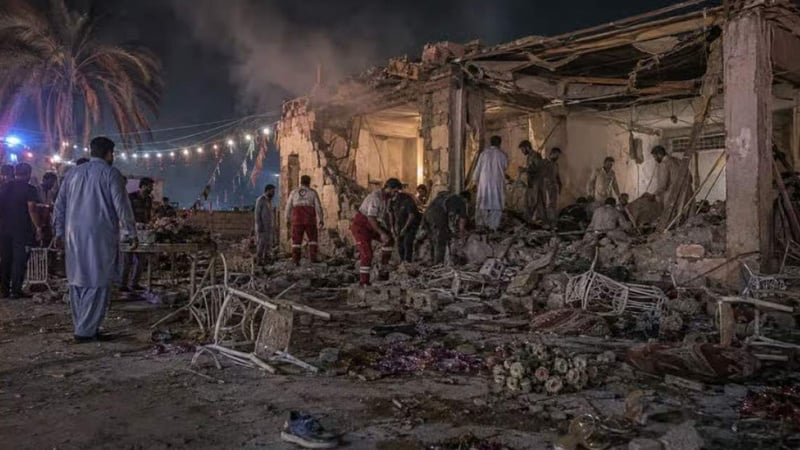
ParsToday – More images of the remnants of the American bomb used in the attack on the wedding ceremony in Kuhestak in Iran's Hormozgan province have revealed important new details.
According to a ParsToday report, previously, by examining the body components and movable fins, it was determined that the weapon used was of the air-to-surface precision-guided bomb type "AGM-154 JSOW." However, the exact version of the weapon used was not clear, but now, by examining the bomb remnants, it has been determined that the version of the bomb used was the "C-1," which is the newest and most up-to-date operational version of this air-to-surface bomb.
The C-1 version of this bomb is not only equipped with an imaging infrared seeker, but by being equipped with a Link-16 datalink, it also has the capability of updating the target after launch by the user, and on this basis, it has the capability of precisely destroying moving maritime and ground targets. With all these characteristics and without a shadow of a doubt, it can be said that American aircraft deliberately and knowingly targeted the wedding ceremony in order to kill as many civilians as possible.
In fact, the US attack on the wedding ceremony in Kuhestak in Hormozgan province is not merely a military incident or an operational error that can be examined within the framework of armed conflicts, but can become one of the most important cases of violation of the fundamental principles of international humanitarian law. The importance of this incident is doubled by the fact that, based on the information presented about the munitions remnants, the weapon used was the air-to-surface bomb "AGM-154 JSOW," specifically its C-1 version, munitions that are fundamentally designed to increase attack precision and the possibility of engaging specific targets.
The AGM-154 C-1 is among munitions in which guidance and target identification technology is used to increase the probability of hitting the intended target. The existence of an imaging infrared seeker and datalink communication capability allows, at least at the design level, the user to update information related to the target during the mission. Therefore, if the specifications presented about the munitions used in Kuhestak are correct, the fundamental question would be how such a weapon hit a wedding ceremony and whether or not a specific military target existed at the location.
In international humanitarian law, the principle of distinction between military and civilian targets is one of the most fundamental requirements of military operations. Also, attacks that are expected to cause disproportionate civilian damage are prohibited. From this perspective, the nature of a weapon alone does not prove the intentionality of an attack, but the more the munitions used have greater identification and precision guidance capability, the greater the necessity of explaining the target identification process, the information used, how the impact point was selected, and the risk assessment for civilians.
If a wedding ceremony was truly selected as a target, the matter goes beyond a possible error in target identification and can expose the perpetrators of the attack to heavier responsibilities. Even if it is claimed that a military target existed near the location, it must still be determined whether the necessary precautionary measures to reduce civilian casualties were taken or not. The presence of a large number of people at a social ceremony, if the attacking forces were aware of it, makes the importance of these considerations far greater.
The political and strategic dimensions of this incident are also noteworthy. The United States has always emphasized in its official discourse the use of precision weapons and efforts to reduce civilian casualties. Therefore, the occurrence of extensive civilian casualties in an attack using guided munitions can confront these claims with serious questions. The important difference between a "precision weapon" and a "precision operation" becomes clear precisely at this point; the world's most advanced munitions, when targeting information is incorrect, the wrong target is selected, or humanitarian law principles are not observed, can also become tools for killing civilians.
Another consequence of the Kuhestak incident is its impact on America's international credibility and its claims regarding compliance with the rules of war. If independent evidence is presented about the intentionality of the attack or disregard for the presence of civilians, this issue can pave the way for demands for an independent investigation and examination of the responsibility of the relevant commanders and decision-makers. Also, such incidents at the regional level can further negatively affect public opinion's attitude toward the US military presence and operations and lead to increased tension and distrust.