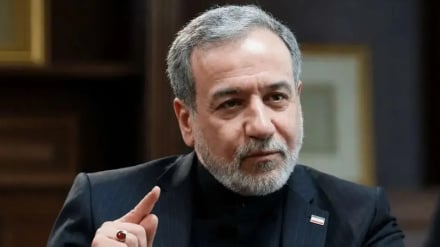
Why Epstein suddenly made headlines
-
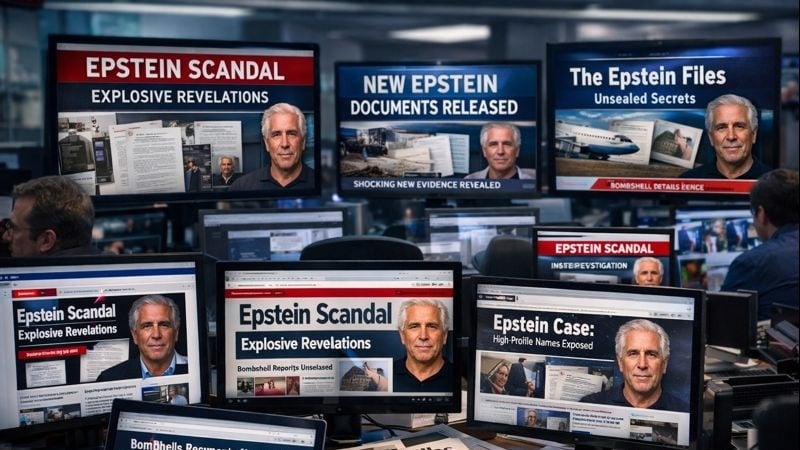
Release of millions of documents from the Epstein case in U.S. media
Pars Today – As the drums of war sound in West Asia, Western media have suddenly brought Epstein back to the top of the news cycle. Is this sudden shift in focus a coincidence, or a deliberate manipulation of public opinion?
A significant Western media shift amid heightened war tensions
In recent hours, front pages of Western media have suddenly filled with news related to the Jeffrey Epstein case—exposés, documents, emails, and accounts seemingly pulled from archives.
Pars Today reports that this news shift occurred just days after Donald Trump, using sharp rhetoric, effectively sounded the drums of war with Iran, at a time when Western media were fully consumed by the narrative of an “imminent war in West Asia.”
Before this shift, nearly all mainstream media focus was on military threats, regional movements, energy prices, and the geopolitical consequences of a potential conflict.
Suddenly, the dominant narrative changed: war moved to the sidelines, and a case that had been opening and closing for years returned to the top of the news cycle.
The key question is: why now?
Coincidence or news agenda management?
The release of over three million pages of Epstein case documents is unprecedented in volume—but questionable in timing. These documents could have been released weeks earlier or later. Choosing a moment when Western public opinion is at its peak anxiety over a potential war hardly seems entirely coincidental.
From a media logic perspective, such revelations typically serve two functions:
- Maximizing attention through shocking, detailed content
- Shifting public focus from one crisis to another
The Epstein case fulfills both criteria. The combination of sexual violence, power, politics, and high-profile figures makes it an ideal subject to dominate the news cycle—a cycle with limited capacity to cover multiple major crises simultaneously.
Trump, Epstein, and the shift in the playing field
Notably, a significant portion of the new media coverage directly or indirectly mentions Trump alongside Epstein, even though it has been repeatedly emphasized that many of these claims remain unverified and no legal charges have been filed against the U.S. president.
From a media perspective, however, the mere “co-occurrence of names” is enough to shift the narrative from war to scandal. In such an environment, Trump is no longer portrayed as a leader preparing for conflict, but rather as a figure entangled in ethical and legal controversies. This reframing carries important political implications.
What do the media highlight—and what do they ignore?
The recent news shift once again demonstrates that major Western media are not merely mirrors of reality, but agenda-setters.
A potential war in West Asia is a complex, high-stakes issue requiring sustained attention. In contrast, the Epstein case—even without a definitive resolution—is ready-made for headlines, clicks, and sensationalism.
This is not to deny the importance of the revelations; rather, it raises the question: why should public attention suddenly shift from a geopolitical crisis to an ethical-criminal one, without clear resolution of the first?
Several hypotheses can be considered in this regard:
Hypothesis 1: Anti-war forces in the U.S. enter the game?
One of the first hypotheses is that anti-war actors within the U.S.—whether from political, media, or even parts of the establishment—deliberately helped spotlight the Epstein case again to block Trump’s path toward war.
For these actors, U.S. entry into a new war in West Asia is not only costly and potentially fruitless, but also a repetition of a failed pattern: long, exhausting conflicts with no clear outcome.
From this perspective, undermining the president’s political focus and credibility by reviving an old ethical scandal could serve as an effective tool to slow down or halt the war machine.
The key question: Was Epstein resurrected to divert Trump’s attention and prevent him from pursuing a military project?
Hypothesis 2: The trap Trump may be caught in
The second hypothesis is even more complex: does Trump himself feel trapped in a situation with neither a clear way forward nor back?
On one hand, backing down from war threats could be interpreted as weakness, hesitation, or political retreat—especially for someone whose political identity is built on projecting strength.
On the other hand, pursuing a war carries the risk of engaging in a costly, uncontrollable conflict—one that could consume his presidency.
In this context, an ethical scandal—even if unproven—can serve both as a threat and an opportunity.
Threat because it erodes political capital and an opportunity because it shifts the playing field.
The question arises: does Trump see himself in a position where he must choose between an “ethical scandal” and a “war-mongering scandal”?
Hypothesis 3: War as a forward escape route?
Unlike the previous hypothesis, the third one considers two key realities:
- The influence of Israeli lobbies in the Epstein case
- The security anxiety in Israel and serious concerns over the consequences of a prolonged conflict
Under this scenario, it is hypothesized that Israel and its supporters in the U.S. may be pressuring Trump to accelerate military action against Iran and fulfill Israeli objectives in such an attack.
In this context, reviving a potential ethical scandal limits Trump’s maneuvering space, putting him in a vulnerable position—one in which launching a war could be framed as a “forward escape” strategy.
Coincidence or design?
None of these hypotheses can be confirmed or dismissed with certainty. However, the very fact that they can be proposed indicates that the recent media shift is far from a simple coincidence.
The Epstein case once again demonstrates that in U.S. politics, the timing of a news release can be as important as the news itself.
If tomorrow the drums of war sound louder once again, it may become clear whether the Epstein case was truly a revelation—or simply a media mission designed to navigate a larger crisis.
And if the war drums sound again, will Epstein remain in the headlines, or has its news mission already been fulfilled?