Deal in delusion: What Trump narrates about an agreement with Iran is a wish, not reality
-
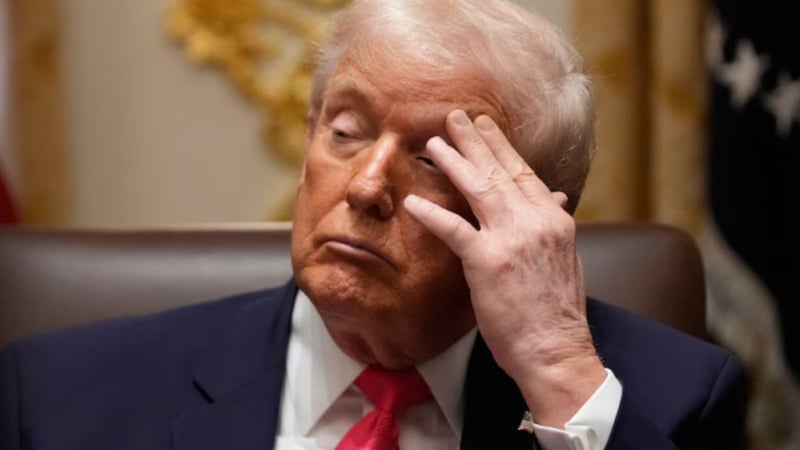
US President, Donald Trump
Pars Today – The gap between narrative and reality is not a diplomatic misunderstanding, but a sign of a hidden defeat within Trump's triumphant claims.
Amid the torrent of contradictory news and tense speculation over the fate of Iran-U.S. tensions, Donald Trump has once again upended the scene by releasing a one-sided text. According to Pars Today, while Tehran had officially announced just hours earlier that it had not yet sent its final proposed text for an agreement to Washington, the U.S. President — projecting an image of decisive victory — introduced clauses as achievements of the negotiations that are either repetitions of Iran's longstanding positions or red lines that Tehran considers matters of existential honor. This deep inconsistency between what Trump says and what Iran confirms indicates that the diplomatic path has not yet reached smooth ground, and what is being narrated from the White House currently resembles more a major bluff or a political wish than a binding joint document.
The first and most important point calling into question the nature of these recent claims is their complete one-sidedness. Trump speaks of an agreement as if it has been finalized between the parties, but the truth is that the Islamic Republic of Iran has still not officially submitted its final text regarding the fourteen clauses circulating in the media to the United States. Iran's Foreign Ministry spokesperson explicitly emphasized this point in response to these claims. Therefore, none of what Trump describes as an agreement has a final status from Tehran's perspective. The essence of bargaining rests on the principle that "nothing is agreed until everything is agreed." This golden rule of negotiations effectively dismantles the foundation of the White House's selective claims.
When examining the content of the claims, the contradictions become even more apparent. Trump speaks of Iran's commitment to not produce nuclear weapons as a new winning card, but this claim is as old as two decades of Iran's nuclear diplomacy. Tehran has repeatedly stated that it is not seeking a bomb — an argument backed by Iran's insistence on remaining within the Non-Proliferation Treaty (NPT) and the late Supreme Leader's religious decree declaring weapons of mass destruction as forbidden. Thus, what Trump touts as a new concession from Iran is not a retreat, but a reiteration of an open and unchanging position.
However, the most controversial part of Trump's claims concerns the Strait of Hormuz and Iran's maritime security measures. The U.S. President speaks of a dream to return the Strait of Hormuz to its pre-war status and to neutralize alleged mines — a dream that Iran has explicitly rejected, emphasizing that "the situation in the Strait of Hormuz will by no means return to pre-war conditions." The field reality is that the United States, despite all its efforts during the period of tension, was never able to eliminate Iran's sovereignty over this vital artery. Interestingly, Trump speaks of "lifting the naval siege," unaware that this very issue has been one of Iran's main preconditions for ending the war. Tehran says that as long as its ships do not navigate freely as before and this unblocking is not operationally realized, it will not change its monitoring mechanism in the Strait of Hormuz. It is worth noting that Iran fundamentally denies charging tolls for vessel transit; what it collects is a service fee for providing security and safe passage.
Trump's claim that the United States removed mines from the Strait of Hormuz is completely unfounded. Iran has never officially confirmed the presence of mines in this waterway, but has consistently emphasized ensuring a safe route for shipping. On the other hand, the question arises: how could the U.S. military have neutralized alleged mines when, throughout this period, it could not even deploy its fleet in the Strait of Hormuz without permission? This part of Trump's statements resembles more a fantasy narrative for domestic consumption in the United States than an operational reality.
On the nuclear issue, Trump's demand to decide the fate of Iran's enriched materials is an obvious fantasy. Tehran has explicitly stated that any decision regarding its enriched uranium stockpiles — whether dilution or storage methods — depends entirely on its domestic needs and sovereign decision, and will only be possible after the full fulfillment of war-ending conditions and following sixty days of negotiations, and even then, only with Iran's agreement. However, amid this overreach, a hidden retreat from Washington can be seen: Trump no longer speaks of "transferring enriched materials to the United States or a third country," meaning that at least on that front, the verbal fireworks have subsided.
Perhaps the most prominent part of Trump's claims for the public is his statement about not paying money. He implies that the agreement has been reached at no financial cost to the United States, while Tehran's vital condition for ending hostilities is the immediate and simultaneous release of Iran's blocked assets worldwide. Iran considers the end of the war contingent on a signature on an agreement that simultaneously unlocks its assets — these two, in Tehran's view, are inseparable.
But what truly exposes the nature of the gap between the two sides are the issues Trump has deliberately ignored, which according to unofficial reports constitute Iran's red lines: first, the withdrawal of U.S. forces from military bases in Iran's neighboring countries — a vital security guarantee for Tehran. Second, a U.S. commitment not to impose new sanctions during the sixty-day period of supplementary negotiations. Third, which may be the heaviest clause, Washington's commitment to provide at least $300 billion for rebuilding war damage and paying reparations. And finally, the complete and simultaneous lifting of all sanctions upon signing the agreement. These demands reveal the profound disconnect between Trump's narrative of a "quick and America-friendly agreement" and the complex reality on the negotiating table. Until these deep gaps are filled, Trump's one-sided claims remain nothing more than a failed draft statement for the media.