Analysis | Why U.S. is afraid to punish countries cooperating with Iran
-
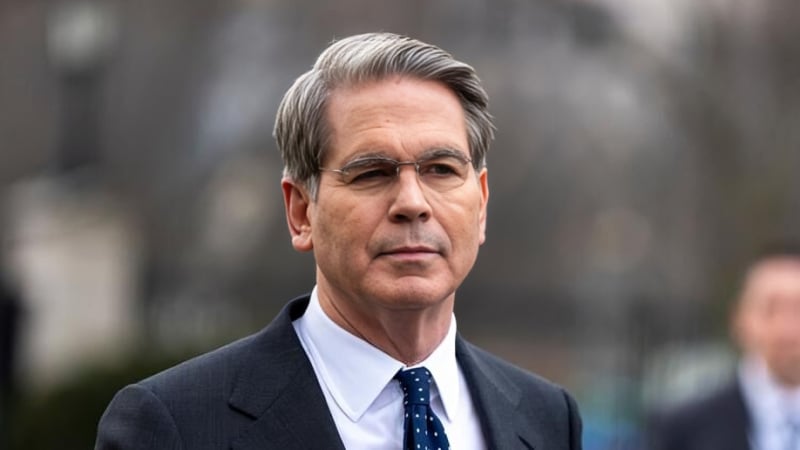
U.S. Treasury Secretary Scott Bessent
Pars Today – While the United States is making an unprecedented show of force in an attempt to wage a major economic war against Iran, what stands out most in practice is not the overwhelming power of its purported sanctions, but rather the contradictions and apparent panic among U.S. officials.
According to Pars Today, the so-called “Economic D-Day,” or the “major offensive economic operation against Iran,” and Iranian Parliament Speaker Mohammad Baqer Qalibaf’s sarcastic response to U.S. Treasury Secretary Scott Bessent, offer a revealing picture of the complex situation in which the United States finds itself—a situation in which threats to punish countries cooperating with Iran stem not from a position of strength, but from fear and desperation.
Scott Bessent, who had previously compared the new sanctions against Iran to the massive Normandy operation during World War II in an article for the Financial Times, was confronted at a press conference the following day with a question about the hollow nature of that claim. To everyone’s surprise, he replied: “Why would I want to blow up the global financial system?!”
This apparent retreat became the subject of a sarcastic post by Qalibaf on X: “This program was nothing like the Normandy operation; it was a ridiculous stand-up comedy show at a nightclub where you even forgot your own script.” By adding a clown emoji to his post, Qalibaf effectively painted a picture of an absurd theater in which the lead actor not only fails to deliver a convincing performance, but also forgets his own lines.
Beyond the bitter humor, however, what makes this episode noteworthy is the question of why the United States is reluctant to punish countries that refuse to join its new sanctions against Iran.
The United States, under a campaign dubbed “Operation Economic Outcast,” has expanded the scope of its secondary sanctions into five key sectors—digital assets, technology, gold, aviation, and shipping—and has sanctioned more than 60 entities, individuals, and vessels.
According to Bessent, the objective of the campaign is to “cut off all the economic lifelines supporting the Islamic Republic until Tehran is completely isolated.”
However, Washington is well aware that these sweeping threats face a major obstacle: today’s world is one of complex economic interdependence and solidarity that cannot easily be dismantled by an order from the U.S. capital. Countries such as China, Turkey, and the UAE are among Iran’s largest trading partners, and punishing them would not only disrupt the global economic order but also impose heavy costs on the U.S. economy and its allies.
Bessent’s response at the press conference— “Why would I want to blow up the global financial system?!?”—was precisely an acknowledgment of this reality: the United States knows that imposing secondary sanctions on Iran’s trading partners could turn into an all-out economic war with uncontrollable international consequences.
Moreover, historical experience has shown that U.S. unilateral sanctions have not only failed to achieve their objectives in past decades, but have also driven targeted countries to develop alternative ways of engaging with the global economy. In this context, non-Western countries—particularly China and Russia, as major economic powers—have consistently sought to circumvent U.S. dollar dominance and American sanctions through mechanisms such as significantly expanding economic and trade exchanges, establishing bilateral currency arrangements, and reducing their dollar-denominated foreign-exchange reserves.
Washington is well aware that any punitive action against these countries could trigger retaliatory measures and the emergence of new economic blocs, in which the role and influence of the United States could decline sharply.
Another important factor is U.S. concern over the political consequences of such measures. In a similar response to these threats, Iranian Foreign Ministry spokesperson Esmaeil Baghaei wrote: “When a bully declares that every bank, company, port, and government must choose between obeying Washington and facing U.S. retaliation, this is no longer just about Iran.”
The statement clearly illustrates that threatening to punish third countries is not merely an economic measure, but also a serious challenge to the national sovereignty and political independence of countries around the world. Many countries, particularly in the Global South, view such measures as a form of “economic terrorism” and are unwilling to readily trade away their independence in exchange for compliance with Washington’s threats.
Meanwhile, Bessent’s remarks about a “Pascal’s Wager,” in which he urged countries to carefully calculate the consequences of cooperating with Iran, suggest a degree of desperation in persuading international audiences.
At the same time, America’s reluctance to carry out its threats stems from the fact that sanctions have gradually lost their effectiveness over time. Over the past four decades, the Islamic Republic of Iran, by relying on its resistance economy, diversifying its trading partners, and reducing its dependence on the dollar, has managed to keep its economy functioning despite unprecedented pressure. Moreover, US military attacks against Iran—which, according to Bessent, “destroyed a significant portion of Iran’s military capabilities”—have failed to break Tehran’s political will to resist. Washington therefore finds itself in a position where it has neither sufficient military power to force Iran into submission nor confidence that a full-scale economic blockade would succeed.
Ghalibaf’s sarcastic response, along with those of other Iranian officials, therefore appears to be more than merely an emotional reaction; it reflects an objective reality: the United States has become trapped in a situation of its own making. On the one hand, it feels compelled to resort to threats and bellicose rhetoric to preserve its image, while on the other, it fears the practical consequences of carrying out those threats.
The performance staged by Bessent at his press conference was, in Ghalibaf’s words, not a “day of victory” but a “day of the clown”—a day when the main actor not only forgot the script, but when audiences around the world also realized that the entire performance was little more than an empty bluff.
“Operation Economic Outcast” may look impressive on paper and in the media, but in reality, it is the last gasp of a failed strategy—one that, driven by fear of failure, has been reduced to contradictions and empty rhetoric.