Rouhani: Iran opposes sectarianism, attempts to promote religious gaps
Oct 03, 2016 04:48 UTC
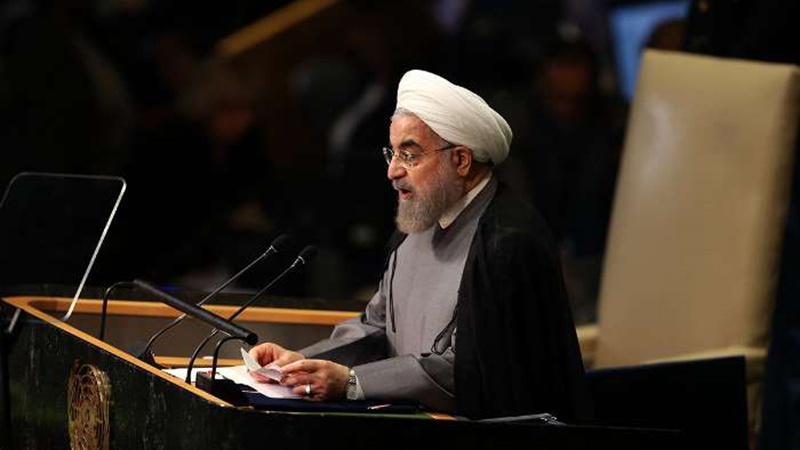
President Hojjat al-Islam Dr. Hassan Rouhani’s visit to New York in mid- September for the annual session of the United Nations General Assembly, once again provided the Islamic Republic of Iran the opportunity to clarify its principled positions on crucial international issues, besides meetings with several heads of state to discuss promotion of bilateral ties. It was the current Iranian president’s 4th consecutive visit to the headquarters of the World Body.
Rouhani arrived in New York from Havana where he met senior Cuban officials to discuss further bolstering of mutual ties. Prior to that he was in Margareta Island, where the Islamic Republic of Iran formally handed over NAM chairmanship to host country Venezuela, after four years as Head of the Non Aligned Movement. Stay with us for highlights of the Iranian President’s stay in New York.
In his address to the 71st UN General Assembly on Thursday September 22, President Rouhani delineated Iran’s principled approach in national, regional and international stages, stating: “Iran calls for constructive partnership with our neighbours with a view to establishing an enduring order based on shared security and efforts aimed at enhancing the development of the countries in the region and mutually beneficial economic cooperation”. He said Iran is opposes any kind of sectarianism and attempts to promote religious rifts, adding: “The future of our region rests on dealing with fundamental challenges such as security crises, due to the inefficiency and the lack of legitimacy of governments. We won't be able to combat criminal and terrorist networks without genuine democracy and without a real participatory approach at the national and transnational levels”.
He criticized the seditious policies of Saudi Arabia, which this year violated one of the basic norms of Islam by banning Iranian Muslims from the Hajj pilgrimage, following its criminal mismanagement of last year’s Hajj, where on the sacred plain of Mena, some 7,000 Guests of God, including around 500 Iranians, were martyred in a stampede. He said: “If the Saudi government is serious about its vision for development and regional security, it must cease and desist from divisive policies, spread of hate ideology and trampling upon the rights of neighbours, accept its responsibility for the protection of the lives and dignity of pilgrims and construct its relations with the nations in the region on the basis of mutual respect and accountability.”
He advised Riyadh to stop its year-and-a-half long bombardment of Yemen that has so far killed over 10,000 civilians and destroyed the infrastructure of that country. He was also critical of Saudi Arabia’s support for Takfiri terrorist outfits that have unleashed bloodbaths in Syria, Iraq, and Libya.
Dr. Rouhani said: “Undoubtedly, if the region is to reverse the current dangerous trend into one towards development and stability, certain countries must stop bombing their neighbours, and abandon supporting Takfiri terrorist groups; and, while accepting responsibility, try to compensate for past mistakes. If the Saudi government is serious about its vision for development and regional security, it must cease and desist from divisive policies, spread of hate ideology and trampling upon the rights of neighbours, accept its responsibility for the protection of the lives and dignity of pilgrims and construct its relations with the nations in the region on the basis of mutual respect and accountability. The future of our region rests on dealing with fundamental challenges such as security crises, due to the inefficiency and the lack of legitimacy of governments.
We won't be able to combat criminal and terrorist networks without genuine democracy and without a real participatory approach at the national and transnational levels. We believe that countries in our region can create their shared future through relying on their common history and culture and isolating terrorist groups We should never allow our region to run once again the risk of a new dismemberment following the one that took place close to a century ago.
Today in fact, the discourse of hatred and violence in the Middle East and North Africa is spreading with an astonishing speed, and this region is stuck in a web of the most savage and destructive policies. Millions of Syrians are stranded in deserts and high seas, and hundreds of thousands of them are subjected to violent deaths. Iraqis of every ethnic group are concerned about their territorial integrity and the future of their homeland. The defenceless people of Yemen are subjected to daily aerial bombardment, and Afghanistan, following decades of occupation and atrocity, is yet to find comfort from suffering, violence and terror.”
The Iranian president blasted the illegal Zionist entity for its continued suppression of the rights of the Palestinian people. He said: “The oppressed Palestinians are still afflicted by a web of apartheid policies and atrocities set by the usurping Zionist regime.”
Rouhani lauded the experience acquired through dialogue between Iran and the group of 5+1 in the fruition of the Joint Comprehensive Plan of Action (JCPOA), saying the deal confirmed the peaceful nature of Iran's nuclear program through devising confidence-building mechanisms, and reinstating Iran's right to develop a peaceful nuclear program. This deal also put an end to unfounded concerns and led to the removal of the brutal sanctions against Iran.
He was, however, critical of Washington’s double-standard policies regarding the sanctions and the full implementation of JCPOA. He said: “The US is fully aware that JCPOA constitutes a recognized multilateral agreement, and any failure on the part of the United States in implementing it would constitute an international wrongful act and would be objected to by the international community. Any failure in implementing the JCPOA will further erode the credibility of the United States in the world. The lack of compliance with the JCPOA on the part of the United States in the past several months represents a flawed approach that should be rectified forthwith. Unfortunately, such illegal actions are not unprecedented: the latest case in point is the US Supreme Court ruling to seize billions of dollars of the Iranian people's assets. This experience demonstrated that the Zionist pressure groups could go as far as having US Congress pass indefensible legislations forcing the highest American judicial institution to violate pre-emptory norms of international law.”
Iran's Chief Executive outlined the Islamic Republic’s principled approach for constructive partnership with our neighbours with a view to establishing an enduring order based on shared security and efforts aimed at enhancing the development of the countries in the region and mutually beneficial economic cooperation. He said that to uproot violence in the region, there is no choice but to focus on promoting democracy, citizenship rights and economic development. Rouhani said: “Iran opposes any kind of sectarianism and any attempt to promote religious rifts. The Muslim people, whether Shi'as or Sunnis, have and continue to live together for centuries in harmony and mutual respect. Attempts to turn religious dissimilarities into tense confrontations is rooted in vested interests of certain countries, which try to hide their quest for power covered in religious slogans. Iran considers it imperative to preserve territorial integrity of countires, keep national borders intact, enhance peoples' right to self-determination and uphold the principle of refraining from the threat or use of force. We also reiterate the need to use diplomacy for conflict resolution.”
He said security has become a global problem at a time when major powers are mainly focusing on advancing different methods of repression and military intervention under the pretext of creating a secure environment for their citizens. According to Dr. Rouhani, the genesis of borderless violent extremism and terrorism could be attributed to the security strategies developed by major powers over the past 15 years. He said: “The main lesson to learn from the analysis of this trend is that security in one region at the cost of insecurity in others would not only be impossible but it could also lead to more insecurity everywhere.”
The Iranian president’s UN speech was hailed by the media, both at home and abroad. Brigadier General Farzad Esmaili, the Commander of the Khatam al-Ambiyya Air Base said the “courageous” speech of President Rouhani during UN General Assembly manifests Iran’s rationality and might. He said: “In Dr. Rouhani’s speech, his adherence to all of the Islamic Revolution’s values and principles were manifested.”
On the sidelines of the UN meeting in New York, the Iranian president met with American elites and elaborated Iran’s principles policies. He said elites and intellectuals should try to convince politicians of the threats of terrorism threats. He added: “In the current circumstances, the most important and crucial point is that some governments and politicians, who are doubtful of terrorism threats and harms, be convinced that combating terrorism and its roots is essential. For years, the Islamic Republic of Iran was unjustly accused of something and my country’s people paid a heavy price for it. Therefore, we were very interested in having a frank and face-to-face dialogue with all major world powers about this important issue.”
He added: “A true politician is someone who can stop wars and disputes before they happen, but if a politician enters war, both the policy and the politician have failed”.
Meanwhile, in his meeting with Iraqi Prime Minister Haider al-Ebadi in New York, the Iranian president said: “Iran will do whatever it can to help Iraq establish full peace and security in the country.” He added that the main goal of Tehran’s support of Iraqi government, army and popular forces is “liberating the people from Daesh terrorists and completely clearing the country of terrorists and we will spare no effort in doing so.”
He said: “Iran has always stood by Iraqi government and people, especially during recent ups and downs, and will continue supporting Iraqi people until the end.”
At the meeting, At the meeting, Iraqi Prime Minister Haider al-Ebadi described Tehran-Baghdad ties strategic and beneficial to both parties and the region. Referring to Iran’s cooperation in combatting terrorism, he said: “Currently, thousands of popular forces are fighting Daesh and these terrorist groups are nearing the end of their lives in Iraq and we are attempting to clear the path for liberating Mosul”.
In related news, Dr. Rouhani met UN Secretary-General Ban ki-Moon and discussed with him the most important issues of the region. He referred to the crises in Syria and Yemen, saying: “In Yemen, continuing military attacks and committing war crimes is extremely worrying as all international conventions in the country continue to be violated. This war against Yemeni people has no base, beginning against all regulations and continuing with bombarding women and children. Most of the impartial international organisations acknowledge that a country has committed war crimes there.”
The Iranian president then referred to the Syrian crisis and Iran’s readiness to continue its constructive role in the country and went on saying: “In the process of combating terrorism, the chief point is maintaining sovereignty and integrity of the countries, while in the current situation, humanitarian considerations are the top priority”.
Stressing that UN should fulfil its duty towards Yemeni people despite some pressures, Dr Rouhani said: “The United Nations and the Secretary-General should play their important role in this historic moment”.
UN Secretary-General Ban Ki-moon said: “I admire Iran’s excelling management during its presidency over Non-Aligned Movement”.
Dr. Rouhani also met the Prime Minister of Japan Shinzō Abe and expressed satisfaction over ties between the two countries. He said Iran welcomes joint ventures and cooperation in technology, such as health, scientific and environmental fields, adding: “Now it is time for Tokyo to invest in Iran’s energy sector like the past”.
He added: “Both Iran and Japan are the victims of WMDs and we support the idea of a world without nuclear weapons,” continued Rouhani, saying that Iran believes that nuclear weapons do not bring security.
On terrorism and its threats to the region and the world, Dr Rouhani said: “Iran has been the region’s defence line against terrorism and Daesh”.
Prime Minister of Japan Shinzō Abe said: “Japan appreciates Iran’s approach towards constructive interaction with the global community and will try to develop ties in various fields”.
AS/SS
Tags