Leader hails Iran’s brave, educated and revolutionary youths
Oct 27, 2016 11:21 UTC
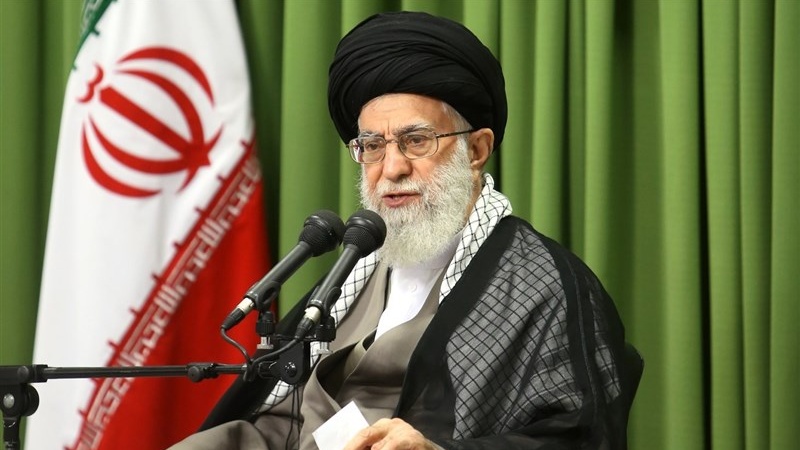
Leader of the Islamic Revolution, Ayatollah Seyyed Ali Khamenei, recently granted an audience to over a thousand young Iranian elites and top scientific youths, praising them as precious gifts of God. He emphasized that he will not lose even a single moment in defending the country’s scientific community and elites.
The Leader was confident that by relying on the elites scientific brains and through building a young and perseverant generation, the Islamic Iran will turn into an advanced, powerful, honoured, and dignified country, holding aloft the flag of the modern Islamic civilization. Stay with us for excerpts in this regard.
The Leader of the Islamic Revolution described elites, especially the talented youths, as unique and precious gifts and divine trusts given to the Iranian nation, and added, “The [main] duty of [Iranian] officials vis-à-vis these valuable divine gifts is to protect them and make effort to identify and train more elites.” He also emphasized that elites, for their part, are responsible with regard to this divine bounty and should thank it by feeling responsibility and taking advantage of their talent and ability in the correct way.
Ayatollah Khamenei stressed the Iranian society’s belief in the general notion “we can”, and called for supporting the brilliant brains of the country. He then pointed out: Unfortunately, during the Qajar and Pahlavi eras, the profound belief in ‘inability’, ‘we cannot’, and ‘dependence’ had been instilled in the Iranian people and youths, with the result that a great country brimming with human and material resources, in addition to its glorious history and ancient civilization, had been humiliated by the West. He then noted that it was the triumph of the Islamic Revolution which reversed this negative trend and brought about a huge change in the Iranian society.
As a matter of fact, he said, the Islamic Revolution instilled in the Iranian youth “self-belief and self-confidence”, which was fully manifest during the 8 years of Holy Defence when the US through its agent Saddam of the repressive Ba’th minority regime of Baghdad, imposed the unwanted war on Islamic Iran. He added: “Although the war was a very bitter, damaging and difficult event, it proved to the Iranian youths that through trust in God and reliance on domestic talents and capabilities, one can overcome an enemy, who is supported by all big powers.”
Ayatollah Seyyed Ali Khamenei said, despite the fact the Islamic Revolution revived the spirit of ‘we can’ as opposed to the spirit of ‘dependence’, and promoted self-belief in the society, the opposite side has been taking steps to re-impose the culture of dependence on the West in new and apparently attractive forms, as part of the soft war. Mentioning the issue of “globalization” and the offer by Americans and Europeans to Iran to join the so-called “global community,” as another clear example of efforts made to re-impose the culture of dependence, he noted, “Opposition to joining what the Western side calls the global community is not tantamount to opposing [any form of] foreign communications, but means resistance in the face of the culture imposed by big powers on the economy, politics and security of the country.”
The Leader of the Islamic Revolution added that the main reason behind special and serious attention that Iranian officials pay to the issue of elites is the need to achieve the great goals of the Islamic establishment, He said: “Elites are the driving force for achieving these great goals and officials must take a serious, practical, sympathetic and insistent approach to the issue of elites.” Elaborating on the great goals pursued by the Islamic system, he said: “The Islamic Republic of Iran must turn into an advanced, powerful, [and] honourable country endowed with new ideas, [and] with dignity, having the feeling of self-esteem, full of spirituality and faith and hoister of the flag of the new Islamic civilization. The requisite [condition] for achieving these lofty goals is to attach importance to elites and appreciate this great divine bounty.”
Focusing on calamities and problems that are nagging humanity today and the deadlock faced by materialistic schools of thought, Ayatollah Khamenei argued that the world needs to hear something new with regard to human and international issues, adding, “The [ongoing] election campaigns in America and issues raised by the two candidates constitute a clear and evident example of the consequences of lack of spirituality and faith among those in power.”
He continued his remarks by saying that to achieve its great goals, the Islamic establishment needs to create a brave, faithful, educated, innovative, pioneering, self-believing, zealous, vibrant, and motivated generation, adding, “This generation, which despite some false propaganda [claims] is a revolutionary generation in the real sense of the word, will dedicate all it has to the progress of Iran.”
The Leader of the Islamic Revolution described the role played by elites in shaping and motivating this young generation as very important and added, “Through their vibrant effort, elites can serve as a driving force and encourage the young generation, which is the main asset of the country, to work and make efforts.”
He pointed to his own frequent emphases since 15 years ago on the need to launch a scientific and software movement and said, “This movement was welcomed by elites, scholars and students and led to good results, but later faced [certain] obstacles, which must be identified and removed.”
The Leader of the Islamic Revolution mentioned obstructionist efforts by enemies as one of those obstacles and added, “Some people are upset as soon as the word ‘enemy’ is repeated, but this repetition and warning, like the repetition of the word ‘Satan’ in the Holy Quran, is aimed at creating constant vigilance and, in fact, is ‘recognition of conspiracy’, not ‘imagining conspiracy’.” He referred to obstructions thrown in the way of Iran's scientific movement as another main goal of the enemies and said, “If they fail in realizing this goal, they will make an effort to deviate it [from the correct path] and if it fails, they will try to defame and tarnish it. Therefore, everybody must be watchful not to help the realization of these goals [which are pursued by the enemies] through our naïve acts.”
Ayatollah Khamenei noted that diverting research works and student theses from meeting the real needs of Iran was an example of the effort made to help divert the country’s scientific movement. Citing another example about defaming this movement, he said, “They invite a person to the country claiming he is a scientist and that person publishes a photo of [public] boards with ads about selling theses in Iran to defame the country’s young elites; are such people really scientists?”
The Leader cited information from creditable global scientific sites, adding, “The speed of scientific progress of Iran was thirteen times higher than the world’s average at a juncture and this speed must by no means be reduced, but must increase because we are afflicted with many [forms of] scientific backwardness.”
He made it clear that any damage to the country’s scientific movement will cause desperation of elites and the young generation, adding, "This very heavy damage would not be compensated easily and rapidly and would cause [Iran's] young elites to look to other countries.”
The Leader of the Islamic Revolution mentioned certain points, which can further energize the “blessed movement of science and technology” in Iran, noting that “supporting knowledge-based companies,” “quantitative development and qualitative upliftment of these companies,” and “getting them involved in the country’s main sectors and plans” were major necessities, which must receive serious attention. He then pointed to the important role of “promoting use of the products made by knowledge-based companies” in bolstering such companies, and while addressing state officials, said, “Ask state-run bodies to meet their needs through the products of knowledge-based companies.”
Calling for “serious attention to forming elites’ centers in universities” and urging Ministry of Education to “solve problems faced by the National Organization for Development of Exceptional Talents,” were two other points mentioned by Ayatollah Khamenei as being effective and useful for the strengthening of the country’s scientific movement. Ayatollah Khamenei then referred to the importance of the National Elites Foundation, and indicated his deep trust in the capabilities and good management of this foundation. He, however, added, “There are concerns about problems that exist between the vice presidency for science [and technology] and the [National] Elites Foundation and these problems must be solved through either separating these two [institutions], or appointing a powerful director for the foundation.”
Ayatollah Seyyed Ali Khamenei then expressed concern about reports on slowing down or stoppage of large-scale research projects in such important fields as aerospace, satellite and nuclear technologies, and some other fields, and emphasized, “Officials must pay full attention [to the fact] that such important projects must absolutely never be slowed down, mothballed or stopped, because through the scientific damage they cause, they would make young scientists desperate and this is a very grave danger.”
He said: “The main goal is to create a society and a country, which while being endowed with such global indices as ‘scientific progress and power and wealth’, be also inundated with ‘faith, spirituality, and honor’, and save the humanity from the current ignorance and misguidance by appealing to nations’ hearts. And without a doubt, the realization of this important goal will be possible for the great nation of Iran and the dear, intelligent, and highly-motivated youths of the country.”
Ayatollah Khamenei then referred to hostility of satanic powers toward any move that is opposite to them, adding, “A few days ago, an American statesman said as long as Iran supports and takes sides with the resistance [axis in the region], it is not clear if sanctions [imposed on Tehran] would see a major change. This is the same reality about which I have frequently talked to officials.” Referring to remarks made by some American officials in their meetings with their Iranian counterparts about “pessimism of the Leader of the Islamic Revolution toward America,” Ayatollah Khamenei asked, “Can one be optimistic toward you despite such remarks that you make?”
Ayatollah Khamenei then recalled the previous remarks he had conveyed to officials in private and public sessions, saying, “I have said time and again that if you retreat in the nuclear [case], then they will raise the issue of [Iran's] missile [program]; if you further step back, they will raise the issue of [Iran's] support for the resistance [axis]; if you continue to retreat [in the face of the Western countries’ demands], they will focus on the issue of human rights, [and] then, if you accept their norms, they will try to do away with religious norms in the [Iranian] government.”
Referring to a recent statement by the European Union, which had focused on huge potentialities and capacities of Iran, the Leader said, “What I say about potentialities for progress as well as human and natural resources of Iran is not ranting, but is a reality to which Western countries have owned up.” The Leader of the Islamic Revolution emphasized, “Americans will certainly fight an ‘Iran with such a capacity for progress and endowed with a government based on Islam’, and understanding and analysis of this important point among young elites will help them play their historical role.”
In his speech, Ayatollah Khamenei described the event of Ashura, or the 10th of Moharram on which in the year 61 AH, Imam Husain (AS), the grandson of Prophet Mohammad (SAWA), preferred to drink the elixir of martyrdom rather than acknowledge the Godless rule of Yazid, as a sun that never sets. He said, “The event of Ashura is a true image of the struggle between light and darkness, and this [evolutionary] course was made complete by the martyred Imam’s sister Hazrat Zainab and the martyred Imam’s son and successor, Imam Zain al-Abedin (AS).” In the end he thanked those organs, which manage Ashura mourning processions which this year saw multitudes of youths and speeches rich in content during the mourning ceremonies.
AS/SS
Tags