Leader: We will not stand if US extends sanctions
Nov 27, 2016 07:22 UTC
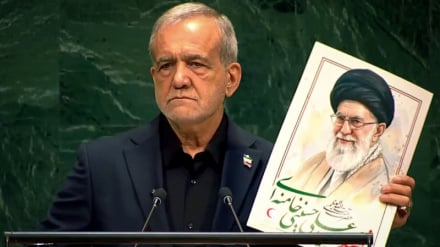
Leader of the Islamic Revolution Ayatollah Seyyed Ali Khamenei granted an audience in Tehran on Wednesday November 23 to commanders and thousands of members of the Basij volunteer mobilization forces, during which he described the Basij as the “army of the revolution,” and the “symbol of the popular religious system of government,” which relies on insight.
He also praised the presence of over 20 million pilgrims in Karbala for commemoration of the Arba’een anniversary at the holy shrine of Imam Husain (PBUH), saying: “The magnificent march of Arba’een is truly a historical and divine phenomenon; one that indicates that this path is a path of love entwined with insight.” On the recent decision by the US senate to extend for another ten years a set of illegal sanctions against Iran, Ayatollah Khamenei called it “yet another breach of JCPOA”, and made it clear “the Islamic Republic of Iran will not stand by idly,” in case it becomes an executive act. Please stay with us for details.
Ayatollah Khamenei elaborated on the establishment of the Basij Volunteer Mobilization Forces Basij, calling it “an amazing phenomenon that took shape during the Revolution”. He said the Father of the Islamic Revolution, Imam Khomeini (God bless his soul), “had this divine intuition to create something so phenomenal; that is to say, entrust the revolution in the hands of the youth.” He warned that “among the enemy’s plots is to infiltrate and create rivals and parallels for the Basij and the officers of the soft war. We should be vigilant.”
While emphasizing the necessity of making accurate plans based on establishing deliberation boards to promote synergism among various layers of the Basij in order to ensure its powerful and influential presence in various social fields, Ayatollah Khamenei said, “The Basiji spirit means to always see God on your side and with you and never give in to despair and depression and deadlock. Therefore, in an answer to those weak people who have been afflicted with the fright of the enemy and the spirit of ‘we cannot’, we say that through reliance on the divine power and believing in the strength of people’s presence, we can overcome all problems without being afraid of any power.”
He quoted the Late Imam Khomeini as saying: ‘Throughout the revolution I always saw the powerful divine hand behind the huge popular movement’.”
Ayatollah Khamenei pointed to trustworthiness of the young people for transferring the “revolutionary spirit” from one generation to the next, noting, “Despite the fact that today’s youths have not seen the period of the revolution and the Imam, they are [still] present in the arena with the same revolutionary spirit and with an insight, awareness and experience, which outdoes the young people [who were present] in the early [years] of the revolution, and this is proof of the Islamic Revolution’s progress.”
The Leader of the Islamic Revolution emphasizing that protecting and safeguarding the Islamic Revolution is a mission and task for all members of the nation, described the youth as the driving force behind this great movement and added, “Certainly, the movement of the Basij in our country is victorious, but the [necessary] condition for the realization of this victory is to choose personal and collective piety and do good deeds, because these two important factors will attract God’s assistance and support.”
Referring to an example of Divine Assistance from the holy Qur’an, where Prophet Moses and his brother Aaron triumphed against the superpower of those days, that is, the Pharaoh of Egypt, Ayatollah Khamenei said: “God told Moses: ‘Don’t be afraid because I am with you and I hear and see’. When Israelites became frightened on seeing the huge army of the Pharaoh and said ‘they will annihilate us’, Prophet Moses firmly replied: ‘Never! My Lord is with me and will guide me.”
Ayatollah Khamenei then told the audience: “If we develop and preserve, within ourselves, piety and the perquisites for deserving God’s assistance among us, even a power 10 times mightier than the US will not be able to overcome or dominate us.”
He then enumerated five important topics, which must receive serious attention when the Basij force is making plans and procedures. The first was reliance of the Basij force on “insight”, since “the Basij is not merely an emotional movement, but is based on understanding, knowing and insight and this orientation must be maintained within the force.”
Referring to some people, who were very enthusiastic and revolutionary in the early years after the Islamic Revolution, but are now standing against it, the Leader said, “These people greatly distanced from the Islamic Revolution and finally stood against the revolution due to ‘lacking religious depth, moving on the basis of emotions and companionship with those people who have differences with the revolution’.”
Ayatollah Khamenei then mentioned the expanded domain of the Basij for all members of the nation and not being affiliated with any political faction as the second topic of his discussion and said, “The Basij is the army of the revolution and if there is a dichotomy in this regard, it is the dichotomy of ‘revolutionary’ as opposed to ‘counterrevolutionary’, because even a ‘non-revolutionary’ person can be attracted [to the path of the revolution].”
Putting emphasis on the need to attract as many people to the path of the revolution as possible, he said, “Of course, this maximal attraction does not mean to take advantage of any method and measure but any faction or person, who believes in the revolution and serves the revolution, would be included in the Basij as well.” The Leader of the Islamic Revolution then pointed out, “The Basij is not affiliated to any of the revolution’s factions, but it is a huge current and river, [which flows] towards the [achievement of] the goals of the Islamic Revolution.”
He then mentioned the necessity of “synergism among various layers of the Basij,” as the third topic related to the Basij and added, “The [vast] expanse of the Basij includes various strata of people, in which a suitable mechanism for coordination and synergism must be worked out.”
He then explained the fourth topic to ensure more powerful and influential presence of the Basij, saying: “the Basij is a symbol of popular religious rule and is Islamic” in nature. He added, “Some people assume that popular religious rule is limited to going to the ballot boxes and participating in elections while this issue is just one of the manifestations of the religious system of government and its real meaning is that ‘people are masters of the life in their society according to the religion of Islam.”
The fifth and the last topic which the Leader of the Islamic Revolution highlighted, was the need to form deliberation boards at two levels, that is, the top and lower levels of the Basij. He said: “The duty of these deliberation boards at various levels of the Basij is to make plans for various missions, including the hard war and the soft war and reconstruction and providing services [to people].”
Ayatollah Khamenei emphasized that the establishment of such deliberation boards will help the Basij become more dynamic, wiser, and more influential and will turn it into a pioneer in all fields. He said, “In addition to deliberation boards, monitoring boards must be also established whose mission would be making sure not to let viruses infiltrate [into the Basij] and prevent [any form of] harm to the organization of the Basij.”
He stressed that these five topics were necessary for the continued growth and fruition of the pure tree of the Basij, noting: “These topics are related to action and reality and should be put into action through accurate planning.”
The Leader of the Islamic Revolution also noted that the Basij is currently being used as a role model by certain regional countries, and while pointing to the enemy’s plan to deal a blow to this model, said, “One of the enemy’s plans is the very important issue of ‘infiltration’, about which frequent warnings have been issued since more than a year ago.”
At the beginning of his remarks, Ayatollah Khamenei described the recent glorious Arba’een march as a “historic phenomenon” and the sign of “the Powerful Divine Hand.” He noted that on lasting and immortal occasions and uprisings such as the Arba’een march, or in like the capture of the US spy den in Tehran in 1979, the people’s huge demonstration in support of the Islamic Republic on December 30, 2009 following the sedition, and the E’tekaaf or staying at mosques for worship on special days of the years, “are not the results of propaganda, but the Hand of God can been seen more clearly than other places.”
He further said the multimillion-strong presence of people in the divine phenomenon of Arba’een was a sign of “love and attraction accompanied with insight” and added, “We welcome those pilgrims, who succeeded to do this great task, and we thank the people of Iraq, who kindly received and managed this huge population.”
The Leader said gratitude to God for this bounty is the necessary condition for the continuation and persistence of the extraordinary phenomenon of the Arba’een march, and said, “The real thanking [of God] must be done in practice, and just in the same way that the majority of the Iranian people protected the bounty of the Islamic Revolution with sacrifice and selflessness, the bounty of Arba’een must be appreciated through the preservation of spirits and states [of mind], which have been obtained during this illuminated trip, including brotherhood, compassion, attention to the principle of Wilayah [that is, devotion to the Prophet and the Imams of the Ahl al-Bayt] and readiness for presence in difficult arenas.” Ayatollah Khamenei went on to note that some people in the world seek to eliminate or distort the illuminated phenomenon of Arba’een, but will never succeed in so doing and without a doubt, this great bounty for the Iranian and Iraqi nations will last and bring them honor and glory.
On the issue of the JCPOA, Ayatollah Khamenei reiterated: “We currently cannot make any judgment about the new administration which is to come into power in the US however, the outgoing government acted against the JCPOA commitments and the agreed decisions—as reported to us by the officials then—and has committed multiple wrongs. The current government of the United States has breached the JCPOA on multiple occasions; the most recent being a 10-year extension of existing sanctions. If these sanctions are put into effective, the JCPOA has been, certainly, breached and they [USA] should be aware that the Islamic Republic of Iran will not stand by idly."
The Leader of the Islamic Revolution emphasized, “The nuclear agreement or the JCPOA must not turn into leverage for [mounting] pressure on the Iranian nation and country.” He then referred to remarks made by Iran's officials and those in charge of the JCPOA, who said the main goal of the nuclear deal was to remove pressures and lift the sanctions, adding, “The US government has not only failed to fulfill those promises and obligations in the case of the JCPOA or [at best] has acted incompletely, something which officials in charge of the JCPOA have explicitly mentioned, it is now [also] using the JCPOA as leverage for renewed pressure on Iran.”
Elsewhere in his speech, the Leader of the Islamic Revolution pointed to desperation expressed of some state-run bodies in certain fields, and noted, “How could [they] express despair given the background that exists for doing great jobs in the country and with the presence of an organization like the Basij? [Indeed] the name of the Basij will inspire any depressed and desperate person with hope and liveliness.”
Emphasizing that there is never a deadlock in the Basij, Ayatollah Khamenei said, “[Even] a Basiji might be overcome with fright or doubt at a certain juncture, but he will never face a deadlock, because power generating and guiding elements in the Basij are so numerous that they turn all weaknesses into strengths.”
The Leader pointed to the country’s economic problems and designation of the current Iranian calendar year as the year of “the Economy of Resistance, Action and Practical Steps,” and added, “Administration officials submitted a report on measures taken since the beginning of this year for the realization of the Economy of Resistance yesterday, in which figures and statistics related to measures that have been taken were mentioned, but the important point is that the result of these measure need to be seen in practice.”
The Leader of the Islamic Revolution concluded his remarks by saying, “If there are some people, who would imitate the weak spirits of Israelites by saying that ‘we cannot’ and would be afraid of the enemy, we [for our turn] will follow suit with Prophet Moses (PuH) and tell them in answer that this is never the case, because the Almighty God is with us and will guide us.”
Before the remarks of the Leader of the Islamic Revolution, Major General Mohammad Ali Ja'fari, the commander of the Islamic Revolution Guards Corps, stressed the need to boost the Islamic Revolution’s progressive capacities and added, “The Basij is strengthening itself and expanding and deepening the Islamic Revolution in various fronts of fighting deprivation, civil defense and scientific progress.”
General Ja'fari also declared readiness of the Basij forces to fight the enemy in various fields and said, “All of us, with one goal and one voice, will bring into the scene all our capabilities to serve the dignified strategy of the Economy of Resistance and the Basij will stand by the nation to the last in order to implement this sacred cause.”
Brigadier General Mohammad Reza Naqdi, the head of the Basij Organization, also took to the podium and while explaining the enthusiasm of the Basij force for fight and martyrdom, noted, “Thanks to the devoted resistance of the Basiji people of Iran, today, the force has turned into a model for all freedom seekers across the world.”
He also presented a report on the activities and achievements of the Basij in various fields, including the Economy of Resistance, and said, “The Basij forces will create such epics through the power of their faith and determination that enemies will have no choice but to admit failure and regret.”
AS/ME
Tags