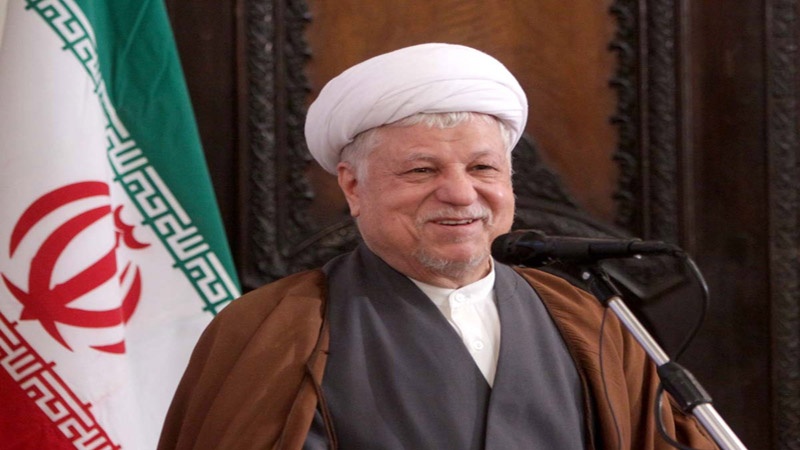
Hashemi Rafsanjani: Unique politician (3)
Jan 14, 2017 04:46 UTC
In this article, we talk about the life of Akbar Hashemi Rafsanjani after the end of the imposed war till his passing away.
On the occasion of the passing away of Akbar Hashemi Rafsanjani, we prepared a three-part program to briefly introduce Hashemi Rafsanjani. In the two previous programs we talked about his campaigns prior to the revolution and his role in coordinating and consolidating the revolutionary and religious forces and conveying Imam Khomeini's messages from Iraq as the leader of the movement. After the victory of the Islamic Revolution, Rafsanjani was still one of the main figures of the nascent system of the Islamic Republic of Iran. Under the leadership of Imam Khomeini (God bless his soul), Hashemi Rafsanjani had a determining role in managing the post-Revolution crises. Few popular revolutions have faced as many plots, conspiracies, hostilities and crises as the Islamic Revolution in Iran.
The activity of the counter-revolutionary groups and separatists supported by the then two blocs of the east and west, assassination of high-ranking personalities of the system, economic sanctions and finally imposing the 8-year war by the Great Satan through its puppet, Saddam, along the 1200 kilometer Iran-Iraq borders had created special conditions. Each of these crises was enough to overthrow any newfound system. The resistance and steadfastness of the Iranian people under the leadership of Imam Khomeini (God’s mercy upon him) and the presence of capable, astute, learned and revolutionary figures helped the nation overcome all these crises.
In the previous program, we said that one of the responsibilities assumed by Hashemi Rafsanjani in the post-Revolution era was deputy commander in chief of the armed forces and commander of the war. The Islamic Republic of Iran, through its courageous youths gained great victories in fighting the Baathist forces of Saddam who were equipped with stet-of-the-art weapons provided by the two eastern and western blocs.
The failure of the former Iraqi dictator Saddam was a drastic defeat for his supporters and a great victory for the Islamic Iran. Hence, in the last phase of the war (1987 to 1988), the US overtly entered war with Iran in the Persian Gulf. Meanwhile the Persian Gulf littoral states, especially the top hypocrite in the region Saudi Arabia, while increasing financial aids to Saddam, tried by soaring oil production and lowering oil price as the main source of Iran's foreign income to stymie Iran’s successive victories against Saddam.
In 1987, the war prospect became more complicated. Rafsanjani in an interview expressed: "What is important for the world is that Iraq's failure is not regarded as a military victory for the Islamic Republic of Iran.” In 1987, the UN Security Council issued resolution 598 and it was accepted conditionally by Iran. After the resolution's approval, the foreign ministry's diplomatic moves increased for considering Iran's conditions in implementing the resolution. The country's huge economic problems, the US’ direct support for Saddam, the western green light to the Baathist regime for using the advanced weapons and ammunitions and violation of international laws in committing war crimes such as the chemical gassing of Halabja convinced Imam Khomeini and the top officials that continuation of the war was not to Iran's benefit. Rafsanjani was one of the key figures to accept resolution 598 and end the 8-year imposed war. The 8-year sacred defense of the Iranian people in confronting the Baathist regime's aggression ended in the circumstances that a handful of the global bullying powers known as international community were forced to recognize Saddam as an aggressive regime and initiator of the internecine war.
The Islamic Republic of Iran ended the 8-year war and this came at a time when Saddam and his supporters were seeking to overthrow the nascent Islamic Republic system in a short time.
Reconstruction of the war's ruins was one of the most important priorities of the country after the end of the war. Mr. Rafsanjani played a special role in this arena. In view of Imam Khomeini's charismatic feature, the enemies of the Islamic Revolution thought that with his departure from the mortal world, the Islamic Revolution will come to end and the Islamic Republic would cease to exist. But to the chagrin of all enemies and ill-wishers the Assembly of Experts within less than 24 hours of the Imam’s passing away amazed the entire world by electing Ayatollah Khamenei as the Leader of the Islamic Revolution. Mr. Rafsanjani had an effective role in this election. After the appointing the best and most deserving person as the Leader of the Islamic Republic, the Iranian people elected Akbar Hashemi Rafsanjani as president for two terms from 1989 to 1997. This 8-year period became known as the reconstruction era. Growth in the GDP in this period reached 4.6%.
The 50% budget deficit in 1988 was turned into balance of budget and the government’s expenditures changed to the benefit of development expenses. The negative foreign trade balance became positive and foreign debts decreased. In addition to economic growth, per capita and social welfare increased and the key policy of welfare facilities and health care got a wide coverage in cities, villages and the deprived regions.
The construction work of over 60 dams started and the development of irrigation and drainage networks and other agricultural measures caused products such as wheat and crops to have nearly 6% annual growth. The nominal capacity of the country's power plants rose from minus 13,000 megawatts to plus 23,000 megawatts and production of different types of energy and steel, cement and petrochemicals got an average growth of up to 18.3%, 5.3% and 21 % respectively. After the end of his tenure, Hashemi Rafsanjani was elected as the chairman of the Expediency Council by Ayatollah Khamenei. The Expediency Council is an organ for resolving differences between the legislative and the Guardian Council of the Constitution and determining the country’s major laws. Rafsanjani assumed this responsibility till the end of his life. One of the measures taken by the Expediency Council during his chairmanship was the approval of the Islamic Republic of Iran’s perspective in the horizon of 1404 AH. The name of Akbar Hashemi Rafsanjani has intermingled with the contemporary era and especially Iran’s past half a century. His role has been historic and that is why his name has been placed in line with the other history-building names such as Amir Kabir.
During his campaigns and after the victory of the Islamic revolution, Rafsanjani put himself at the service of the movement till the victory and at the service of people and the country after the victory. It is believed that he never gave up moderation in all periods of his responsibilities. It was this characteristic and policy of Hashemi Rafsanjani that even his opponents and critics attached a special respect for him. With his death, Rafsanjani showed that he was a great politician. The participation of people and political figures from all walks of life in his funeral procession showed his influence in the hearts of Iranian people.
FK/RM/ME
Tags