Apparent withdrawal of U.S. refueling aircraft following heavy Iranian strikes
-
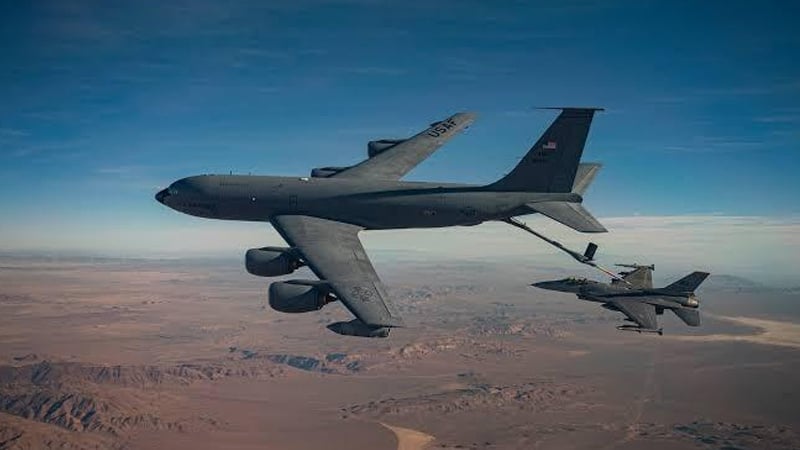
Apparent withdrawal of U.S. refueling aircraft following heavy Iranian strikes
Pars Today — U.S. aerial refueling aircraft have reportedly been relocated to the occupied Palestinian territories out of concern over possible Iranian attacks.
According to Pars Today, in a clear sign of the Pentagon’s retreat following Iran’s heavy strikes, American refueling aircraft were transferred because of fears of further Iranian attacks. Speaking to Defa Press, an informed military source referred to the severe blows inflicted by Iran’s armed forces on the aggressor U.S. enemy in recent days.
The source stated that the Iranian armed forces’ attack on Friday night against the U.S. bases of Al Udeid in Qatar, Al Kharj in Saudi Arabia, and Al Azraq in Jordan resulted in the destruction of, or damage to, a number of American refueling aircraft.
The report added that, following these developments, commanders of the terrorist U.S. military carried out a clear retreat by relocating several refueling aircraft that had escaped the attacks to Ben Gurion Airport in the occupied Palestinian territories. It further claimed that, after this redeployment, the concentration of tanker aircraft at the airport could become “a suitable target” for resistance forces.
According to the report, Iran has inflicted significant damage in recent days on U.S. personnel and military equipment stationed at American bases across West Asia, including in Kuwait, Qatar, Bahrain, and Jordan.
Western analysts, however, argue that the large-scale deployment of U.S. refueling aircraft to the occupied Palestinian territories stems from two main considerations: defensive deterrence against potential Iranian missile and drone attacks, and offensive preparations for possible larger-scale military operations.
In this context, the report states that, amid escalating military tensions between the United States and Iran, the Pentagon has concluded that American air bases in the region—particularly those in Qatar and Bahrain—are vulnerable to Iranian rocket, missile, and drone strikes. As a result, relocating refueling aircraft, which are costly, relatively immobile, and essential assets for any air operation, to a safer location is viewed as a necessary defensive measure.
According to reports, several KC-135 aerial refueling aircraft have been relocated from Al Udeid Air Base in Qatar—the largest U.S. military base in West Asia—to Ovda Air Base in the southern occupied Palestinian territories. Dozens of other tanker aircraft have reportedly been stationed at Ben Gurion International Airport and Ramon Airport.
Analysts believe that, compared with other countries in the region, the occupied Palestinian territories possess stronger air defenses and more effective protective systems, making them a suitable location for hosting this fleet.
An important point, according to the analysis, is that while the deployment of refueling aircraft reflects the close military alliance and coordination between the United States and Israel, it has also created challenges for Israel itself. The presence of dozens of large tanker aircraft at these airports—which are already coping with heavy summer passenger traffic and tourists—has reportedly led to widespread flight delays and cancellations, increasing political pressure on Prime Minister Benjamin Netanyahu’s government ahead of parliamentary elections.
Another factor that should not be overlooked is that the sharp increase in the number of U.S. refueling aircraft in the region—to around 60 planes—is viewed as going beyond a purely defensive measure. Aerial tankers are considered a key component of air-power projection: without them, fighter jets and bombers would be unable to carry out long-range and sustained missions.
With this fleet deployed in the occupied Palestinian territories, U.S. aircraft—and potentially Israeli aircraft as well—would be able to strike targets deep inside Iran with a much greater operational range, including nuclear facilities, power plants, underground installations, and air-defense systems. This move coincides with the White House’s consideration of broader military options and is seen as a sign of preparedness for a possible escalation of the conflict.
At the same time, the significant buildup of American refueling aircraft in the region is being interpreted as evidence of heightened hostility on the part of the United States and of its potential readiness for large-scale air operations. The deployment has prompted Iran to threaten military retaliation against U.S. facilities in the region.