Leader: Universities at the forefront
Jun 13, 2017 12:13 UTC
-
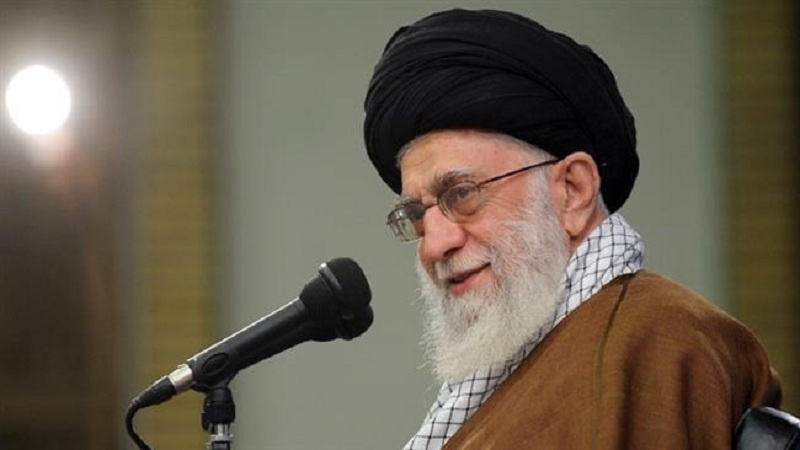
Leader of the Islamic Revolution addresses a group of university students and representatives of university student associations
The Leader stresses the need for realism and an active contribution by the revolutionary student associations.
Leader of the Islamic Revolution, Ayatollah Seyyed Ali Khamenei, on June 8 in a meeting with a group of university students and representatives of university student associations, across the nation, referred to the June 7 US-Saudi backed twin terrorist attacks in the fasting month of Ramadhan at the mausoleum of the Founder of the Islamic Republic, Imam Khomeini (God bless him), and at the parliament that led to the martyrdom of 17 citizens and injury to over fifty others, said: “The Iranian people are moving forward, and this fumbling with firecrackers will not affect their will-power. Everyone must realize that the terrorists are too small to dent the will of the Iranian people and the authorities. This also reveals that if the Islamic Republic had not resisted, at the centre of all this conspiracy, we would have had much more trouble of this sort in the country. God willing, they will bite the dust.”
A day earlier in his message to the nation, while offering condolences to the bereaved families of the twin terror attacks, Ayatollah Khamenei had said: “This is clear manifestation of the malicious enmity of mercenaries of (Global) Arrogance against the respectable Iranian nation and anything which concerns the (Islamic) Revolution and the Islamic establishment such as the mausoleum of the Esteemed Late Imam. Such crimes, which are indicative of the malice and at the same time the pettiness of the accomplices as well as its masterminds and perpetrators, are too trivial to leave any weakening impact upon the resolve of the Iranian nation. The definitive result of such (incidents) is nothing but more hatred against the US government and its regional agents such as the Saudi (regime). United and resolute, the Iranian nation will move forward God willing. I do honour the memory of the martyrs of the incident. I also extend (both) my congratulations and condolences to the families of the victims and pray to God Almighty for the recovery of those injured and hurt.
Stay with us for excerpts of the Leader’s June 8 speech to university students, who during the 3-hour long cordial meeting that culminated in the evening prayers and Iftar or fast breaking with him, briefed him on their activities and problems.
Ayatollah Khamenei, after listening to the opinions and viewpoints of university students about scientific and academic topics as well as the country’s political, cultural and economic topics, said university students were at the frontline of the Islamic Republic’s relentless campaign against the hegemonic order. He stressed the need for realism and an active contribution by the revolutionary student associations. He called for prevalence of the Islamic Revolution discourse at universities, saying: “The basic pillar of universities is science and the most important duty of a university body is the production of scholars, the production of science and the provision of proper direction to scholars and science.”
The Leader of the Islamic Revolution described the students’ remarks at the meeting as “very solemn, powerful, though-out, and high-level”. Calling on officials of the Ministry of Science, Research and Technology and Azad University to benefit from these firm opinions of students, he said: “The gist of what was said points to a rise in the reasoning level of university student bodies compared to the early years of the revolution and even previous years and this is exactly what we need.”
He elaborated on the phrase “hegemonic order”, saying: “The hegemonic order is global bipolarity one pole of which is occupied by the domineering and the other by the dominated.”
Pointing to the dichotomies created under the hegemonic order, he said: “The dichotomy of ‘progress and inertia,’ the dichotomy of ‘innovation and emulation,’ the dichotomy of ‘political independence and dependence,’ the dichotomy of ‘self-confidence and passivity’ are dualities that have emerged over the past two or three centuries. The domineering countries, using precise and scientific planning sought to make this situation permanent while imposing their ideology, culture and lifestyle.”
Ayatollah Khamenei said some countries found the opportunity for partial liberation, while “the Islamic Revolution confronted the hegemonic order and succeeded in fully pulling out Iran from this sinkhole.”
The Leader of the Islamic Revolution said: “Some may ask ‘How has the Islamic Republic fully broken free from the hegemonic order while some traces of the Western culture can still be witnessed in the society?”
Providing the answer himself, he remarked: The Islamic Republic not only broke free from all matters related to the hegemonic order, but it took charge of the country’s cultural, political and economic affairs, and managed them as per its own definitive laws. He added that the prime reason for efficiency of the Islamic Republic system is its survival and continuity, and if it was inefficient it would have been devoured by now.
Ayatollah Khamenei described as a very important development the clear and categorical declaration of the Islamic Republic’s positions against big powers and stressed: “This very issue is one of the signs of the efficiency of the system.” Stressing that faithful, revolutionary and devout youths must not forget the innumerable advances and achievements of the Islamic establishment, he added, “The Islamic Revolution succeeded in granting identity and purpose to the Iranian nation by standing up to the hegemonic order.”
He described “Iran and Iranian identity” as the reason for the failure of the hegemonic order to devour Iran, reiterating: “The identity of the Iranian nation and the plentiful causes of this nation naturally pitted the hegemonic order against the Islamic Revolution and an intensive campaign began between the Islamic system and the big powers that influence world movements.”
The Leader of the Islamic Revolution, pointing to the hegemonic powers’ attitudes towards other states on the basis of what they like to call “hard, semi-hard and soft” approaches towards other countries, hailed the universities and students as one of the main centres involved in this campaign. He said: “Over the past years, great effort was made to eliminate universities from the battle scene.”
Pointing to the domination of currents opposed and hostile to Islamic values over universities in the early years of the Islamic Revolution, he remarked: “In those years, universities had become battlegrounds and debate wars but eventually it was the Muslim and revolutionary students who prevailed at the universities.”
Ayatollah Khamenei referred to remarks and measures by some people inside the country in line with efforts by ill-wishers to “de-revolutionize” universities, saying: “Unfortunately, some people are helping the undermining of the devout spirits at universities.”
Addressing Islamic and revolutionary bodies at universities throughout the country, he said: “You should position yourselves at the frontline of the continuing campaign of the Islamic system against the hegemonic order, while closely studying the battle scenes of the campaign, since you should shoulder humanitarian, national, Islamic and international responsibility.”
The Leader of the Islamic Revolution urged university not to lose hope or become frustrated at any stage, by briefing them of the resolve of their parents and elders during the struggle era against the British-installed and US-backed Pahlavi regime, and during the 8-year war imposed by the US through Saddam of the repressive Ba’th minority regime. He said the students should bear in mind the unique achievements of the Islamic system and stressing that you should always feel proud because of the Islamic Revolution, he added: “Today, the policies of the big world powers have faced defeat in West Asia and they themselves admit that the reason for this failure is the Islamic Republic of Iran’s exertion of influence and might; is this a small achievement that the demand of the Revolution be realized but the demand of the US and its allies come to nothing?”
Ayatollah Khamenei said one of the designs of the enemy is to instill hopelessness into the minds of Iranian youths by floating such notions as “it is pointless,” “you cannot (do it),” “there is nothing you can do”. He deplored: “Unfortunately, some people inside the country are loudly parroting such remarks, in newspapers, and in cyberspace; the same mindset that the enemy wants to instill in the society.”
He told the students: “Your critical and questioning spirit should be sympathetic and solution-seeking regarding the problems of the country, but your confrontation against the enemy should be resolute, explicit and aggressive like their aggressive attitude.”
The Leader made it clear: “University student bodies are free in confrontation with the external enemy, and although some considerations concerning diplomatic issues rests with diplomats but students should loudly and clearly declare their stances regarding foreign issues.”
Highlighting the importance of moving forward in the scientific arena, he said: “Scientific progress has not yet materialized as befitting the Islamic system and the boundaries of science must be crossed because progress in science will result in progress in technology, and progress in technology will lead to influence in life and becoming the subject of attention in the world.”
He made it clear: “All university bodies, whether ministers, university presidents, managers, professors, curricula contents and education procedures must be placed within this framework.”
The Leader of the Islamic Revolution described the issue of independence as “very important”, assessing the issue of the UNESCO’s controversial 2030 educational agenda within this framework.
He was critical of the government’s laxity in this regard, saying: Some (officials) say they showed reservation, or they said that they did not agree with some parts: No, this is not the matter. Even if, we assume that there is no example of evident contradiction to Islam, which is not the case... I still say the country’s educational system should not be written outside the country. There are instances in the UN document of contravention of Islam, and the assumption of some people who imagine that we have not received correct reports on this issue is not a correct assumption.”
Ayatollah Khamenei reiterated, “This is Iran and the Islamic Republic and this nation is a big nation. Why should some people in UNESCO or the UN draft our education system for us?”
In his speech, the Leader made some recommendations to student associations, saying “Do not forget idealism.” He pointed out: “The achievement of a ‘just, free, advanced, faithful, devout, well-off, strong, resolute and independent society are ideals for the materialization of which, and the salvation of the country and the needy, life is worth sacrificing.”
He cited the Islamic Republic’s youthful and talented population, underground resources, strategic geographical location and progress in various fields as important realities of the country, saying, “Idealism means to look for and find the path faced with obstacles and problems and this undertaking requires intellectual debates.”
“Realism” was another of the Leader’s recommendations, and elaborating it he said: “By realism some people mean to merely tackle the obstacles. Realism actually means to see the positive realities.” In the next recommendation to the students, he asked them to play an “active role” in various bitter and sweet incidents and not act as a mere “bystanders.” He said: “Earnest and all-out efforts for the prevalence of the discourse of the Revolution in universities” was vital. He added: “Of course, this address is not particular to universities, rather every one of the cores of intellectual struggle throughout the country must independently work in this area.”
Ayatollah Khamenei further elaborated: “Sometimes, the central institutions of intellectuality, culture and politics suffer disruptions and shutdowns in which condition the officers of the Soft War must make decisions and take action in a fire-at-will forma through the realization of their responsibility.”
He urged the student associations to establish genuine relations with their audiences through round-table discussions, journals, multi-people debates and not sufficing to cyberspace and continuing asked them to properly clarify and not forget some keywords such as “independence,” “the role of the people in governance,” “freedom,” and “the rejection of the hegemonic order.”
Ayatollah Khamenei described ‘popular religious rule’ as one of the important keywords and pointing to the need for participation of all people in the elections and its result, he said: “Catastrophe is the day when people turn their backs on ballot boxes and the enemy too is after the day when 90 percent of the people do not go to the ballot boxes.”
Ayatollah Khamenei advised student associations on “religiosity and worship in deeds and words” and asked them to act according to religious principles and divine responsibility, coupled with courage in action.
He asked female students to follow the “issue of women in the West” in their research, and strongly denounced “corruption” and “injection of Western culture.” Pointing to the existence of some motives to “promote Western culture in the country,” he reiterated: “These motives will never succeed in diverting the Revolution from its course and submerge the country in Western culture.” He said Islam and the Revolution are the major obstacles to attempts at westernization of the country’s culture.
In conclusion, the Leader of the Islamic Revolution pointing to the persistence, resistance and progress of the Islamic Republic over the past 38 years, said the recent terrorist events in Tehran showed today’s generation what terror and terrorist movements are and how terrorists target innocent people.
He said: “Conditions much bigger and tougher than what occurred in Tehran today prevailed in the country for several years, but the Islamic Republic succeeded in continuing its push forward and the hegemonic order did not achieve success. The Leader of the Islamic Revolution added, “The events of today will have no impact upon the people’s will and everyone must know that the terrorists are too trivial to be able to have an effect on the will of the country’s nation and officials.”
He reiterated, “Of course, these incidents showed that had the Islamic Republic not stood up at that region which is the hub of these acts of sedition, we would so far have faced many predicaments in this area inside the country and these [terrorists] will God willing be uprooted.”
AS/EA
Tags