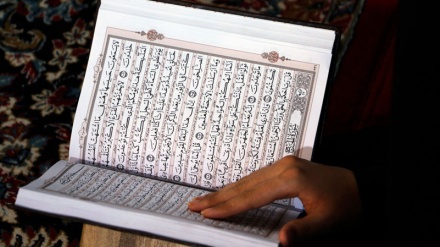
Qur’an in view of Qur’an
May 30, 2017 10:21 UTC
In this series of programs we try to study the status of Qur’an according to the ayahs of this Heavenly Scripture itself.
As a reminder, it was said in the previous episode that it is only the ones who have purified spirit that can get access to the realities and mysteries of the holy Qur’an. According to ayah 33 of surah Ahzab they are the Prophet and his Ahl al-Bayt or the infallible Imams of his progeny. Now the question might arise as, “If the Qur’an maintains such a lofty position so how can we get familiar with its concepts as ordinary people?”
First, being at a lofty position doesn’t mean that the way of understanding the Qur’an is closed to us. Rather it means that the surface of this heavenly Book is understandable for all as it is the book of life. While God says to the Prophet in surah Muzzammil, “Indeed soon We shall cast on you a weighty word”, He stresses in surah Maryam, “Indeed We have made it simple in your language so that you may give good news thereby to the Godwary and warn with it a disputatious lot.”
Moreover, the Qur’an itself shows the ways and stages of familiarity to us. The first step is to read the Qur’an. The interesting point is that the holy Qur’an doesn’t emphasize on quantity and says in surah Muzzammil, “So, recite as much of it as is feasible.”
The next step is to get familiar with the meaning of the words and deep concepts. After that we have to listen wholeheartedly to the ayahs and following the instructions of the ayahs. It is said in ayah 204 of surah A’araf, “When the Qur’an is recited listen to it and be silent maybe you will receive mercy.”
For sure, the process of understanding the Qur’an is not limited to the mentioned steps. These are just the preliminary steps.
The holy Qur’an says, “Indeed We have sent it down as an Arabic Qur’an so that you may apply reason.”
Surely, reasoning maintains a special position in the Islamic culture for we get acquainted with the secrets of creation and the goal of creation of human being via reasoning.
Another step for understanding the Qur’an is to think in the signs of God. The Great God says to His Prophet in surah Nahl, “We have sent down the reminder to you so that you may clarify for the people that which has been sent down to them, so that they may reflect.”
Beyond thinking is contemplation and pondering. The word “tadabbur” derives from “dobor” meaning back and behind. It means to think behind the matters; hence, foresightedness and insightfulness. This leads to grasping the things that are not attainable on the surface. In ayah 29 of surah Saad, God says, “It is a blessed Book that We have sent down to you so that they may contemplate its signs and that those who possess intellect may take admonition.”
In order to show that there is no contradiction in the Qur’an and all of its ayahs and surahs are consistent, God notes in ayah 82 of surah Nisa’, “Why don’t they contemplate the Qur’an? Had it been from someone other than Allah they would have surely found much discrepancy in it.”
In spite of the emphasis the holy Qur’an puts on contemplation of its ayahs, most of the people are content with superficial understanding of it. This heavenly Scripture lambastes these people in ayah 24 of surah Mohammad, “Why don’t they contemplate the Qur’an, or are there locks on the hearts?”
The final step in understanding the Qur’an is to put it into practice; i.e. to behave exactly according to the dos and don’ts of this Book. As a matter of fact, the Islamic Ummah is suffering from this great ill. In other words, the outward of the Qur’an is respected very much and it is published in beautiful shapes and prints but it is not practiced; whereas the holy Qur’an says in ayah 155 of surah An’am, “And this Book that We have sent down is a blessed one; so follow it and be Godwary so that you may receive mercy.”
What is worth pondering is that reception of the divine mercy requires behaving according to the teachings of the Qur’an. In ayah 55 of surah Zumar, God warns against abandoning the holy Qur’an in practice, saying, “And follow the best of what has been sent down to you from your Lord, before the punishment overtakes you suddenly while you are unaware.”
RM/EA
Tags