An unholy alliance: Trump, Israel and Saudi Arabia
Jun 13, 2017 12:09 UTC
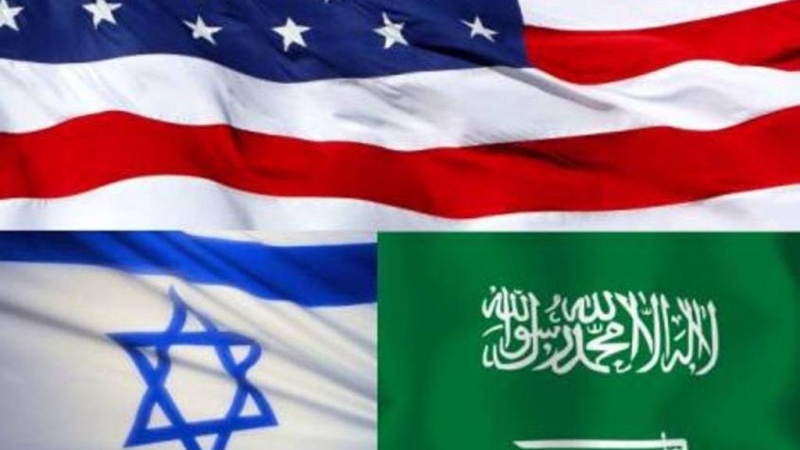
The US has ganged up with two spurious entities, Saudi Arabia and the Zionist regime, to try to threaten the Islamic Republic of Iran in order to disturb peace in the region.
Malaysian analyst, Chandra Muzaffar has written an interesting analysis titled “An Unholy Alliance: Trump, Israel and Saudi Arabia – Targeting Iran.
In the wake of President Donald Trump’s visit to West Asia, is there even a faint glimmer of hope for peace in the most conflict-ridden region of the world? Or, has his visit to Saudi Arabia and Israel from the 20th to the 23rd of May 2017 only strained the region’s undercurrents of friction and tension? Some reflections on areas of conflict in West Asia may throw a bit of light.
On the Israel-Palestine conflict — one of the world’s longest conflicts — Trump adopted an extremely biased position while mouthing platitudes about Israelis and Palestinians living side by side in harmony. He was effusive in his sympathies for Israelis faced by so-called “threats” from Palestinians and other Arabs and the alleged “suffering” they have to bear, but he was totally silent about the usurpation of Palestinian and Arab lands, their mass expulsion and their extermination through acts of genocide and ethnic cleansing pursued by the Zionist regime. He appeared oblivious to the humiliation and oppression that Palestinians have to undergo on a daily basis at Israeli checkpoints in the West Bank or to the incarceration of about 2 million Palestinians in the world’s largest open-air prison called Gaza.
From Trump’s words and gestures in Israel it is obvious that he is working towards a supposed solution that will see Palestinians subsisting in Bantustans with the whole of Bayt al-Moqaddas (Jerusalem) firmly in Israel’s control, reinforced by settlement of Jews from other parts of the world in the West Bank exercising jurisdiction over its water resources. Palestinian agents of Israel and the US will be enticed into accepting this arrangement which in turn will be endorsed by a number of other Arab and Muslim governments keen on pleasing Washington for their own interests.
Needless to say, the Bantustan solution will further incense Arabs and Muslims everywhere. Given the current pattern of terrorism, the effects will be felt far and wide with Western cities as special targets.
In addressing other conflicts in West Asia, Trump proved to be equally obtuse. For him the whole region is confronted by the challenge of terrorism which has to be resolved by Muslims themselves. If Trump and his advisers had looked at the present phase of terrorism and how it had developed, they would have realized that it is linked directly to the Anglo-American invasion and occupation of Iraq in 2003. It is because of that act of aggression and subsequent political events that al-Qaeda established a foothold in Iraq and launched terrorist attacks against the Shia-Muslim government in Baghdad. In other words, the US intervention had given rise for the first time to organised terrorism on Iraqi soil. It is significant that al-Qaeda terrorists in Iraq were funded, equipped and trained by groups from Saudi Arabia, Qatar and Turkey who for different reasons were opposed to the new rulers in Baghdad.
As a faction of the Iraqi al-Qaeda moved to Syria, encouraged by groups in Saudi Arabia to fight President Bashar Assad, the US elite saw it as an opportunity to advance its own longstanding agenda of ousting Bashar from power. Bashar is not only an adversary of Israel which occupies a large chunk of Syria’s strategic Golan Heights, he is also a close ally of both Iran and Lebanon’s Hezbollah, which are both deeply committed to resisting US-Israeli hegemony over West Asia. This is why American and Israeli intelligence, together with the intelligence services of Britain and France, worked hand-in-glove with their counterparts in the region to recruit tens of thousands of people from all over the world to engage in a supposed ‘Jihad” against the Bashar Assad government. These are the recruits who became part of Daesh, the Jabhat Fateh ash-Sham and other outfits which until recently controlled parts of Syria. Syria is another tragic example of an attempt to affect regime change which in turn has generated terrorism and, in the course of it, brought death and sorrow to hundreds of thousands of people.
There is a third example of the intimate nexus between regime change and terrorism. In October 2011, the US and other NATO members provided aerial cover while ground forces including some terrorist groups organised the overthrow of Libyan leader Muammar Qadhafi who was subsequently tortured and murdered. Libya has since plunged into chaos. There is no effective functioning government. As a result of the mayhem, terrorist cells have proliferated. Libya has also become a conduit for illegal migrants from North Africa and other parts of Africa trying desperately to escape the turmoil and find sanctuary in Europe. There are also thousands of migrants from Iraq, Syria and other countries who because of the mess their societies are in, cross the Mediterranean to Europe in search of shelter and stability. This goes to show that in at least three countries, Libya, Iraq and Syria, regime change is also directly and indirectly responsible for the migration crisis.
That neither migration nor terrorism can be separated from regime change is a truism which is not part of Trump’s radar screen. None of the Arab or Muslim leaders who gathered in Riyadh recently to listen to Trump had the guts to tell him that the US pursuit of regime change, that its quest for hegemony has a lot to do with the upheavals that have overwhelmed some of their societies. The US should cease to control and dominate other nations through regime change and invasion and occupation if it wants to bring terrorism to an end.
But it is not just the US that seeks hegemony through regime change. Israel is also an aggressive advocate of regime change. An Israeli Minister had called recently for the assassination of President Bashar Assad. On regime change as on a number of other issues there is tremendous convergence of goals and perspectives between the US and Israel. Both for instance regard Hamas, the Palestinian resistance movement, which commands the support of a huge percentage of Palestinians, and Lebanon’s Hezbollah, which is committed to the liberation of Arab lands from Israel and Zionism as terrorist organisations. Trump reinforced that view during his recent visit to West Asia.
The Trump visit also demonstrated US-Israeli convergence against the Islamic Republic of Iran. Both allege the Islamic Republic of Iran to be a sponsor of terrorism. It is, however, important to note that supporting a liberation movement such as Lebanon’s Hezbollah is not the same as the colluding of the West and its Arab client states with Daesh or al-Qaeda. It is important to note that in the last so many years not a single Iranian has been involved in any of the terrorist attacks in West Asia and North Africa, or in Europe or in North America, or for that matter in other parts of the world. In fact, the leading terrorist groups such as Daesh and al-Qaeda are anti-Iran and anti-Shi’a. The irony is that in Iraq, popular Shi’a Muslim militias are cooperating with the US in the bid to defeat Daesh terrorists in Mosul. It is obvious from all this that the attempt by Trump and Israel to smear Iran with the terrorist brush does not stand up to scrutiny.
Neither does their attempt to concoct fear among Iran’s neighbours about its civilian nuclear programme.
Besides, the agreement that Iran entered with the five permanent members of the UN Security Council and Germany (P5+1 group) in 2015 called the Joint Comprehensive Plan of Action (JCPOA) to assert the peaceful nature of its civilian nuclear programme, Iran’s Leader of the Islamic Revolution, Ayatollah Seyyed Ali Khamenei, has openly proclaimed on a number of occasions that manufacturing nuclear weapons is haram from an Islamic perspective.
The question of Iran’s civilian nuclear programme exposes Israel’s hypocrisy. Why is it so perturbed by Iran’s civilian nuclear programme whose peaceful intent has been verified over and over again by UN Inspectors when Israel is the only state in the region that has a nuclear weapons arsenal of perhaps at least 200 warheads? Israel’s obsession with Iran’s civilian nuclear programme stems from its desire to maintain a nuclear weapons monopoly in West Asia.
Trump also revealed in the course of his visit that US-Israeli convergence was enhanced by the similarities they shared with Saudi Arabia. On Iran’s civilian nuclear programme all three are on the same page. Most of all they are all totally united in their misconstrued view that the greatest threat to peace and stability in the region is Iran. Iran is their mortal foe. The big conference in Riyadh that brought together heads of state or government or their representatives from some 40 countries was in a sense to convince all of them that Iran is also their greatest enemy.
Saudi antipathy towards Iran has a certain history behind it. It became pronounced after the Islamic Revolution in Iran of 1979 which overthrew a feudal monarch. Before that, Saudi Rulers and the Shah enjoyed good relations partly because both paid obeisance to the same overlord, namely, the US.
Revolutionary Iran under Imam Khomeini was clearly opposed to US and Western imperialism and saw Islam as a religion of justice and human dignity that championed the oppressed. Faced with a revolutionary interpretation of Islam, the Saudi Rulers were concerned with preserving their feudal power and perpetuating their ties with the US whom they saw as the protector of their throne. Besides, they leaned towards Wahhabism – a cult that antagonistic towards Shi’a Muslims. This explains why the Saudis got together with the Persian Gulf Sheikhdoms and had goaded Saddam – of Iraq’s repressive Ba’th minority regime – to go to war against Iran in 1980.
After the pain of the war receded into the background, relations between Saudi Arabia and Iran improved somewhat. However things began to change when the Shi’a Muslim majority in Iraq came to power through the ballot-box in December 2005, following the overthrow of Saddam. The Saudis viewed Shi’a Muslim ascendancy in Iraq as benefitting Iran.
Then in 2006, the Hezbollah thwarted the Israeli attempt to gain control over Lebanon which boosted Hezbollah’s standing among the entire Arab population, much to the dismay of the Saudi elite. When the Arab uprisings began in 2010, and spread to places like Bahrain which is over 70% Shi’a Muslim, the Saudi elite became even more determined to maintain its grip upon the region and moved quickly to crush the popular movement for human rights.
In Yemen, the Saudi installed government is facing a popular challenge, a significant segment of which comes from Ansarallah, who happen to be Shi’a Muslims. The Saudi elite is involved in extensive military operations to shore up the position of its stooge, Mansur Hadi, and in the course of it has committed some serious human rights violations which have tarnished its image. Its inability to oust President Bashar of Syria after six years has also frustrated the Saudi elite.
The frustrations of the Saudi elite were matched by dismay of Israel’s Benjamin Netanyahu, over the setbacks suffered by the Takfiri terrorist outfits in the region. This is why both the Saudi king, Salman, and Netanyahu welcomed the arrival of Trump in Riyadh and Tel Aviv with such joy.
It is in this context that one should view Trump’s arms deal with Saudi Arabia worth 350 billion dollars over 10 years, with nearly 110 billion to take effect immediately. US military assistance to Israel also runs into billions and is a constant feature of their bilateral relations. The common aim of both military aid programmes is crystal-clear.
If the most concrete achievement of Trump’s visit to West Asia was to forge a US-Israel-Saudi alliance against Iran, it can only be described as a bane upon peace. Given the friction and tension that already exists, it could lead to open intra-regional conflict. And if the grand sell-out of Palestinian rights occurs at the same time with all its dire consequences, all hell will break loose.
This is why global citizenry should be focused on what is unfolding in West Asia – and act now.
AS/EA
Tags