Why Washington’s Arab-NATO doomed to failure from the start
May 01, 2019 04:34 UTC
Even after hitting a number of stumbling blocks on the road to the establishment of a military bloc of Arab states – the Middle East Strategic Alliance, MESA, Washington would still carry on its attempts to create a unified armed opposition to its primary opponent in West Asia.
Martin Berger, a freelance journalist and geopolitical analyst, has an analysis on impossibility of Washington’s Arab-NATO in an article titled Why Washington’s Arab-NATO doomed to failure from the start.
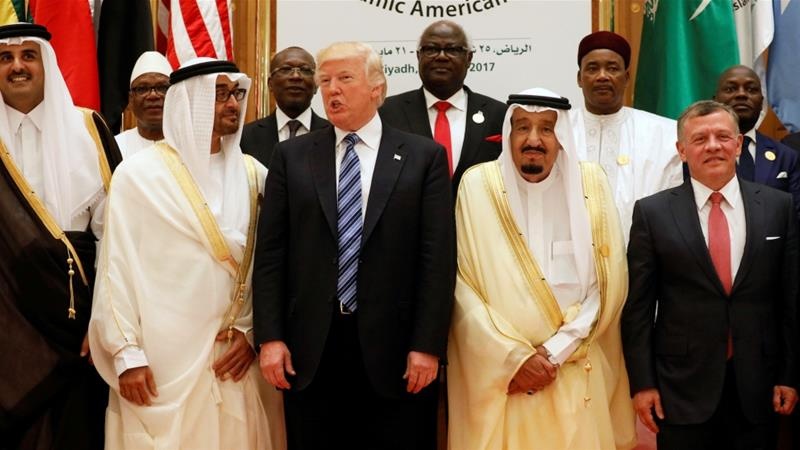
In late February, the White House summoned high-profile representatives to Washington to hold discussions about the future of the so-called “Arab NATO.” Among those who attended the meeting were representatives of the six Persian Gulf countries together with those from Jordan and Egypt. Earlier this year, prior to the above mentioned meeting, US Secretary of State Mike Pompeo toured those eight countries to promote the notion that all of Washington’s allies must join the so-called unified anti-Iran opposition.
According to Pompeo, on top of being a platform for consultations, MESA will establish a framework for joint military exercises and alleged counter-terrorist operations. Ideally, from the point of view of the US, the establishment of the so-called Arab-NATO will create preconditions for the signing of the common security pact and the consequent formation of a unified military force, which may allow the Pentagon to reduce its military presence in West Asia by handing over its gendarme functions to Arab Allies.
The sitting US president has made it clear that in his opinion the United States has been footing the bill for the alleged security of its allies in West Asia for too long, and now he’s inclined to force them into defending themselves. Unsurprisingly, Trump’s intentions are in line with the updated US National Security Strategy, which postulates the need to expand regional cooperation by deepening interactions between all of the satellite states that Washington still has for its own vested interest.
It’s clear that US policymakers remain concerned that as Washington carries on reducing its presence in the region, the void that will be created by its withdrawal may be filled by powerful and influential Islamic Iran, as it was revealed by the spokesman for the US National Security Council last October.
Even though the White House and a number of Persian Gulf states have been working in close cooperation for years in a bid to some refer to as containment of growing Iran’s regional influence, it would be impossible to describe this cooperation as something akin to a full-fledged coalition, as there’s no unified strategy that all the players involved try to implement. To make the matters worse, there’s still more questions about the possible layout of MESA than answers, and therefore the future of this initiative looks dim.
Although Washington would really like its allies subjected to a single line of command, these day they remain nothing more than irreconcilable rivals that are fighting bitterly for leading positions in the region. The main obstacles to the creation of such an alliance remains the bitter feud between Saudi Arabia, the United Arab Emirates, Bahrain and Egypt on the one hand and Qatar on the other. The latter has been subjected to a complete diplomatic isolation in the Persian Gulf for more than a year, which resulted in its recent decision to withdraw from OPEC, the organization badly influenced by the oil-rich Saudi Arabia.
It’s curious that Qatari officials have no illusions about the prospects of a common military alliance in the region. Speaking at the 55th Munich Security Conference, Qatar’s Foreign Minister Mohamed bin Abdelrahman ale-Thani noted that Washington is making every step to establish a joint military alliance in the Persian Gulf, while paying no heed to the fact that future members of this alliance are at war with each other.
However, Saudi Arabia and Qatar are not the only states that cannot find common grounds to proceed with their diplomatic relations. In particular, Egypt announced that it would have no intension of joining MESA while Doha carries on sponsoring the Muslim Brotherhood, yet the US pays no heed to this fact.
To make the matters worse, Cairo is fully aware of the threats that US Secretary of State, Mike Pompeo voiced in the US Congress, about the impending repercussions that Egypt must face should it decide to buy Russia’s SU-35 fighters. Therefore, it is hardly surprising that upon the completion of Donald Trump’s recent visit to Cairo, Egypt officially informed Washington of its refusal to participate in the future military alliance.
Oman’s potential membership in the perceived “Arab NATO” looks unrealistic at best, as this country will under no circumstances choose to sacrifice its traditional friendship for a chance to take a shot at Iran.
To make the matters worse, the unresolved murder case of Saudi journalist Jamal Khashoggi further complicates the already troubled negotiation process for Washington, since the CIA has recently concluded that Saudi Crown Prince Mohammed bin Salman personally ordered the killing of this high-profile journalist.
That is why, with no other options left on the table, Washington made the decision to abandon the idea of forming a full-fledged military-political bloc. On top of the long list of obstacles presented above, it’s also unlikely that the Congress will be willing to ratify the treaty should it be signed one day. With US lawmakers getting increasingly frustrated with Riyadh and its shady dealings, the Capitol hill is most likely to block any initiatives that will bring the US closer to Saudi Arabia or empower the latter.
Therefore, Washington decided to take the long road towards the formation of the Arab-NATO through signing bilateral memorandums or joint declarations. But should it succeed on this path its brainchild will still be doomed to fail due to the fact that no alliance can exist as an informal association without any binding principles or integration steps. It’s safe to say that at this point the US tries to throw every idea it has against the wall to see what sticks, which is the recipe for disaster in any international endeavor.
The US State Department tries to tweak its wording by making MESA more about counter-terrorism, cybersecurity and conflict resolution and less about countering Iran. However, the attempt to present the old thing in the new wrapping doesn’t bring much success to the US Deputy Assistant Secretary Of State for Persian Gulf affairs, Tim Lenderking. And it’ hardly surprising, as Washington’s anti-Iranian hostile attitude is only shared by Saudi Arabia, the United Arab Emirates and Bahrain. All of the rest are not interested in confronting the Islamic Republic directly in any form or fashion. But then again, is Washington going to use MESA to oppose Daesh in Syria and in Iraq, that it has been supporting behind-the-scenes for years?
It remains unclear how the usurper regime of Israel will respond to the emergence of a new military alliance in West Asia. On the one hand, the alliance is beneficial to Tel Aviv in terms of its deep hostility toward Iran. But on the other hand, the perceived Arab “alliance” may, on the contrary, become a serious threat to Israel due to the mounting anti-Israeli sentiments in the region.
In the past, the Zionist regime had to face multiple Arab opponents in the same conflict more than on one occasion. And Trump hasn’t made it any easier for Tel-Aviv by announcing his illegal decisions about the transfer of the capital of the usurper regime from Tel Aviv to al-Quds and the transfer of the Syrian Golan Heights under Israeli jurisdiction in direct violation of a number of UN Resolutions. By the way, the plan of bringing the Arab-NATO to life is impossible for Washington to pull off and “a failure from the start”.
EA/SS
Tags