The Holy Defense: 8 years of US-backed war on Iran
Sep 27, 2016 05:48 UTC
The Islamic Republic of Iran is currently marking the 36th anniversary of the start of the war the US imposed through its agent Saddam of the repressive Ba’th minority regime of Baghdad.
For Iranians unprovoked aggression is reminder of the 8-year long Holy Defence during which by relying on God Almighty and on their own resources, they managed to blunt the aggression of an armed-to-the-teeth war machine that was supported by both the Capitalist West and the Communist East, in addition to scores of billions of dollars provided by reactionary Arab regimes, particularly Saudi Arabia. Conscientious American writer Yuram Abdullah Weiler has written a feature titled “The Holy Defense: 8 years of US-backed war on Iran” – a blessing in disguise that inspired Islamic Iran to build up a powerful military and defense system.
September 22 marked the anniversary of the start of the bloody, 8-year-long war on Iran, initiated by Iraq but supported by the US and the western powers. Known in Iran as “Defa-e Moqaddas” or Holy Defence, the war, which was the longest conventional conflict in the 20th century, claimed hundreds of thousands of lives, and left an entire generation with vivid firsthand familiarity with martyrdom in Islam.
As a result of the US-supported war, many Iranian youths who survived suffered permanent psychological damage due to due to waves of explosions on the battlefield, and especially because of use of internationally banned chemical weapons by Saddam, while the UN and the world powers choose to turn a blind eye to these war crimes. Saddam had initiated aggressions against Iran as early as May 1979, only three months after the victory of the Islamic Revolution, with the bombing of Mehran and other Iranian villages on the border with Iraq. It must also be kept in mind that Saddam was obsessed with maintaining his demagoguery and would lash out with grotesque brutality at any hint of disloyalty to himself or his regime.
Of course, any suggestion of support for the fledgling Islamic Republic fell into this category. The degree of this megalomaniac’s fiendish cruelty can be seen from his treatment of Ayatollah Seyyed Mohammad Baqr as-Sadr, the preeminent Shi’a Muslim scholar, philosopher and founder of the Iraqi Da’wa party, whose only crime was to voice support for the Islamic Revolution in Iran and envisioning a democratic future for Iraq. After placing him under house arrest in June 1979, Saddam eventually executed the respected scholar but only after forcing him to witness the murder of his sister, Amina Sadr bint al-Huda. Saddam also placed the revered Grand Ayatollah Seyyed Abu’l-Qasim Kho’i under house arrest in Najaf.
The more vicious Saddam became in his repression to assure his own security and the longevity of his regime, the more suspicious he became of everyone. Unchallenged loyalty and obedience to him was the ultimate goal, as Saddam sought to unify Iraq in “a personality cult of awesome proportions,” and towards achieving this, he began massive deportations of those Shi’a Muslims suspected of being of Iranian origin, or to have connections with Iran, and hence seen as “threats” to the regime.
Many other Shi’a Muslims were either imprisoned or fled to Iran as Saddam tried in vain to establish alternative leaders dependent on the regime. However, failing to establish an obedient patronage network among the remaining Iraqi Shi’a Muslim leaders, Saddam, with his mentally warped perspective, felt he was left with no alternative but to launch an offensive against the source of these “threats,” namely Iran, which he did at precisely noon on September 22, 1980.
By ordering his technically superior armies to invade the Islamic Republic, whose own military forces were already feeling the impact of western sanctions and the resulting scarcity of spare parts and supplies, Saddam became a modern embodiment of the tyrannical Yazid ibn Mu’awiya, who ordered the murder of Imam Husain (AS), the grandson of Prophet Mohammad (blessings of God upon him and his progeny).
Iranian suspicions that Saddam received a “green light” from Washington were confirmed when investigative journalist Robert Perry revealed a confidential memo written by former US secretary of state Alexander Haig referring to an April 1981 meeting with Saudi Heir Apparent Fahd bin Abdul-Aziz. The memo indicated that Haig had learned from Fahd that US president Jimmy Carter had given Saddam permission for the invasion of Iran. Despite Saddam’s record of bloodthirsty brutality, even against his own supporters, the US took the Iraqi regime off its list of state sponsors of terrorism in February 1982 enabling the regime to legally purchase US weaponry.
The move by Washington removed the veil of neutrality and marked the start of open US support for the Iraqi dictator. Nevertheless, three months later and with extreme sacrifice on the part of Iranians, Saddam’s troops had been forced out of those parts of Iran where they had made small territorial gains in the early years of the war. Khorramshahr was liberated on May 24, 1982 and some 19,000 demoralized Iraqi troops were captured.
At this point, the leaders of the Islamic Republic of Iran decided it was time to put an end to Saddam’s regime and liberate the oppressed people of Iraq from this ruthless tyrant. As a direct result and strangely enough in consideration of events that have occurred since, the US came out openly and decisively on the side of the repressive Ba’th minority regime.
Reasons for this are unclear, but most likely it was a combination of factors, which included Washington’s fear of Iranian control of Iraqi oil fields. In any event, the decision to aid Iraq was made in June 1982 by US president Reagan, who tasked CIA director William Casey with ensuring that “Iraq had sufficient military weapons, ammunition and vehicles to avoid losing the war.”
By the end of 1983, the US was sharing satellite imagery of Iranian troop movements with Saddam. In December of that year, then US president Ronald Reagan even sent Donald Rumsfeld, later secretary of defense under Bush Junior, to assure the Iraqi regime of support by Washington, which “would regard any major reversal of Iraq’s fortune as a strategic defeat for the west.” While the US continued to insist it was neutral, former secretary of state George Shultz wrote that “our support for Iraq increased in rough proportion to Iran’s military success, plain and simple.”
Shultz, incidentally, was president of Bechtel Corporation, the main contractor of one of Iraq’s petrochemical plants capable of producing Saddam’s chemical weapons. Shultz also lobbied for the delivery of Bell helicopters to Iraq for “crop spraying.” These were likely used by Saddam in the 1988 chemical attack on the Kurdish village of Halabja, in which 5,000 people were killed.
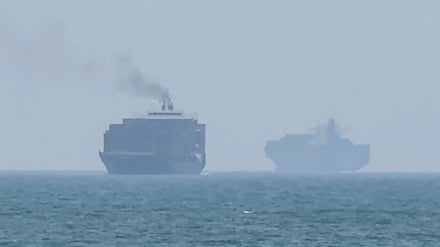
With his forces routed from Khuzestan, Saddam began the so-called tanker war by mounting an attack on Iranian tankers and the strategic Kharg Island oil terminal. A series of Iraqi assaults and Iranian responses escalated to the point that in 1987, Kuwait, a major supporter of Saddam’s regime, requested protection for its tankers. Washington offered Kuwait the use of the American flag on its tankers, and in so doing, made a commitment to protect Kuwaiti oil shipments, which led to direct clashes between US warships and the Iranian Navy in the Persian Gulf.
These clashes, which were tantamount to an undeclared US war against Iran, resulted in tragedy when on July 3, 1988, the hothead US naval commander of the Aegis missile cruiser USS Vincennes fired two heat-seeking missiles at Iran Air Flight 655, blasting the civilian aircraft out of the sky and killing all 290 passengers and crew on board, including 66 children. Concerning this brazen attack, the then Majlis Speaker Hojjat al-Islam Akbar Hashemi Rafsanjani, who was president of Iran from 1989 to 1997, later wrote, “I was certain Iran could not prevail in a war against both Iraq and the United States, while they have no shame to use chemical weapons and attack civilian airplanes.”
Rafsanjani was correct. In a marginal note to his secretary of defense, Reagan wrote, “An Iranian victory is unacceptable.” To that end, the US not only supplied Iraq with intelligence, weaponry and strategic technical advice, but also 14 separate biological warfare agents and cyanide, as well as sarin and tabun nerve agents, whose use, according to senior defense intelligence officer Colonel W. Patrick Lang, “was not a matter of deep strategic concern” to Reagan and his staff.
Apparently, Lang was correct. For on the very day that Rumsfeld again met with Iraqi foreign minister Tariq Aziz on March 24, 1984, UN investigators had concluded that Iraq had used mustard gas and tabun nerve gas against Iranians. Nevertheless, US officials were pleased with Washington-Baghdad relations and recommended the resumption of full diplomatic relations, which occurred that November. The Pentagon did not appear to care, either, since gas “was just another way of killing people.”
Saddam’s Iraqi regime emerged from the 8-year-long war decimated militarily and financially with some $40 billion in debt. In less than three years, Saddam’s forces would be driven out of Kuwait by his former US benefactor; in fifteen years, Saddam would be toppled by an American invasion. The Islamic Republic of Iran, on the other hand, emerged a strong, united and independent country with demonstrated defense capabilities, and today is stronger than ever.
AS/SS
Tags