Burma’s Rohingya crisis and human rights imperialism
Dec 04, 2017 05:02 UTC
The visit by Pope Francis to Burma (Myanmar) has brought into focus the tragedy confronting the country’s Muslim Rohingya minority who have been forced to flee in droves to neighbouring countries.
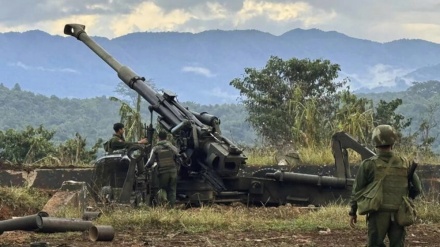
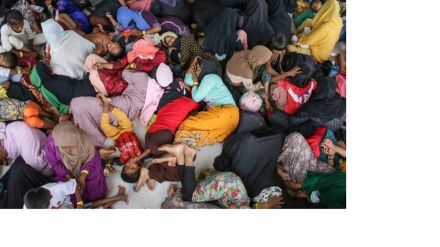
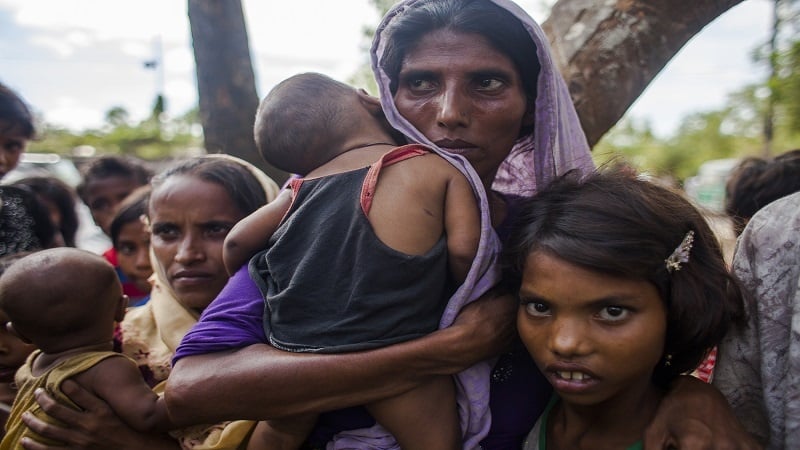
At least 620,000 men, women and children have been driven out Burma in recent months by the Burmese army and associated gangs of thugs following minor attacks in August allegedly by the Arakan Rohinya Salvation Army. The refugees live in squalid, overcrowded camps in Bangladesh and India, both of which have made clear they are not welcome.
The international response to this massive humanitarian crisis is saturated with hypocrisy and cynicism, above all by the major imperialist powers—the United States, the European Union and their allies—that exploit “human rights” to further their geo-political interests, including through regime change and wars.
For decades, following its brutal crackdown on mass protests and strikes in 1988, the US and the EU treated the Burmese military regime as a pariah, denouncing its abuse of democratic rights and imposing harsh sanctions.
Aung San Suu Kyi, leader of the opposition National League for Democracy, NLD, was universally promoted as a ‘democracy icon’ and awarded the Nobel Peace Prize in 1991. Her house arrest by the junta, despite her role in derailing the 1988 protests and keeping the military in power, allowed the establishment media to bestow martyr status on her.
Neither the condemnations of the military nor the accolades for Suu Kyi was based on any genuine concern for the democratic rights or suffering of the Burmese people. Washington’s chief grievance with the Burmese army was that it was too closely aligned with China. Suu Kyi represented that faction of the Burmese elite oriented to the West and the opening of the country to foreign investors.
All that changed when the military regime signalled its willingness to distance itself from China and to engineer a political role for Suu Kyi and her NLD. Virtually overnight, the designation of Burma was changed from “rogue state” to “developing democracy,” US and European officials made a beeline for the country, US President Obama visited in 2012 and sanctions were dropped step by step.
When the NLD won the 2016 election and Suu Kyi was installed as de facto head of government, it was hailed as the flowering of democracy. Barely noted was the fact that the military remained in charge of the key security ministries and, through a bloc of unelected parliamentary seats, retained a veto over any change to the constitution it had drawn up.
This sham has now being exposed by the military’s atrocities against the Rohingya in Burma’s western state of Rakhine.
The vilification of Muslim Rohingya in predominantly Buddhist Burma has deep historic roots in the policies of divide-and-rule fostered by British colonial rule over India which included Burma until 1937. Unlike other ethnic minorities, the Burmese elite regarded the Rohingya as “illegal immigrants” or “Bengalis” brought in by the British, even if they had lived for generations within what became independent Burma in 1948.
The military junta that seized power in 1962 whipped up anti-Muslim and anti-Rohingya chauvinism to divide working people and buttress its hold on power. In 1982, it stripped the Rohingya of citizenship rights by not including them as one of the country’s recognised ethnic minorities. Suu Kyi and the NLD are no less deeply imbued with such xenophobia and are opposed to the granting of basic democratic rights to the Rohingya.
With Suu Kyi and her government acting as its facilitators and defenders, the army is carrying out a purge of Muslim Rohingyas on a scale that a decade ago would have produced an international howl of condemnation and demands for tougher sanctions, if not military intervention. The international reaction today is decidedly muted and the calls for action symbolic.
In response to the growing international outrage over the military’s rampage, the US has followed the lead of UN officials and criticised the army’s actions as “ethnic cleansing.” US Secretary of State Rex Tillerson, who visited Burma earlier this month, declared that he was “deeply concerned by credible reports of widespread atrocities committed by Myanmar’s security forces and vigilantes.”
Asked if the US would reimpose sanctions on Burma, Tillerson declared that it was “not something that I’d think advisable at this time.” He added: “We want to see Myanmar succeed. You can’t just impose sanctions and say therefore the crisis is over.” Tillerson and the Trump administration have studiously avoided any criticism over Suu Kyi’s role in defending the military’s actions.
Various individuals, media and human rights organisations who helped inflate Suu Kyi’s status as a “democracy icon,” have begun to cautiously criticise her, even suggesting that her Nobel Peace Prize be withdrawn. Whether Pope Francis makes any criticism at all of the army or Suu Kyi, or even uses the term “Rohingya,” is the subject of media. He met with Burmese military head Senior General Min Aung Hlang without issuing so much as a murmur of criticism.
Pope Francis, on a visit to Myanmar, has called for “justice” and respect for the human rights of ethnic groups, a thinly-veiled reference to the minority Muslim Rohingya who have been facing state-sponsored violence in the Southeast Asian country. He also called for “respect for each ethnic group and its identity.” General Min Aung Hlang later said that he had told the pontiff “there’s no religious discrimination in Myanmar,” blatantly denying the heavily-documented cases of horrific violence against the Muslim Rohingya minority in the Southeast Asian country. The general is in charge of the country’s internationally-condemned military crackdown on ethnic Muslims in Myanmar’s western Rakhine State. The United Nations (UN) has described that campaign as similar to “textbook ethnic cleansing.”
The pontiff, who has in the past used the term “Rohingya brothers and sisters,” was reportedly advised not to use the term “Rohingya” — which means a resident of Rakhine — during his stay in Myanmar. That advice was reportedly given by Myanmar’s sole Catholic cardinal so as not to invoke the rage of the country’s officials and Buddhist establishment against the minority Catholics. In his speech, Pope Francis avoided the term “Rohingya” and did not even directly speak about the persecution of the Muslims in Myanmar. Myanmar’s officials use the term “Bengali” for the Rohingya. The group, which has lived in Myanmar for decades, has been denied citizenship in both Myanmar and neighboring Bangladesh.
All this could rapidly change and Burma could return to the status of “rogue state” if Washington judges that it is again getting too close to China. Commander in chief General Hlang has just completed a six-day visit to China where he met with Chinese President Xi Jinping. Suu Kyi is about to head off to Beijing to attend a conference of world political parties and “pay a working visit to strengthen bilateral relations.”
The sordid manoeuvres of the major powers and their utter indifference to the suffering of Burma’s Rohingya minority are another lesson in geo-politics. Behind the banner of “human rights” always lie the predatory interests of the imperialist powers which they will ruthlessly prosecute regardless of the terrible consequences for the world nations.
That was from a disclosing article by freelance writer and political observer Peter Symonds.
EA/ME
Tags