ASEAN turns blind eyes to Rohingya crisis
Apr 25, 2018 05:49 UTC
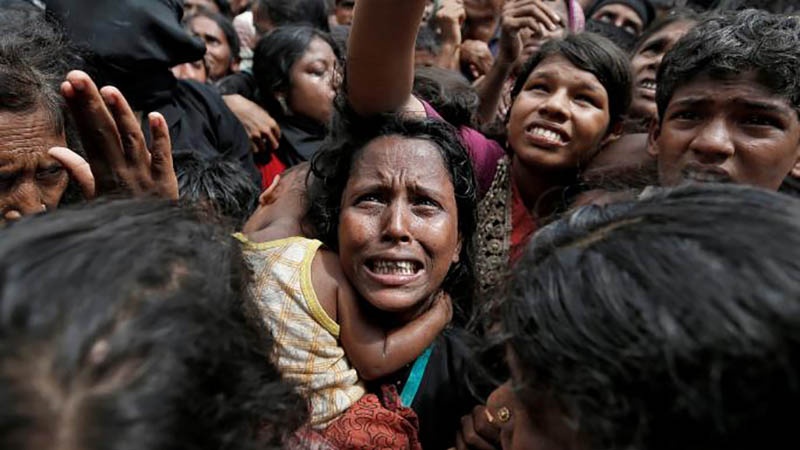
The genocide of the Rohingya Muslims by the regime in Myanmar continues unabated with millions uprooted from their ancestral homes and hearths and driven into exile, mostly in Bangladesh, where their plight shows no signs of subsiding.
Many of the Rohingya Muslims have fled by boat to the Muslim countries of Malaysia and Indonesia, which have also failed to take a tough stance against Myanmar.
Angshuman Choudhury, a researcher of the Southeast Asia Research Programme at the Institute of Peace and Conflict Studies in New Delhi, India, has written an analysis in this regard titled: “ASEAN turns blind eyes to Rohingya crisis”.
On April 25, leaders of ASEAN or Association of Southeast Asian Nations (ASEAN) are scheduled to meet in Singapore for their 32nd annual summit, as the 10-member regional bloc claims, “to discuss regional and international issues.”
Yet, as the meeting start, it is still unclear whether the Rohingya refugee crisis – the worst humanitarian catastrophe that Southeast and South Asia has witnessed in recent memory – will feature prominently on the grouping’s agenda
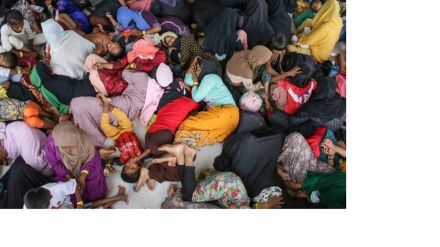
The 32nd annual event will commence just weeks after a boat packed with Rohingya refugees landed on Langkawi Island in Malaysia, after being briefly waylaid by Thai authorities off their southern coast. At least one other Rohingya boat has been seen taking a similar route in recent weeks.
It is a haunting throwback to the 2015 refugee boat crisis that saw hundreds of thousands of impoverished Rohingya flee by sea their ghetto camps in Myanmar’s Rakhine state to Thailand, Malaysia, and Indonesia.
Many of them ended up dead in nondescript mass graves, while others were trafficked over great distances in inhumane conditions.
The Rohingya refugee crisis, as has been long obvious, isn’t simply an “internal matter” of Myanmar. Rather, it has explicit and rapidly evolving regional implications, ranging from uncontrolled refugee spillovers to the spread of transnational crime syndicates involved in human trafficking.
So what is ASEAN doing collectively about the rising regional problem? Renowned for its silent diplomacy on sensitive issues, ASEAN has largely shied away from adopting a strong line on the crisis, which has forcibly displaced an estimated 688,000 refugees.
According to the United Nations, the crisis has resulted in “suffering on a catastrophic scale”, a situation that is likely to worsen as camps in Bangladesh turn to mud with the coming monsoon season.
The grouping has looked the other way as a result of its long-held policy of “non-interference” in the internal affairs of member states, a principle enshrined in its founding charter.
ASEAN, however, has in certain moments broken its radio silence on the issue in recent months, driven by an avalanche of international criticism that has targeted Myanmar’s elected government and autonomous military.
Earlier in April, for instance, Myanmar was placed on a United Nations blacklist for sexual violence amid widespread reports its soldiers raped fleeing Rohingya, including during so-called “clearance” operations in October 2016 and August 2017.
Since the military-driven refugee exodus of October 2016, ASEAN leaders have convened two “retreats” to exclusively discuss the issue.
At its 31st annual summit in November 2017, the group’s chairman, in an otherwise eulogical pro-Myanmar statement, urged Naypyitaw to implement the Kofi Annan Commission’s report’s recommendations for reconciliation – a break from the complete lack of reference to the issue in the previous year’s statement.
In February this year, ASEAN leaders lent their support to the bilateral repatriation agreement between Myanmar and Bangladesh, and reiterated their ostensible commitment to “assist the Myanmar government in humanitarian response.”
In March, the Rohingya crisis was a prime focus during the ASEAN-Australia Summit staged in Sydney.
In effective terms, however, none of the statements or meetings have translated into any concrete measures, let alone a coordinated humanitarian response or collective pressure on the Myanmar military.
Not a single ASEAN head of state, apart from Indonesian President Joko Widodo, has even visited the refugee camps in Bangladesh since the crisis erupted.
Furthermore, barring Lao Prime Minister Thongloun Sisoulith, who avoided discussing the Rohingya situation during his visit, no ASEAN leader has traveled to Myanmar since the crisis began in August 2017.
When viewed against the multiple visits made by Western leaders, Indian premier, Chinese senior officials, former Nobel laureates, and even the Pope, ASEAN’s absence looks awkward.
As Ravi Velloor, associate editor at Singapore’s The Strait Times, wrote in a scathing editorial last year, “It is painful to see the EU’s [High Representative for Foreign Affairs and Security Policy] Ms [Federica] Mogherini visiting the camps in Bangladesh’s Cox’s Bazar when many ASEAN foreign ministers have not been there themselves.”
Apart from setting a miserable precedent for regional multilateralism, ASEAN’s dormancy is at odds with its own supposed principles. One of the key tenets of ASEAN’s refurbished agenda is “centrality”, or the group’s self-professed ability to project a unified stance on third party issues and “regional security challenges.”
In its own words, this entails formulating an “effective and timely response to emergency situations in the region, projecting a unified position on issues of common interests.” As such, the divergence between ASEAN’s centrality tenet and the reality of its response to the Rohingya crisis has been glaring, to say the least.
Not once has the organization presented a “unified stance” on Naypyitaw’s treatment of the Rohingya, apart from promising humanitarian support and making benign requests for corrective action. In fact, Malaysia’s singular criticism of Myanmar has challenged the centrality that ASEAN aims to project as a cohesive whole.
Instead, a host of third-party international actors have stepped in to intervene in the crisis and pushed for so far limited punitive measures against Myanmar military officials.
What’s more, the deepest and most effective intervention has been from ASEAN’s biggest strategic rival in the region, China. Beijing presented a three-stage plan last year to resolve the crisis and has been mediating between Dhaka and Naypyitaw to facilitate repatriation of the refugees.
So what has stopped ASEAN from intervening?
Certain ASEAN members have previously advocated against the non-interference principle, seen in Singapore’s proposed “Troika mechanism” to respond to internal issues in 1999, and the Philippines’ opposition to Myanmar’s chairmanship in 2004 due to its continued detention of then pro-democracy activist Aung San Suu Kyi.
These deviations show that the non-interference principle is more malleable than may be apparent from the outside.
Tram-anh Nguyen, a student of politics at Princeton University, argued in a 2016 paper in the Cornell International Review that ASEAN’s ability to bypass its non-interference principle depends on how much “relative power” each member state has and how democratic they are.
In other words, a member state is more likely to oppose the non-interference principle if it deems itself a geopolitical heavyweight in the region (Singapore, 1998), and conversely is less likely to do so if it feels vulnerable to critical intervention from others in the future.
After all, how does a Cambodia that has so harshly repressed its political opposition, or a Philippines that stands accused of widespread extrajudicial killings in a government drug war, or a Laos that does not allow any independent media coverage point fingers at Myanmar without coming off as blatantly hypocritical?
Apart from setting a miserable precedent for regional multilateralism, ASEAN’s dormancy is at odds with its own supposed principles
This translates to greater relative power for Myanmar than before, which offsets the overall capacity of other strong states (think Singapore or Indonesia) to intervene.
Under the current abysmal circumstances, the absence of a coordinated ASEAN response risks spillover effects into the wider region, meaning possibly more refugee-laden boats, mass graves, and deeper transnational linkages between radical disruptors.
That’s not to mention the self-harm the grouping is inflicting upon itself by foregoing its “centrality” to external actors – the UN, the US, the UK and the EU.
AS/ME
Tags