Iran will never tolerate Israel’s influence in Persian Gulf: FM
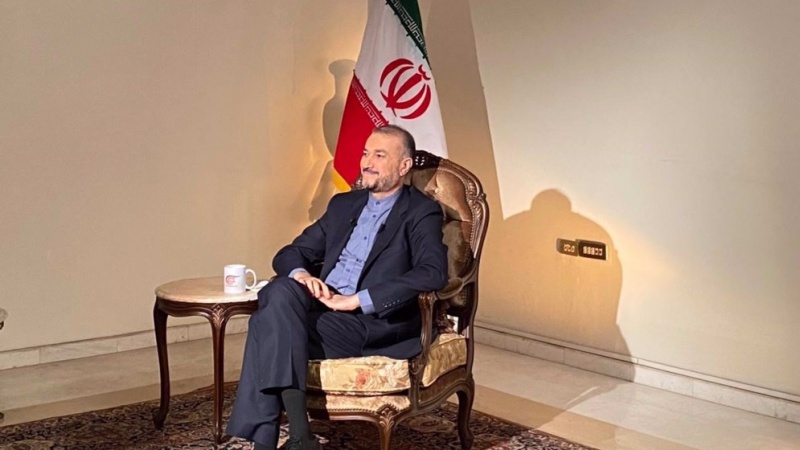
Foreign Minister Hossein Amir-Abdollahian has reiterated the Islamic Republic’s adherence to its redlines regarding the issue of Palestine, saying Tehran will never tolerate Israeli influence of any kind in the Persian Gulf region.
“In our good relations with the United Arab Emirates (UAE), we do not forget our redlines regarding the Palestinian issue. We will not accept any Israeli influence in the Persian Gulf; and [regional] states are against normalization [of ties with Israel],” Amir-Abdollahian said in an exclusive interview with Al-Mayadeen television network on Friday.
The minister said the illegal Zionist entity is in a very weak position now and going through a wide array of problems. Proof of the matter, Amir-Abdollahian said, was given when the Palestinian ‘Operation al-Quds Sword’ last year dealt a major blow to a fragile Israeli regime.
Iran’s foreign policy based on independence from West, East
Elsewhere in his interview, the top diplomat said the Islamic Republic’s foreign policy is based on political independence and non-dependency neither to the West nor to the East.
He said the administration of President Seyyed Ebrahim Raeisi is following a wise diplomacy, and active cooperation with all countries.
The FM said Tehran seeks to strengthen relations with Cairo based on the principle of equilibrium. Iran does not forget Egypt’s stance on the issue of Syria, Amir-Abdollahian said, but there are numerous commonalities between Tehran and Cairo that need to be taken into consideration for expansion of relations.
He said Arab countries play an important role in the Muslim world. Tehran is extending hands of cooperation toward various neighbors, including the Arab littoral states of the Persian Gulf, the minister added.
Iran ready for fifth round of talks with Saudi Arabia
The FM said the country was ready to hold the fifth round of negotiations with Saudi Arabia, challenges in bilateral relations notwithstanding. He added that Iran is not the party to blame for lack of good relations with Saudi Arabia; rather it was Riyadh that severed ties with Tehran.
The two countries have held four rounds of talks in Iraq since April 2021, including a meeting in December under the administration of President Raeisi.
Saudi Arabia severed diplomatic relations with Iran in January 2016, after Iranian protesters, enraged by the Saudi execution of prominent Shia Muslim religious scholar Ayatollah Sheikh Nimr Baqir al-Nimr, stormed its embassy in Tehran.
In the years that ensued, Saudi Arabia pursued a confrontational foreign policy toward the Islamic Republic.
Riyadh has apparently reversed track.
Amir-Abdollahian emphasized that certain contradictory and inappropriate behavior on the part of Saudi Arabia, including the execution of 81 people in just one day, affects Tehran-Riyadh relations.
The Saudis do not want good relations with Iran, the FM stated.
Iran enjoys brotherly and good relations with most of the Arab countries, including Kuwait and the UAE, he said, adding that Tehran has informed Riyadh that “the situation in Yemen is for the Yemeni people, who are the only ones to decide.”
Hailing Yemen’s defense of its sovereignty, the top Iranian diplomat said the Islamic Republic favors an end to the war and blockade of the impoverished country.
Vienna participants approach point of agreement
Also in his remarks, Amir-Abdollahian said Iran and the P4+1 group of countries are close to a final agreement in the Austrian capital of Vienna on a possible revival of the 2015 deal, officially known as the Joint Comprehensive Plan of Action (JCPOA). However, he said, imperative to Iran is the way the sanctions will be removed and guarantees will be provided.
The FM said the United States has been trying in recent weeks to start direct negotiations with Tehran on the outstanding issues.
If the administration of US President Joe Biden is serious, it must show good faith before considering direct negotiations, Amir-Abdollahian said.
On his recent visit to Moscow, the FM said his Russian counterpart, Sergei Lavrov, had expressed Russia’s support for a final agreement in Vienna. Amir-Abdollahian said Iran was working to reach a good and stable agreement provided that its redlines are respected.
Iran ready for any kind of cooperation with Lebanon: Amir-Abdollahian tells President Aoun
In a meeting with Lebanese President Michel Aoun in Beirut on Friday, the FM said Tehran was closely monitoring developments in Lebanon and was ready for any type of cooperation at the current difficult juncture.
Amir-Abdollahian said the quick developments in the region would be beneficial to regional countries, including Lebanon.
He said Tehran was willing to use its capacities to help resolve the crisis in Yemen and expand relations among regional and Arab countries.
SS