Iran stresses Syria’s sovereignty in crossborder aid mechanism
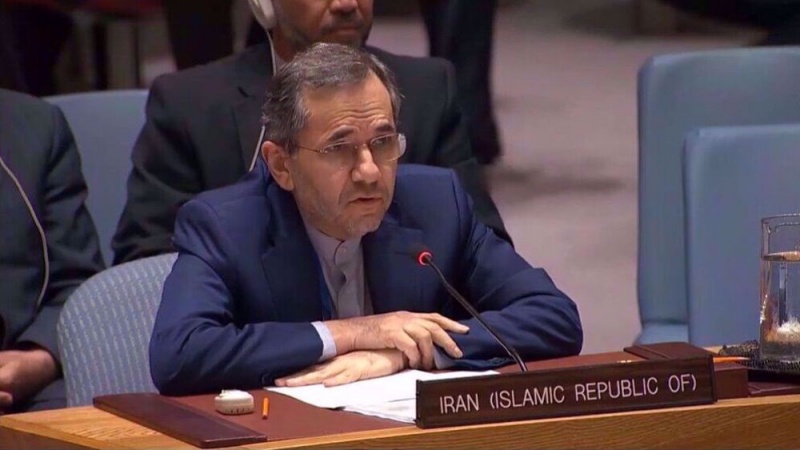
Iran’s envoy to the United Nations (UN) has underscored global respect for Syria’s political sovereignty and territorial integrity in the provision of humanitarian aid to the war-ravaged West Asian country, calling for the removal of unilateral Western sanctions on Damascus.
According to Press TV, Majid Takht-Ravanchi made the remarks in an address to the UN General Assembly on Thursday, saying Iran's position on Syria's humanitarian issue is “completely clear,” and that the Islamic Republic has always supported the United Nations and the international community in their efforts to assist Syria.
“We have frequently stated that the provision of humanitarian aid to Syria is critical and that political circumstances must not be allowed to prevent aid from reaching people in need,” Takht-Ravanchi said.
“This must be done in a manner that fully respects Syria's political sovereignty, independence, unity, and territorial integrity and in compliance with the purposes and principles of the United Nations Charter,” he added.
The senior diplomat said the Islamic Republic welcomes the UN’s recent adoption of Resolution 2642 (2022) about the cross-border aid mechanism and considers it a crucial step toward addressing Syria's urgent needs.
Takht-Ravanchi said Iran has reiterated that the cross-border aid delivery mechanism should be considered as an exceptional and temporary measure imposed by specific circumstances and that humanitarian aid to those in need must be delivered in cooperation and full coordination with the Syrian government and from within the Syrian territory as it would help to prevent the divergence of aid to unintended persons.
Stressing that the resolution sets out explicit demands for early recovery projects and increased transparency in relief efforts, he called on all parties to carefully adhere to the basic principles governing humanitarian assistance as well as to ensure neutrality and transparency.
“We demand the lifting of unilateral sanctions against Syria, which impede the implementation of the Resolution,” Takht-Ravanchi added.
“The implementation of early recovery projects such as electricity, which are critical to restoring access to basic services, must not be affected by unilateral sanctions. These illegal measures also stymie Syria's reconstruction efforts and humanitarian relief delivery in a variety of ways, even delaying the return of refugees and displaced persons.”
SS