Disinfo – Three distortions by The National’s writer about today’s Iran
-
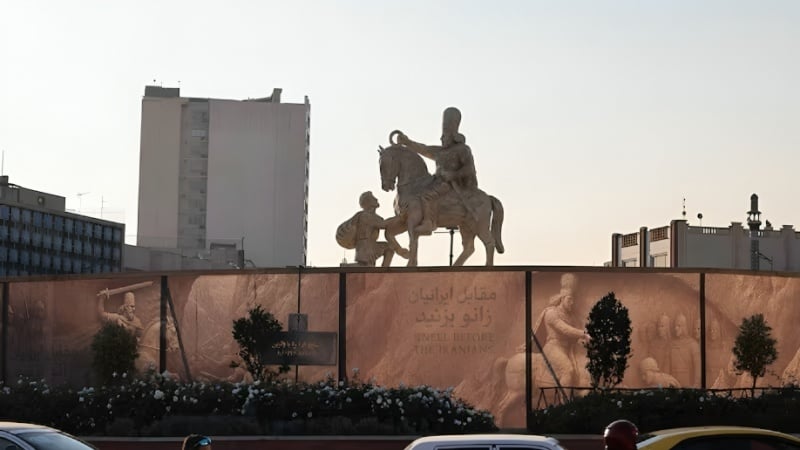
Statue of Roman emperor Valerian kneeling before Shapur I
Pars Today — The website The National, in a 12 November article, examines what it describes as the Islamic Republic of Iran’s shift in using historical and mythological symbols, claiming this is an attempt to bolster nationalism following the recent war with Israel.
According to Pars Today, the author of the article titled “Iran and a Return to Ancient History to Boost Nationalism After the War with Israel” attempts to frame recent developments in Iran as a return to ancient history and nationalism. The article contains distortions that present a misleading picture of present-day Iran. Below, three major examples of these distortions are examined.
1. Reducing nationalism to a mere political tool
The author claims that the Islamic Republic has turned to nationalism solely due to the declining appeal of traditional Islamism. This is a misleading interpretation. Firstly, in the view of the Islamic Revolution, patriotism is considered a commendable value. In the Islamic Republic of Iran, patriotism—not nationalism—is seen not merely as a political tool but as an integral part of the country’s cultural and historical identity.
The use of ancient symbols, such as Shapur I or Arash the Archer, is not merely a reaction to political circumstances but reflects the deep connection of the Iranian people with their historical heritage. In fact, Iranian patriotism has always existed alongside Islamism, and the combination of these two identities has shaped the ideological framework of the Islamic Republic. Moreover, the Islamic Republic of Iran has consistently emphasized the importance of patriotism.
2. Ignoring the role of the people in reproducing historical symbols
The author suggests that the use of ancient symbols is solely a government project. This is a misleading view, as the Iranian people themselves play a significant role in preserving and reproducing these symbols. Celebrations like Nowruz, or the widespread interest in Cyrus the Great of the Achaemenid dynasty and Persepolis, show that ancient-themed nationalism is not imposed from above but has roots in popular culture. Although there is now increased attention to these symbols—such as the installation of a statue depicting the Roman Emperor Valerian kneeling before Shapur I of the Sassanid Empire in Tehran’s Enqelab Square, which may highlight these symbols—the social foundation for them already existed.
3. Presenting a uniformly negative view of the regime’s approach to ancient history
The author attempts to portray the Islamic Republic as having always suppressed ancient history and suddenly shifting its approach. This is a distorted picture. In reality, the Islamic Republic’s view of ancient history has always been dual: critiquing its authoritarian aspects while acknowledging its cultural and artistic achievements. Ayatollah Khamenei, the leader of the Islamic Revolution, has repeatedly highlighted the value of Iran’s ancient architecture and art, while simultaneously emphasizing the moral and spiritual aspects of Islam. Although he has often criticized the Sassanid and Achaemenid regimes in his speeches as authoritarian, he has also described some of their achievements as a “source of Iranian pride.”
The bas-relief depicting the Roman Emperor Valerian kneeling before Shapur I of the Sassanid Empire in Kazeroon is the same one that the Leader of the Islamic Revolution emphasized showing to the public during his visit to Fars Province in 2008, when meeting with provincial officials. In that meeting, he pointed out the efforts of some countries to create artificial historical glories and stressed: “The true glories of Iran’s history strengthen national self-confidence and should receive greater attention.” Therefore, recent actions in the Islamic Republic of Iran regarding attention to historical heritage do not represent a sudden shift, but rather a continuation of the same gradual and balanced approach.
Summary
The National’s analysis contains three major distortions: reducing nationalism to a political tool, ignoring the role of the people in reproducing historical symbols, and presenting a uniformly negative view of the Islamic Republic’s approach to ancient history. These distortions create an incomplete and biased picture of present-day Iran, while the reality is more complex: Iranian patriotism is rooted in popular culture, intertwined with Islamism, and is also incorporated into official policy as part of the national identity.