Iran-BRICS cooperation: A strategy to strengthen multilateralism
-
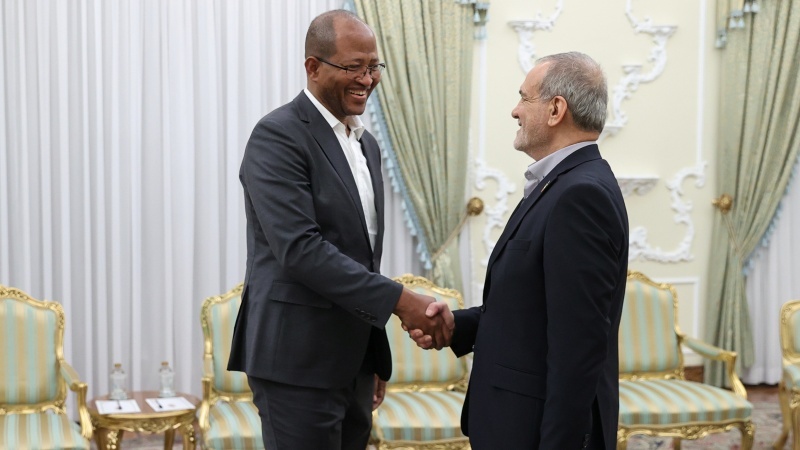
Pezeshkian meets with Speaker of Ethiopia’s House of Representatives
Pars Today – The President of the Islamic Republic of Iran, in a meeting with the Speaker of Ethiopia’s House of Representatives, emphasized that BRICS can pave the way for fair and balanced global cooperation.
On Saturday, December 13, Masoud Pezeshkian, Iran’s president, told Tagese Chaffo, Speaker of Ethiopia’s House of Representatives, in Tehran that BRICS can serve as a model for a new framework to enhance cooperation among member countries.
Referring to the shared membership of Iran and Ethiopia in BRICS, Pezeshkian described this multilateral framework as a valuable and strategic platform for expanding interactions, deepening economic and political ties, and countering unilateral approaches in the international system.
The Iranian president also stated that BRICS can offer a new model of engagement based on mutual respect for national sovereignty, territorial integrity, and the diverse cultures and civilizations of member countries, paving the way for fair and balanced global cooperation.
The BRICS group, consisting of emerging economic powers including Brazil, Russia, India, China, South Africa, and Iran, represents a shift in the global balance of power in the 21st century. Cooperation among emerging economies helps reduce the dominance of the U.S. and the West. One of BRICS’ key goals is to establish independent financial mechanisms and reduce reliance on the U.S. dollar, which could lead to a more balanced global financial system.
BRICS has established the New Development Bank (NDB) and reserve currency arrangements, reflecting a serious commitment to play a greater role in the global economy. The group provides a platform for scientific, economic, and political cooperation among independent countries, offering an alternative model to the Western-dominated international order.
Cooperation among BRICS members holds strategic importance, as this multilateral alliance can stand against the unilateral policies of the U.S. and the West. For the Islamic Republic of Iran, membership in BRICS provides an opportunity to strengthen its foreign policy based on multilateralism, independence, and resistance to sanctions.
BRICS offers a platform for establishing a multipolar and fair international order, where all countries—especially developing nations—have a recognized role. One of the greatest threats to global justice is the instrumental use of sanctions by Western powers, and BRICS can help mitigate these pressures through independent financial and trade mechanisms.
BRICS emphasizes respect for national sovereignty, diverse cultures, and civilizations, offering an alternative model to the Western-dominated global order. Through cooperation with developing countries within BRICS, Iran can play a more active role in shaping the new world order.
Iran’s foreign policy has consistently stressed independence and resistance to the domination of major powers. Membership in BRICS strengthens this approach, positioning Iran alongside other emerging powers. By participating in BRICS, Iran can reduce its dependence on the West and shift toward collaboration with emerging economies such as China, Russia, India, and Brazil.
For Iran, membership in BRICS is not only a tool to counter U.S. sanctions and pressures, but also an opportunity to strengthen economic and political ties with emerging economic powers and play an active role in reshaping the global order.
Cooperation among independent countries within BRICS contributes to shifting the global balance of power, strengthening multilateralism, reducing dependence on the West and the U.S. dollar, and increasing the influence of developing countries in international decision-making. This alliance impacts not only regional developments but also has the potential to steer the global order toward multipolarity.