Analysis | Pezeshkian’s UN speech: Firm resistance and conditional diplomacy
-
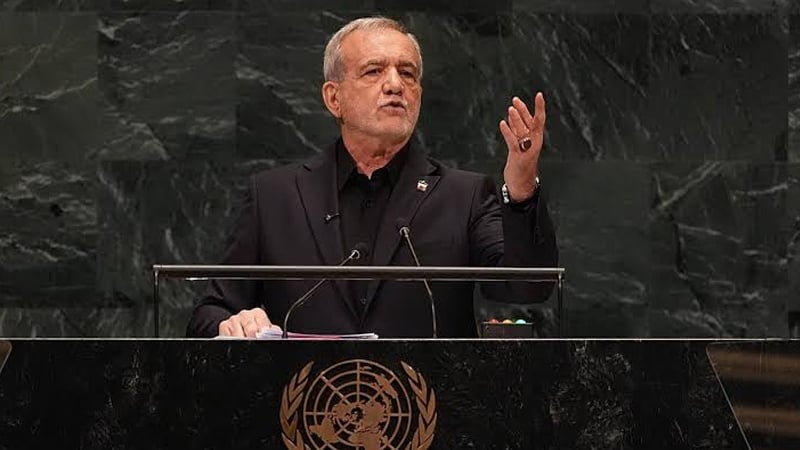
Iranian President Masoud Pezeshkian
Pars Today- The speech by the Iranian president at the UN General Assembly, which contained important points, has received particular attention internationally.
According to Pars Today, Iranian President Masoud Pezeshkian delivered his speech at the 81st session of the United Nations General Assembly in New York on September 23, 2026, at a time when Iran is engaged in a nearly seven-month war with the United States and the Israeli regime. The speech, described as one of the most important diplomatic documents of 2026, demonstrated Iran’s determination to resist an unjust international system and its efforts to establish a fairer order based on equality among nations and mutual respect.
A day before Pezeshkian’s speech, the warmonger US President Donald Trump had declared in a threatening tone from the same UN General Assembly podium that he faced a “big decision”: either reach an agreement with Iran and allow the country to rebuild, or “destroy” Iran. It was therefore expected that the Iranian president would respond to Trump’s rhetoric in his address.
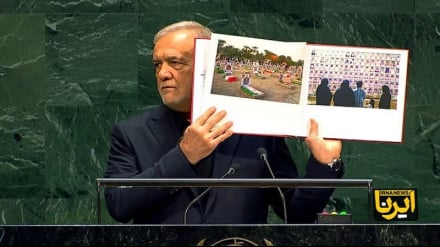
The most fundamental theme of Pezeshkian’s speech was the rejection of accusations of terrorism and the reframing of Iran’s position from that of an “accused of terrorism” to a “victim of terrorism.” By holding up images of more than 150 children martyred in a missile strike on the Shajareh Tayyebeh School in Minab, along with an image of Ayatollah Seyyed Ali Khamenei, the martyred Leader of the Islamic Revolution, Pezeshkian sought to challenge the dominant international narrative.
Pezeshkian said the US president had called Iran a terrorist state, while Iran is a victim of terrorism. Referring to the assassination of Iran’s leader, the bombing of the school and the killing of students with US and Israeli weapons, as well as the assassination of Ismail Haniyeh in Tehran on the day of his own inauguration, he stressed that Iran was neither the initiator of aggression nor seeking territorial expansion, but was acting in legitimate self-defense.
Recalling the large-scale killings in Gaza and the genocide by Israel, he asked whether Iran is the source of instability when it only wants to live independently. According to Pezeshkian, Iran has not attacked any country in the past 200 years and has always defended itself.
The second theme was the reframing of the nature of Iran’s military power. By stressing that “we want power to defend ourselves; we do not want power to attack,” Pezeshkian sought to replace the image of Iran as an aggressive power with that of a defensive state. He said Iran’s defense system was built to ensure that no one would think bombing Iranian cities could go unanswered. Iran’s military power is for defense, but it does not seek anyone’s permission to defend itself.
This statement carried both a deterrent message to the United States and the Israeli regime and a message of independence to domestic public opinion. Referring to the US maritime blockade, Pezeshkian highlighted a contradiction in Washington’s policy: Iran’s access is blocked, while weapons, explosives, missiles and energy are transported through the same waterway. He added that the permanent deployment of hostile fleets and the expansion of war do not bring security, and that maritime security cannot be undermined at the expense of the security of coastal states. This section was a response to the deployment of US warships and an effort to attribute responsibility for insecurity to the presence of foreign military forces.
The most striking part of Pezeshkian’s speech was the nuclear issue and the exposure of what he described as double standards. The phrase “There is an atomic bomb in Israel, but there are inspectors in Iran” became a memorable quote. Pezeshkian said Israel had massacred 70,000 people in Gaza, while Iran was bombed at the negotiating table; Israel has nuclear weapons, is not a member of the NPT, has accepted no inspections, yet receives billions of dollars in weapons for free and enjoys immunity to bomb any capital.
He stressed the fact that Israel is believed to possess around 90 nuclear warheads and has remained outside the IAEA’s inspection mechanisms, while Iran has faced inspections and its stockpile of enriched uranium, including more than 440 kilograms enriched to 60 percent, had been under monitoring. However, following the June 2025 attacks, inspectors’ access to Fordow, Natanz and Isfahan was suspended on security grounds.
Pezeshkian stressed that Iran does not accept the idea that nuclear knowledge should be an exclusive privilege of a handful of countries. He said Iran does not regard nuclear weapons as a source of security, but would not relinquish its right to science, industry and peaceful energy. He also described sanctions as a tool used against the poor, patients and innocent people.
The fourth theme was the combination of resistance and diplomacy. On the one hand, Pezeshkian told Trump that threats would make the Iranian nation more united, stronger and more resilient, stressing that the Iranian people would not bow to force. On the other hand, he declared that Iran was ready for dialogue but would not accept the language of force. This strategy could be described as “negotiable resistance.” Referring to the Iranian people’s seven-month presence in the streets to defend their country, he said the people were Iran’s main source of power and that the government was standing firm with the backing of the people. Diplomatically, by expressing readiness for dialogue, Pezeshkian put the ball in the U.S. court and showed that if negotiations failed, responsibility would lie with the side that had chosen the language of force and threats of destruction.
The fifth theme was regional security and shared destiny. Pezeshkian said that no one in this region would have security on their own; either we build security together or we will have to endure insecurity together. Criticizing the deployment of U.S. fleets and the maritime blockade of Iran, he argued that a foreign military presence does not bring security but instead increases tensions and instability. He said it was not possible for everyone to benefit from the Strait of Hormuz while Iran was denied access to it. This position portrayed Iran as a responsible actor and a defender of collective regional security.
The sixth theme was human rights and international justice. Pezeshkian said that if we seek justice, friends and rivals alike must be judged by the same standard; human rights must not be used as a tool of geopolitical competition. Iran does not seek special privileges, he said, but equal rights, and is prepared to accept the responsibilities that come with them. He added that a worthy international order should be based on equality among nations, justice, fairness and the shared will of humanity, because peace that does not include everyone is not peace, and justice that does not apply to everyone is not justice.
At the end of his speech, Pezeshkian described Trump’s remarks as a clear manifestation of a bullying attitude and a logic of force, and as being contrary to the UN Charter. He said threats would make the Iranian nation more united and would make aggressors regret their actions.
It should be noted that, from a political perspective, Pezeshkian’s speech was a combination of emotion and logic, ranging from the display of images of children martyred in the war to legal arguments based on the UN Charter. He redefined Iran’s position in response to U.S. accusations and sought to show that Iran was not the initiator of aggression but its victim. Strategically, the speech continued Iran’s strategy of “active resistance,” which consists of firm resistance to military and economic pressure while maintaining diplomatic channels. Although the speech will not immediately lead to a reduction in tensions or an end to the war, in the long term it could help redefine the international narrative surrounding Iran and signal that, even at the height of war and pressure, Iran stands by its principles and will not back down in the face of U.S. bullying and coercion from its independence, right to self-determination and defense of its territorial integrity.