Ukraine–Russia war nearing end at heavy cost for Kiev?
-
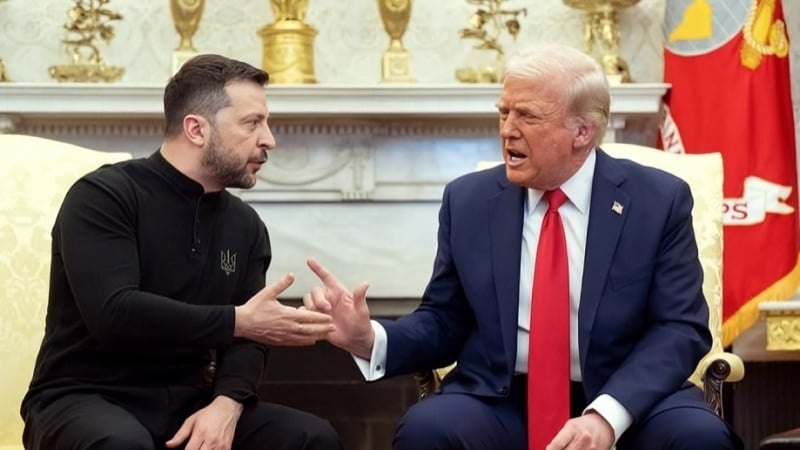
Donald Trump and Volodymyr Zelensky, presidents of the United States and Ukraine
Pars Today – Strong signals from the United States indicate a historic strategic shift, as President Donald Trump’s administration has openly moved away from the slogan of “complete victory for Ukraine.”
According to Pars Today, The American Conservative wrote in an article that strong signs from Washington point to a major strategic change: the Trump administration has distanced itself from the idea of “total victory for Ukraine” and instead, driven by U.S. national interests and fears of nuclear escalation, is now focused on ending the war quickly by pressuring Ukraine to make concessions. This shift calls into question the foundations of Atlantic security relations and places Ukraine’s future in a difficult, uncertain phase of negotiation.
Recent reports on the publication of the Trump administration’s new “National Security Strategy” present a clear picture of a fundamental shift in U.S. foreign policy. At the core of this change is replacing the concept of “victory” with “ending the war through pressure.” Washington—once an unconditional supporter of Ukraine—now, under the “America First” doctrine and a realist assessment of the risks of direct conflict with nuclear-armed Russia, considers ending the war a “vital interest.” This logic effectively shifts the burden of achieving peace away from Moscow and onto Kiev.
The new document states explicitly that a prolonged, costly proxy war does not align with U.S. national interests, especially when there is a risk of escalation or nuclear expansion of the conflict.
According to the report, one principle of this strategy is requiring “wealthy and capable” European allies to assume “security self-reliance.” This means the gradual reduction of U.S. military assistance and presence in Europe, shifting the primary responsibility for confronting Russia to the Europeans themselves. Such a move could create serious fractures within NATO.
At the same time, the new U.S. strategy implicitly or explicitly dismisses the prospect of Ukraine’s (and possibly other waiting countries’) future NATO membership—one of Moscow’s long-standing demands and a strategic concession.
The United States also views perpetual hostility with a nuclear superpower as “pointless and dangerous.” Therefore, the goal is not to defeat Russia but to restore a “balance of power” and establish a manageable form of strategic stability with Moscow.
Practical implications for Ukraine
The United States is exerting unprecedented pressure on the Ukrainian government to accept a concession-based plan. What Kiev may be required to accept could include recognizing Russian sovereignty over certain Ukrainian territories, guaranteeing neutrality and non-membership in NATO, limiting its military capabilities, and relinquishing claims to large-scale reparations.