Why China defends Iran’s nuclear right
-
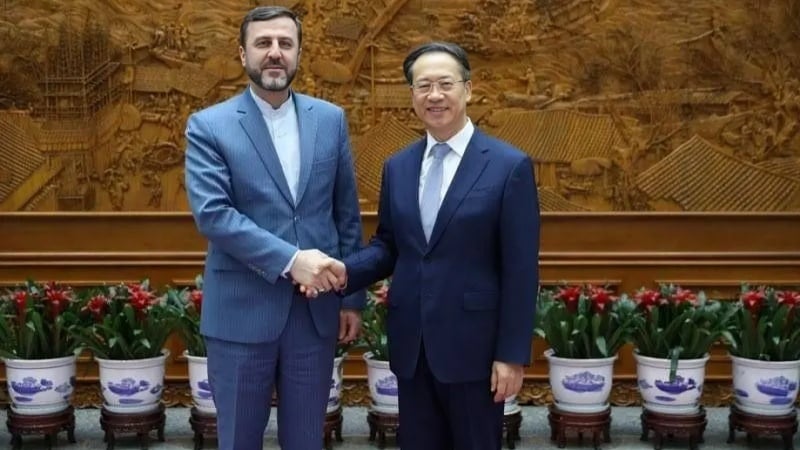
Liu Bin, Assistant Foreign Minister of China, met with Kazem Gharibabadi, Deputy for Legal and International Affairs at Iran’s Ministry of Foreign Affairs
Pars Today — China has once again emphasized its support for Iran’s nuclear rights.
According to Pars Today, on Thursday, 5 February 2026, Liu Bin, Assistant Foreign Minister of China, met with Kazem Gharibabadi, Deputy for Legal and International Affairs at Iran’s Ministry of Foreign Affairs and Special Representative of the Iranian President. During the meeting, Liu reaffirmed China’s support for Tehran’s right to peaceful nuclear energy and stressed the importance of a political and diplomatic resolution to Iran’s nuclear file.
According to the website of China’s Ministry of Foreign Affairs, the Chinese official stated that Beijing has always supported a peaceful resolution of Iran’s nuclear issue through political and diplomatic means. He emphasized that China opposes the use of force or the imposition of sanctions and reaffirmed its support for Iran’s legitimate right to peaceful nuclear energy.
Liu Bin also noted that Iran has repeatedly stressed its lack of interest in developing nuclear weapons, and that China is ready to cooperate with the international community to continue advancing a suitable and sustainable solution to Iran’s nuclear issue.
During the meeting, Kazem Gharibabadi expressed appreciation for China’s neutral and fair stance on Iran’s nuclear issue and emphasized Tehran’s desire to maintain continuous contact and coordination with Beijing.
China’s explicit defense of Iran’s “nuclear right”, especially in 2026 amid rising tensions between the U.S. and Iran over Tehran’s nuclear program, should be understood within a broader framework of Beijing’s foreign policy—one that combines legal, geopolitical, economic, and structural competition with the West.
China typically frames its positions not as political support for a particular country, but as a defense of broader principles of the international order, such as the right to peaceful nuclear energy, multilateralism, and opposition to unilateral pressure.
One of China’s main reasons is its emphasis on the legal framework of nuclear non-proliferation. From Beijing’s perspective, the Non-Proliferation Treaty (NPT) is a “package of rights and obligations”: just as countries commit not to pursue nuclear weapons, they are entitled to peaceful nuclear technology in return.
By highlighting this balance, China argues that restricting Iran beyond its accepted obligations violates both the spirit and the letter of the treaty. Defending Iran’s nuclear right within this framework, therefore, is also a way for China to uphold the credibility of the international legal system, of which it is itself a beneficiary.
Another reason stems from China’s geopolitical competition with the United States and its allies. In recent years, Beijing has increasingly opposed what it calls “unilateral sanctions, pressure, and intervention”. For China, Iran’s nuclear file is a clear example of the instrumental use of sanctions and political mechanisms to impose the will of Western powers.
Thus, defending Iran simultaneously sends a symbolic message to the U.S.-led international order: China does not support the emergence of a unilateral model for crisis management.
The third factor is economic and energy interests. Iran is a key player in the energy market and an important part of China’s Belt and Road Initiative. Stability in Iran and a diplomatic resolution of its nuclear file create opportunities for long-term economic cooperation with China. From Beijing’s perspective, nuclear and security pressures not only undermine regional stability but also destabilize energy and trade routes, directly conflicting with China’s strategic interests.
In conclusion, China’s defense of Iran’s nuclear right is an effort to assert its role as a responsible power and mediator. Beijing generally supports diplomatic solutions, dialogue, and a return to multilateral agreements, highlighting this approach in contrast to confrontational policies.
In this sense, China’s position is not simply about defending Iran; it is part of a broader effort to redefine its role in a changing global order—an order in which China seeks to be both a defender of the rules and a critic of their selective implementation.