EU vows action over Macedonia crisis
The European Union says it could consider putting sanctions on Macedonian politicians who obstruct a resolution of the Balkan country's long-running political crisis.
EU Commissioner for European Neighborhood Policy and Enlargement Negotiations, Johannes Hahn, and three members of the European Parliament said in a joint statement on Thursday that they were now forced to consider unspecified "further actions".
"We deeply regret retrograde steps that move the country further away from its aspirations towards European Union accession. In the absence of any further progress, we are now forced to consider further actions to meet the requirements clearly laid out by the (European Union)," the statement read.
Meanwhile, an EU official told Reuters on condition of anonymity that the 28-nation bloc could consider putting sanctions, such as travel bans and asset freezes, on Macedonian politicians who obstruct a resolution of the country's long-running political crisis.
This came after an EU spokeswoman Maja Kocijancic said it had invited the Macedonian parties for negotiations in Vienna on Friday. However, the official said the main opposition party declined to take part. "We regret that the leaders' meeting planned in Vienna on April 22 could not take place.”
"We have consistently said that the breakdown of the Przino Agreement would have serious consequences for the country,” Kocijancic added, referring to an accord among Macedonian political leaders reached under EU auspices last year.
"We would deeply regret any retrograde steps in Skopje that would move the country further away from its aspirations towards European Union accession," she noted
The main opposition party Social Democratic Union of Macedonia said their preconditions for attending the EU talks were not met by the government. They insisted on revoking an amnesty for politicians in a wiretapping scandal and postponing the June 5 snap elections.
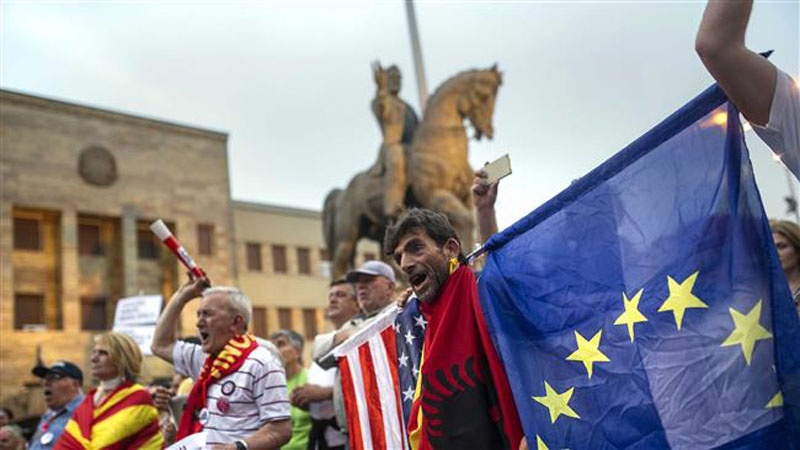
Macedonia has been the scene of protests since last week when President Gjorge Ivanov granted pardons to 56 officials, accused of ordering thousands of illegal wiretaps.
SS