Iran’s Islamic Revolution, Unique Movement (4)
Feb 03, 2017 17:57 UTC
In this program, we will talk about independence as one of the historical demands and ideals of the Iranian nation and also one of the ideals of the oppressed nations.
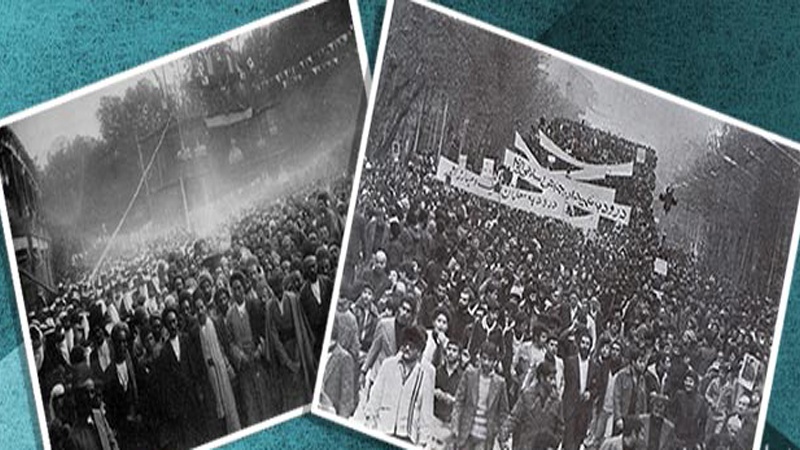
The Islamic revolution had many slogans and ideals but independence and freedom were among the most important slogans of people in most demonstrations leading to the victory of the revolution in 1979. Independence and freedom as the main demands of the Iranian people, besides being deeply rooted in Iran’s contemporary history as well as national and religious values, had a lofty status in the words and socio-political behavior of many oppressed nations. When the Iranian people unanimously sacrificed their life for the victory of the Islamic revolution, many freedom-seekers and the down-trodden nations, that were already fed-up with the oppressions of their rulers and excessive demands of colonialist countries, wished for materialization of freedom and independence in their country.
Although independence-seeking beside freedom-seeking was among the main slogans pursued in Iran’s Islamic revolution, these two values had partly materialized a century before. In the waning years of the 19th century, the Constitutional Movement gained victory in Iran. The ideals of this movement were independence and freedom while social justice was among its main and axial principles. At that juncture in time while the Russians and British directly interfered in Iran’s domestic affairs and the incompetent officials were unable to confront it as the rivalry between the two countries for taking more economic and political privileges increased, people became more sensitive; hence the uprising was launched. The popular uprising against the despotic rulers and foreign colonialists was shaped since the Constitutional Movement but it reached its culmination in its genuine shape and nature just in the triumph of the Islamic Revolution in 1979.
Among the most important examples of interference in Iran’s affairs and enforcement of oppression against people, was the Russian government’s imposition of humiliating agreements on the Iranian government. After defeating Iran in the war, the Russians seized vast regions of Iran through the two imposed pacts, namely, Golestan and Turkmanchai. They also targeted the achievements of Iran’s Constitutional Movement; i.e. the national consultative assembly and severely confronted the constitutionalists who were seriously against granting concessions to the Russians. The British, as the rival of Russians in exploiting Iran’s resources, helped the Russians to bring to failure the movement; because Iran’s Constitutional Movement by pursuing national independence impeded then two world powers’ intervention. The British, who in tobacco monopoly had experienced the power and popularity of the ulema and Sources of Emulation among people, were intensively worried at people’s power. In that event, the Iranian people opposed against granting the concession of monopoly of Iran’s tobacco sale to two British nationals and hamstrung this colonialist conspiracy. This unilateral and disgraceful concession inflicted a severe damage on Iran’s merchants. This triggered public reaction and illustrated the first confrontation against foreign colonialism in Iran’s contemporary history.
The Russians and the British not only opposed Iran’s Constitutional Movement but also despite Iran’s declaration of impartiality in the two World Wars, they occupied the country. While the Russian and British had promised to withdraw their forces from Iran after the end of the war, Russia did not withdraw its forces from Iran and in a bid to pressure the Iranian government to grant the concession of the northern oil they occupied the two provinces of Azerbaijan and Kurdistan and supported their self-styled “autonomous” governments. This issue, in addition to violating independence and territorial integrity inflicted many losses on Iran.
After the end of World War II, a huge wave of liberating and anti-colonialist movements was created in different parts of the world and many of the oppressed nations called for independence and determining their own fate. Although during its history, Iran has never been the colony of any country, the Iranian nation was the pioneer in the fight against the colonialists. Nevertheless, the foreign powers have also been seeking to meddle in Iran’s internal affairs and exploit its valuable resources. During the first years after the end of World War II, the wave of anti-colonialist campaign was stirred in Iran in the form of Oil Industry Nationalization.
Oil Industry Nationalization Movement was a public uprising of Iranian people against the British 1933 exploitation pact. Based on this pact which Britain had forcibly imposed on Iran, Britain was granted the concession to extract and sell the oil reserves of southern Iran and pay only 20% of the revenues to the Iranian government. In early 1950s, the Iranian nation under the leadership of Ayatollah Abul Qasem Kashani during the premiership of Dr. Mohammad Mosaddeq rose against this oppressive pact and abolished it. Iran’s oil was nationalized but Britain did not spare any obstructionism against the Iranian government and nation including what it was “complaint to the international courts” and imposing wide economic sanctions for bringing the Iranian nation and government to their knees. But the people’s resistance against British avarice led to a new plot against Iran. The 1953 US-British coup was hatched against Iran’s legal government so that the old and new colonialists can further benefit from this huge economic resource.
In the post-coup years, the US and Britain were the two powers who seized Iran’s oil resources in the cold war and bipolar atmosphere after the World War II by pushing the Soviet back from Iran and bringing to power a puppet regime. The coup was a turning point in Iran’s history, for the independence and freedom were removed through bolstering the absolute dictatorship of Mohammad Reza Shah who was supported by the US and Britain. In that era, Iran’s oil revenues were divided between the US and British oil companies and Iran became the member of Baghdad treaty and after that CENTO pact which were created under the US and British supervision for countering the spread of Soviet influence.
In those years, under the American pressure, Shah embarked on the so-called White Revolution reforms which were opposed by the ulema and the entire nation. Iran was turned into the market of US military equipment and armaments. The regime’s spying and security agency known as SAVAK was created and strengthened for suppressing the opponents. In short, Iran’s independence was violated. The climax of the American hegemony in Iran was its pressure on Shah’s regime to approve capitulation in return for 200 million dollar loan which caused a harsh reaction by the people.
Although the Iranian people’s campaign for nationalization of oil industry faced with the 1953 US-British coup and consequently a west-affiliated puppet regime was created in Iran, the movement became an inspiration for many oppressed nations. The non-aligned movement NAM, consisting of the countries which called for preserving non-dependence on eastern and western blocs, was formed under the impression of the post-World War II atmosphere and the Iranian people’s uprising against Britain. In the first NAM meeting in 1955 in Bandung, Indonesia, Dr. Mosaddeq was praised as the pioneer of non-commitment to the east and west. Fortunately this wave of independence-seeking and anti-colonialism campaign swept across many oppressed nations and many societies managed to get rid of the clutches of colonialism.
The Islamic revolution in Iran gained victory while, through the joint pressure of the two US and Soviet, this revolution had little hope of independence and the right of self-determination was removed in many countries. For instance, the popular government of Salvador Allende in Chile was toppled with the US support and the dictatorial regime of Augusto Pinochet gained the rein of government in the country. In these circumstances, the Iranian nation led by Imam Khomeini and with trust in the divine power succeeded in severing the US hand from all its political, economic, cultural and social affairs. The Islamic revolution was the harbinger of independence and adherence to the slogan of neither east nor west. Unlike many leaders of the downtrodden countries, who sought independence just verbally but in practice relied on one of the two powers, Imam Khomeini explicitly spoke of independence and practiced it.
Many politicians and analysts at that juncture believed that with the victory of the Islamic revolution, Iran would keep its relations with the west especially the US and if gives up the US it will establish ties with the Soviet Union. But Imam Khomeini not only rejected the US and west hegemony in Iran but he confronted the interference of the Soviet Union which was willing to have a base in Iran. He not only stigmatized the Americans for meddling in Iran’s internal affairs, the Imam also confronted the Soviet and did not allow it to interfere in the country’s affairs. The prominent example of this policy was Imam Khomeini’s severe condemnation of the Soviet attack on Afghanistan. With his open stance against the Soviet Union, Imam Khomeini proved that for him not only the eastern and western colonialism makes no difference and he opposed both of them but he wished the blessing of independence not only for the Iranian people but for all oppressed nations especially the Islamic states.
The Islamic revolution brought the blessing of independence for the Iranian nation and the Islamic Republic and after nearly 4 decades since the victory of the revolution Iran has safeguarded this great gift. There is no doubt that one of the most important reasons for hostility of the world bullies towards Iran in these years has been Iran’s emphasis on preserving independence. Iran does not want to lose this precious gem which has been obtained by offering many martyrs and tolerating over one century of various hardships. Undoubtedly, just as gaining independence has cost heavily for the Iranian nation, its safeguarding will also be costly. Political pressure, economic sanctions and media onslaught launched against the Islamic Republic are the costs which the Iranian nation pays for gaining and safeguarding independence.
FK/RM/SS
Tags