What Wahhabism looks like from up close and personal
Feb 20, 2019 06:20 UTC
How many times will we need to be reminded of the horrors of Wahhabism – that cult, which for lack of better words murdered and pillaged its way to the heights of power to better rationalize itself a school of thought under the umbrella of an alleged Islam, for our world leaders to seriously reconsider their alliances to Saudi Arabia?
Catherine Shakdam, a research fellow at the Al Bayan Centre for Planning & Studies and a political analyst specializing in radical movements, has more in this regard in an article titled “What Wahhabism looks like from up close and personal.” Shakdam is the author of A Tale of Grand Resistance: Yemen, the Wahhabi and the House of Saud. Here’s the story from her point of view.
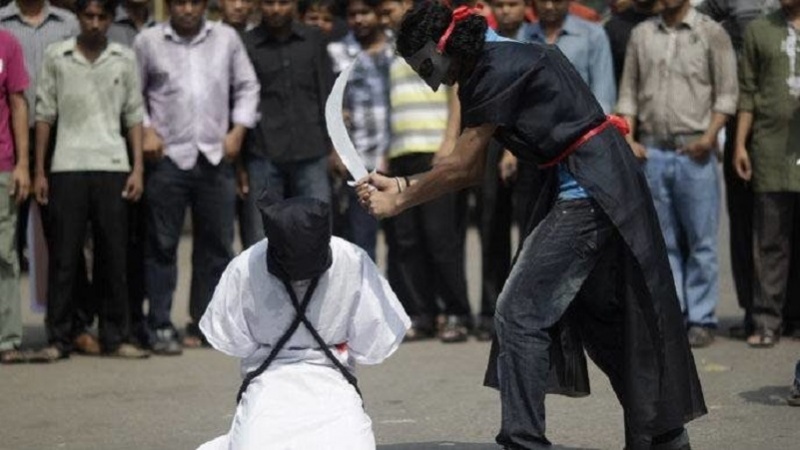
In early February, away from the tumults of world media a child was beheaded in the streets of Madinah in Saudi Arabia, murdered by a religious zealot to assuage the self-proclaimed righteousness of an elite who has defined itself in bloodshed.
Zakariya Bader al-Jabir was seven years old … for Wahhabist Saudi Arabia his faith: Shia Islam, sat him outside humanity’s fold, and his death was a just act, a cleanse, an affirmation that under the skies of Ale Saud all designated ‘apostates’ will suffer annihilation.
This is the nation our world leaders, our state officials and representatives in the West have called and still call friend and ally.
How, can anyone, in the face of everything that has transpired over the decades — the unapologetic calls for genocide on the basis of faith, the en masse production of terror radical militants, and the countless heinous crimes against humanity, still contemplate an alliance with the kingdom?
Those questions are not meant to be rhetorical … they are crying out for an answer; preferably one that does not demand for the normalization of sectarianism. Unless we are careful, we stand to soon resemble those very monsters we say to want to defeat. To tolerate the ideological abomination that is Wahhabism equates to the rationalization of Terror on the basis of pecuniary greed, and that more or less put us on equal footing with some of the most debased of radical militants in existence today.
We hold that beauty exists in the eyes of the beholder; could it be now that both terrorism and fanaticism have become notions relative to the geopolitical purpose they serve as opposed to notions we ought to confront absolutely wherever and whenever they may lie or hide. I would like to think the latter … If not, then we may as well brace ourselves for the grand return of the Black Flag Army and resigned ourselves to a life spent in humiliation and fear. If Wahhabism was formerly confined to the kingdom, it is no longer bound by geography.
A report by the Henry Jackson Society in 2017 established that “Saudi Arabia has, since the 1960s, sponsored a multimillion dollar effort to export Wahhabis across the Islamic world, including to Muslim communities in the West … In the UK, this funding has primarily taken the form of endowments to mosques and Islamic educational institutions, which have in turn played host to extremist preachers and the distribution of extremist literature.”
And: “Influence has also been exerted through the training of British Muslim religious leaders in Saudi Arabia, as well as the use of Saudi textbooks in a number of the UK’s independent Islamic schools.”
To the tune of several billions of dollars per year since the mid-Seventies, Saudi Arabia has exported its ‘faith’ to an only too blind world, ensuring that its literature would drown out all other religious texts, and in a few swift decades rewrite millions of unsuspecting Muslims away from normative Islam and into the clutches of Wahhabism, ensnare them.
As a report published by Freedom House reads: “Adherents of Wahhabism constitute a small minority within world Islam, yet, Saudi Arabia is trying to assert itself as the world’s authoritative voice on Islam.”
Divorced from its context, rewritten to fit a violent and reactionary worldview Wahhabism and its sister in faith ‘Salafism’ have defiled the world of Sunni Muslims to the extent today that it is almost impossible to differentiate them. As for the many communities that exist under its fold, the insidious miasmas of radicalism have tainted minds with an all-encompassing and paralyzing fear.
And why are we even surprised when hate is being taught at school to be later on exported and disseminated across academia abroad, through a clever game of sponsorships and donations?
Nina Shea, Director of the Center for Religious Freedom said back in 2006, “What is being taught today in Saudi public school textbooks about how Muslims should relate to other religious communities will poison the minds of a new generation of Saudis” A decade on and little has changed … if at all.
Wahhabism has grown so bold under our collective silence that acts of murder against Shia Muslims in the streets of Saudi Arabia are now if not common, expected.
Wahhabism is no longer contained though, and while we may still argue that such issues have nothing to do with us per se in the West, that would be to ignore the elephant standing in all our living rooms.
Saudi Arabia is not just fanning hatred at home, it has built itself a network spanning continents. What we should ask ourselves today is how long it will take Saudi Arabia’s zealots to claim our children’s lives in our streets … all the while they are being dined by pampered into signing lucrative contracts by our elite.
In an article published in the Spectator, John R Bradley, puts the problem under an interesting light. He writes: “A recent report, suppressed by the UK government, revealed the majority of funding for UK mosques that promote extremism, and which play a crucial role in radicalizing homegrown so-called jihadis, originates from Saudi Arabia and other Persian Gulf Arab countries that also embrace the odious Wahhabi ideology. These findings tally with other exhaustive studies on the expansion of extremism, both here in the UK and in Europe, which have singled out the spread of Saudi-sponsored Wahhabism as the gravest threat to our security and values. All were similarly ignored by those who rule in our name.”
In an article published in the Spectator, John R Bradley, added: “Last month, the former head of MI5, Jonathan Evans, warned that Britain will face a terror threat for at least 30 years. Only the most blinkered observer would find it difficult to understand his concern. For with the near fall of Daesh, thousands of jihadis steeped in the caliphate’s Wahhabi ideology are returning to Britain and Europe, determined to keep alive the dream of massacring infidels.”
Little Zakariya Bader al-Jabir is one of the many lives that was claimed by Wahhabism, and while many still discuss and argue the validity of an alliance with wealthy Saudi Arabia we may want to consider building defenses against those zealots who so desperately dream of a grand crusade against our children.
A Saudi little boy, while on a pilgrimage to the holy city of Medina with his Shia mother, has been barbarously killed for unknown reasons, fueling speculations that he could have been a sectarian and hate crime victim.
According to what circulated on social media, Zakariya Bader al-Jabir -- said to be six or seven years old -- was savagely murdered by a taxi driver in front of his mother late last month. The New Arab website says his mother’s recitation of salutations for the family of Prophet Mohammed (PBUH) outraged the taxi driver who, according to “witnesses”, broke the window of his car, before grabbing the “seven-year-old” boy by the back of his shirt and slitting his throat in front of his mother.
No official statement has been issued by either the police department or the Saudi government as of now over the potential link to sectarianism in this investigation, and this highlights the need for a transparent probe into the heinous crime.
The Saudi Shia community has been under military crackdown by their government and many Shia activists are in prisons and on death row.
The Saudi regime has cracked down on its Shia citizens, particularly in the Eastern Province, which has been the scene of peaceful demonstrations since February 2011.
Protesters have been demanding reforms, freedom of expression, the release of political prisoners, and an end to economic and religious discrimination against the oil-rich region. The protests have been met with a heavy-handed crackdown by the regime. Regime forces have increased security measures across the province.
Over the past years, Riyadh has also redefined its anti-terrorism laws to target activism. Back in January 2016, the Muslim world was infuriated when prominent Shia cleric Sheikh Nimr Baqir al-Nimr, an outspoken critic of Riyadh, was executed by Saudi authorities. Nimr had been arrested in Qatif, Eastern province, in 2012.
EA/ME
Tags