Plight of Shi’a Muslims in Saudi Arabia
May 20, 2019 11:11 UTC
Muslims who follow the School of Jurisprudence of the Ahl al-Bayt of Prophet Mohammad (Blessings of God upon him and his progeny), and are known as Shi’a, are severely persecuted by the Wahhabi cult that rules the spurious state called Saudi Arabia which the British created in 1932 for the desert brigand of Najd, Abdul-Aziz.
Now we have a report on their situation by a Saudi blogger living in exile, Omaima an-Najjar for Al-Jazeera, titled: “Plight of Shi’a Muslims in Saudi Arabia”.
Last month, Saudi Arabia quietly beheaded 37 people, mostly Shi’a Muslim men from the eastern oil-rich region – which the Saudi clan had occupied in 1913. They had all been sentenced in what international human rights organisations called "grossly unfair" trials - some for alleged "spying" for Iran and others for joining an alleged ‘terrorist’ group. Many of them were tortured into signing false confessions.
None of the bodies was given back to the families, who were told not to hold funerals. In a cruel measure, two of them were pinned to a post for the public to see – a measure clearly meant to stir fear within the Shi’a Muslim community, which makes up more than 25 percent population and is the predominant majority in the Eastern region – while throughout the country the ruling Wahhabis hardly make up 12 percent of the whole population.
Although the Saudi authorities have tried to present this case as a national security issue – trying the 37 men in a kangaroo court that portrays them as ‘terrorists’ and Iranian agents – it has little to do with either terror acts or Iranian influence.
Shi’a Muslim disenfranchisement in Saudi Arabia has deep historical roots and only recently has been instrumentalised in Riyadh’s rivalry with Tehran. The only "crime" of the Shi’a Muslim men who were executed in April and the many more who are still being held in Saudi jails was to demand the end of systemic discrimination and human rights abuses.
Tensions between the Shia population of al-Hasa region (roughly today's Eastern Province) and the House of Saud from Najd have a long history and go back to the time when Mohamed Ibn Saud adopted the teachings of (the British agent) Mohamed ibn Abd al-Wahhab in late 18th century and used them to legitimise his rule. As he and his successors sought to expand the territory they controlled eastward under the banner of fighting infidels and deviants, the Shi’a Muslims of al-Hasa resisted.
In their raids, Wahhabi marauders would often destroy shrines and places of worship belonging to the Shi’a Muslim and Sufi orders; in 1802, an army led by Saud bin Mohamed even attacked the holy city of Karbala in Iraq, looting the sacred shrine of the Prophet’s grandson, Imam Husain (AS), stripping the dome and the minarets of their gold, massacring a large part of the civilian population, and leaving a painful mark in the collective memory of Shi’a Muslims.
For a century, al-Hasa would slip in and out of the control of the Najdi clan of Saudi marauders, until in 1913 it was occupied by Abdel Aziz Ibn Saud, for whom Britain created Saudi Arabia in 1932, seven years after he occupied Hijaz, the Land of Revelation after desecrating the holy cities of Mecca and Medina and massacring thousands of Muslims in the precincts of the holy Ka’ba and the Prophet’s shrine.
Abdul-Aziz unleashed a campaign of repression against the Shi’a Muslims who opposed his rule. As he started building the foundations of the Saudi state, Wahhabi attitudes towards the Shi’a Muslims were woven into its institutions.
As a result, Shi’a Muslims to this day remain highly disenfranchised within Saudi society. For example, they are not allowed to hold key posts within the ministries of defence and interior, the National Guard, and the royal court. They face various restrictions on religious worship; permits for building Shi’a Muslim mosques are often denied and, consequently, in places like the city of Dammam, there is only one mosque for the hundreds of thousands of Shi’a Muslims living there. Processions during Ashura, the 10th of the month of Muharram commemorating the martyrdom of the Prophet’s grandson Imam Husain (AS) during the heartrending tragedy of Karbala, were banned until 2005 and today are still curbed in various ways.
Most importantly, although the majority of Saudi oil reserves fall within the territory of the Eastern Province, the Shia majority of the region hardly benefits from the country's massive oil revenues. Since the founding of the Saudi state in 1932, it has suffered systematic socioeconomic marginalisation and dispossession.
In addition, Saudi religious authorities - vested until recently with almost unrestricted power to police the public - have been allowed to spread anti-Shi’a Muslim rhetoric and even insert it into school curricula. As a result, anti-Shi’a Muslim attitudes among the general population are widespread and have led in the past to various attacks on the community.
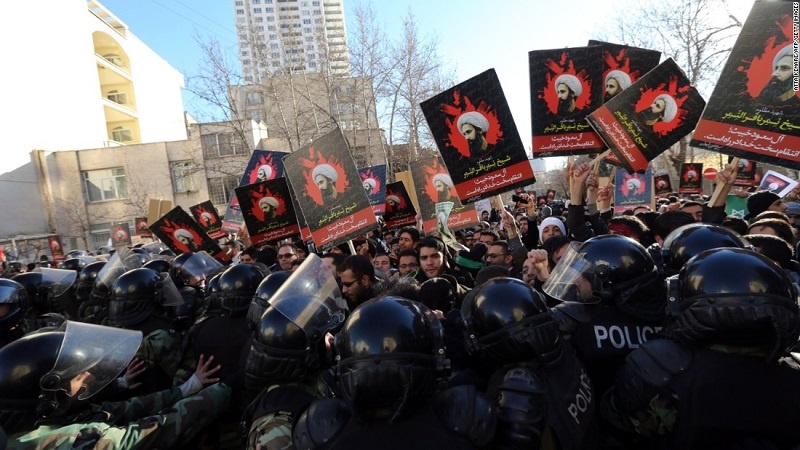
Over the decades of systemic discrimination and disenfranchisement, Shi’a Muslim anger would periodically boil over and result in mass protests, which would always get brutally suppressed by Riyadh.
In 1979, the triumph of the Islamic Revolution in Iran spurred mass demonstrations in the Shi’a-majority city of Qatif, which were met with a violent clampdown and executions.
In 2011, the Islamic Awakening in the Arab World also inspired pro-democracy protests in the Eastern Province. The Saudi authorities were quick to put down the unrest, opening fire on demonstrators and arresting many. It is for participating in these protests that a lot of the 37 men were arrested.
They, along with a number of other activists calling for the end of Wahhabi apartheid and cultish discrimination, were charged with terrorism. In 2016, Shi’a Muslim leader Nimr Baqer an-Nimr, who had supported the protests and had long been critical of the Saudi clan, was executed.
Being well aware that the socioeconomic punishment, cultish apartheid and marginalisation of the Shi’a Muslim community is fuelling anger among the Shi’a Muslims, Saudi authorities are in constant fear that the community might start an uprising calling for independence. Shi’a Muslims have also been accused of being Iranian agents and portrayed as "the fifth column" in the country – a charge that is rejected by both the Shi’a Muslims of Arabia and the Islamic Republic of Iran.
The majority of Shi’a Muslims in Saudi Arabia are followers of Grand Ayatollah Seyyed Ali Sistani. Thus, to present Shi’a Muslim protests and opposition to the House of Saud as an "Iranian plot" is not only completely inaccurate, but it also whitewashes a long history of tensions between the community and the Saudi rulers and their Wahhabi backers and the institutionalised cultish discrimination in the country.
The Shi’a Muslims, like many other Saudi citizens, want their human rights to be respected, to have equal opportunity and access to the massive national wealth. They also want religious freedom and protection against hate crimes.
But as the House of Saud grows ever more anxious about its unstable position, it will not only increase the oppression of Shi’a Muslims, but also escalate its struggle against Iran. After all, having a "foreign enemy" boogeyman which can be used to justify any amount of internal repression is the easiest way to control a discontented population. And in this game of regime survival, the Shi’a Muslim community in Saudi Arabia will likely continue to pay the steepest price.
AS/ME
Tags