
Why protesters set fire to the US Embassy in Honduras? (2)
Jun 30, 2019 18:12 UTC
Ten years after a US-backed coup handed Honduras over to big business, the country is rising up. A leader of deposed President Manuel Zelaya’s party explains to ‘The Grayzone’ what’s behind the protest wave, writes journalist Alexander Rubinstein in his report titled: “Why Protesters Set Fire to the US Embassy in Honduras?”
While Clinton’s State Department did not openly endorse the coup, it immediately defied the Organization of American States’ (OAS) unanimous demand that Zelaya immediately return as president. Clinton unilaterally circumvented the OAS, informally recognizing the business-friendly Roberto Micheletti as the democratically-elected president to be.
The negotiations took place at gunpoint once Zelaya returned to Honduras, and were designed to legitimize the coup behind democratic guise. Clinton’s long-time confidante, Lanny Davis, meanwhile, was hired by the Honduran chapter of the Business Council of Latin America to serve as the primary Beltway lobbyist for the coup. Together with Clinton, Davis consolidated a regime change narrative within Washington circles.
The post-coup elections in 2009, marked by fraud and violence, brought Porfirio “Pepe” Lobo Sosa into the office of presidency. Lobo Sosa, like the current president, was also adjacent to drug trafficking. His son, Fabio Lobo, is serving a 24-year sentence in the United States for conspiring to import cocaine into the country.
Meanwhile, Lobo Sosa’s wife, Rosa Elena de Lobo, is facing up to 80 years in jail for having pilfered nearly USD $500,000 from public coffers during his time in office. Ironically, Lobo Sosa is now calling for his successor, Juan Orlando Hernández, to resign.
Due to austerity measures ushered in by his government and enforced through the militarization of the country, Juan Orlando Hernández quickly became a hated figure among average Hondurans. Nevertheless, he announced he would run for reelection, which is explicitly banned by the constitution. What’s more, Hernandez’s party was banking its success on a series of dirty tricks.
During the run-up to the 2017 election, The Economist weekly of Britain obtained a two-hour recording from a “participant” in a training session held by Hernández’s National Party for party activists “manning voting tables at polling stations on election day.”
The magazine reported: “By The Economist’s count, the session’s leader advocates at least five vote-rigging methods, couching them in banal terms such as ‘strategy’ and ‘technique’.”
Hernandez’s opponent, Salvador Nasralla was five points ahead with most of the vote counted. But suddenly, election authorities stopped releasing results. Almost two days later, when the vote counting resumed, Nasralla’s lead had vanished, allowing Hernández to squeak by with a tiny margin of victory.
Election observers from the Organization for American States noted “the lack of guarantees and transparency, as well as the accumulation of irregularities, mistakes and systemic problems that have surrounded this electoral process during the pre-electoral phase, election day, and the post-electoral phase, that as a corollary do not allow the Mission to have certainty about the results.”
From an on-the-ground perspective, Torres recounted the timeline of the vote-counting process to The Grayzone: “When they had 80 percent of the votes counted we were winning by five points, and so they shut down the system 466 times until they started winning again. We went to the streets and we were on the streets for a month fighting. Then the U.S. ambassador, Heidi Fulton, appeared before the nation saying that the United States recognized Hernández as the winner. Then they provided the support of the United States military forces and they continued giving money to Hernández.”
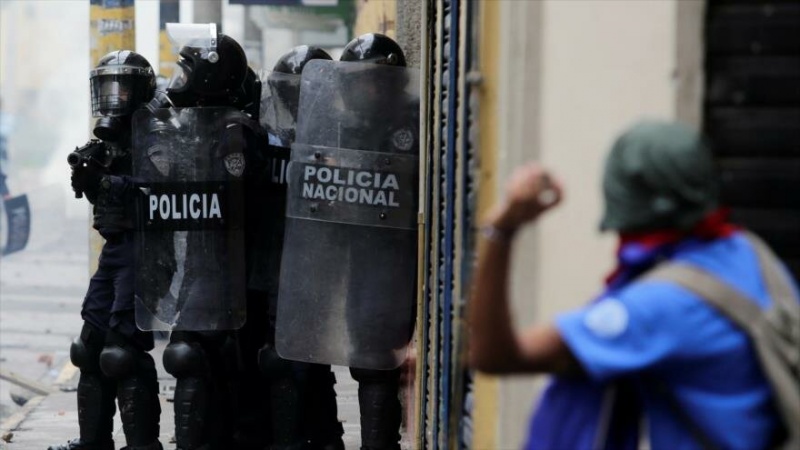
Protests against the apparent fraud exploded around the country. The Office of the UN High Commissioner for Human Rights found that at least 22 civilians were killed in the protests, and at least 16 of them were gunned down by police. 1,300 people were thrown in jail, many in military detention centers.
Torres noted: “We have two compañeros who are still in prison a year and a half after they were accused of burning the front door of a hotel in Tegucigalpa.”
They are Edwin Espinal and Raúl Álvarez who await trial in the military-run, US-style maximum security “La Tolva” prison. Edwin Espinal is a veteran human rights defender held by the Hernandez government
Adrienne Pine told The Grayzone: “Edwin Espinal and Raúl Álvarez are political prisoners. Edwin’s case in particular is particularly egregious, as he is a well-known human rights defender who has been threatened, arbitrarily detained, and even tortured dozens of times by Honduran security forces since the coup for his work organizing for social justice causes. His criminalization for standing up for human rights and democracy stands in stark contrast to the impunity enjoyed by the violent state security forces and death squads,” Pine continued. “The fact that Edwin has protective measures issued by the Inter-American Human Rights Court meant nothing to the U.S.-supported regime, which has placed him and Raúl in pre-trial detention in a prison designed for the most violent organized criminals, putting both of their lives at serious risk. Edwin has lost nearly fifty pounds and has been refused necessary medical care.”
Honduran prisons are notoriously inhumane due to poor sanitation, overcrowding, and insufficient nutritional standards. The country’s prison system is designed to accommodate 10,600 inmates, but held nearly twice that in 2018.
The UN High Commissioner’s Office cites “credible and consistent testimonies” that those detained during the 2017 electoral crisis were subjected to abuse in some cases constituting torture and that the police had fired upon protesters indiscriminately. The same report also found that during the protests, at least six journalists were attacked by police and broadcasts that criticized the government were shut down.
Attacks on the press during the post-electoral crisis were just the tip of the iceberg, however. Even the Ministry of Justice and Human Rights of Honduras, itself a part of the government, documented the murder of 25 journalists between 2014 and 2016 while Hernández was in power. In 2016 the body also registered 16 violent attacks on lawyers, in which 13 were killed.
Since the 2009 coup, according to the human rights organization, Cattrachas, more than 300 Hondurans have been killed. The numbers represent a dramatic increase in violent hate crimes against the community compared with previous periods.
And in 2019 alone, prior to the current uprising, the UN Human Rights Office “received 51 complaints about murders of human rights defenders in the country, of which at least 21 have been verified by UN Human Rights Office.”
A new criminal code to go into effect in November, published on May 10, lays bare the prosecutorial priorities of the Honduran government. For one, the law reduces the maximum prison sentence for aggravated drug trafficking by five years. Some new penalties introduced under the law bring prison sentences as low as four years for trafficking crimes. It also opens up the door for traffickers who cooperate with investigations by authorities.
The legal reforms were proposed in the wake of the 2018 arrest of President Hernández’s brother, Juan Antonio Hernández, in Miami on drug trafficking charges. According to LIBRE’s Torres, the US has looked the other way while the Hernández government has done the bidding of powerful local drug cartels.
He said: “The United States knew in 2017 that Juan Orlando Hernandez was being investigated over participation with drug cartels and still supported him and allowed him to forcefully stay in power with an illegal reelection, and without winning.”
Meanwhile, journalists and publishers face fresh risks under the new criminal code, including “crimes against honor” and “crimes against morality.” Defamation and slander may now come with increased prison sentences, including more than a year behind bars.
Prison sentences for women who get abortions and doctors who perform them will increase to up to six and 10 years, respectively. Participation in “illicit meetings and protests” will also be punishable by up to four years in prison, while protest leaders and financiers could face 15 years.
These draconian measures have been met with virtual silence from Washington and little coverage in a corporate US media that served as a megaphone for Nicaragua’s right-wing opposition when it launched a coup in April 2018.
“The hypocrisy is really obvious,” Torres said. “Nicaragua is just beside Honduras. We are neighbors. And it’s interesting how in two countries that are so close, that are in the same region, the US has such different policies.”
The contradiction in treatment between Honduras and Nicaragua can be easily understood in terms of US military interests. Just over 50 miles from Tegucigalpa is the Palmerola Soto Cano military base, where the US army has free reign.
Hernández supported US threats against Venezuela, acceded to Trump’s call to move the Honduran Embassy in Occupied Palestine from Tel Aviv to Bayt al-Moqaddas in violation of international law, and agreed to surges in US troops in the country’s Northern Territory to have more control in the Caribbean and Central America.
Torres explained: “Even though the DEA has some investigation into Hernández it is clear that the US Southern Command wants Hernández in power.”
The US gave more than $80 million in military assistance to the Hernández government between 2013 and 2017 according to the Security Assistance Monitor
Recently, tires were set on fire in the doorway of the US embassy in Tegucigalpa. The Associated Press reported that it wasn’t clear why those who set fire to tires at the embassy’s doorstep “weren’t stopped by guards outside the embassy.”
While the uprising has been largely peaceful, acts of property destruction have occurred. Protest leader and head of the Honduran Medical Association Dr. Suyapa Figueroa, blamed “infiltrators from this country’s dictatorial government.”
In response to a tweet by reporter Gilda Silvestrucci noting that 20 minutes has passed since a group of masked individuals set and there were no police officers or firefighters to be seen, the Black Fraternal Organization of Honduras, OFRANEH, responded: “What a coincidence [that this would happen in] one of the most surveyed and protected locations in Honduras…”
Adrienne Pine, the anthropologist at American University, noted, “The similarities between false flag operation that took place at the Tegucigalpa Marriott and the embassy fire are obvious. In the former instance, police uncharacteristically disappeared from the scene. Numerous infiltrators from the National Party were clearly identified and recorded inciting and participating in violence; yet only longtime human rights defenders were criminalized and are being held as political prisoners.”
Pine continued: “The same thing happened last Friday–you see the unprecedented absence of security forces at the US embassy just before a group of heavily disguised individuals set the fire, and the immediate targeting of social justice activists, despite a similar lack of evidence that they played any role in the vandalism.”
While the fire very well may have been an act of sabotage by an agent provocateur, it could have also been the result of the pent-up anger of the Honduran population at the United States for its role in the coup and dictatorship that followed. Bystanders at the scene chanted, “American trash, American trash” as the fire burned.
Since May 24, the embassy had issued three “security alerts” and two “demonstration alerts.”
It also issued a statement condemning the arson, which read: “The acts of violence that took place today at the US Embassy in Honduras are unacceptable. We are working closely with the Honduran authorities to bring those responsible to justice.”
A week later, protest leaders refused a government offer for dialogue, vowing only to engage in talks once the government’s IMF-backed scheme targeting the healthcare and education sectors are withdrawn.
A few days later, activists announced that social security workers from the IHSS would join the struggle.
Though the protests were triggered by the latest round of privatization measures, Hondurans are also lashing out against the outside powers that imposed these policies.
Torres told ‘The Grayzone’: “The action against the US embassy is something that has been, historically, prepared in the mind of the people. People are aware that the United States embassy is the only reason why Juan Orlando Hernández is still the president of Honduras.”
AS/SS