China is Hong Kong’s future, not its problem
Jul 20, 2019 20:08 UTC
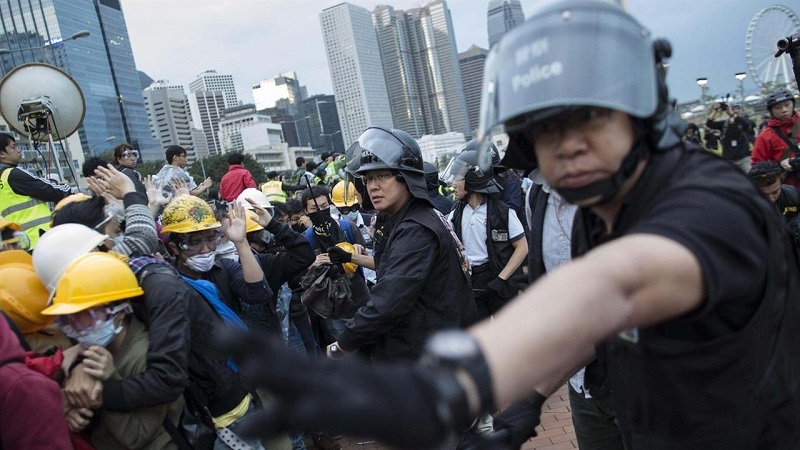
The western media and western regimes are trying to blow out of proportion the protests in Hong Kong, which are definitely no secessionist movement against Beijing, and merely part of people’s right to express their agreement or disagreement with local laws in a sovereign Chinese territory – as it happens in all world countries, including the US and European states.
Stay with us for an article in this regard for ‘Asia Times’, titled: “China is Hong Kong’s future, not its problem”.
The author is Ken Moak, who has taught economic theory, public policy and globalization at university level in the US for 33 years, and co-authored a book in 2015 titled “China's Economic Rise and Its Global Impact”.
With all the Western media hype about so-called “pro-democracy” protests in Hong Kong about its return to mainland China, one could be forgiven for thinking that the country is the territory’s problem. The Western media portrayal of the protests gave the appearance that Hong Kong’s future would be at risk when the territory fully reverts to mainland rule.
However, reality on the ground paints a very different picture. China played a very important role in sustaining Hong Kong’s economy by sending in large numbers of tourists, designating the territory as the yuan hub and affording other economic promoting stances. And on the charge of the central government taking away Hong Kong’s “freedom,” it might be an exaggeration and, in fact, untrue. A young man seen on television responding to a reporter’s question about why is he waving the colonial flag in the recent protest said, “We have freedom in Hong Kong”, which is proof that the Special Administrative Region (SAR) is just as free, if not, more as during the colonial era. Judging from the comments made by former Hong Kong residents now living in Canada, it is doubtful that Britain would allow its subjects to protest its authoritarian colonial rule.
Moreover, the Chinese central government seemed to want a “harmonious and peaceful” re-unification with the institution of the “one country, two systems” architecture.
The “one, two systems” platform was first proposed by Marshal Yi Jiangying as a way to reunite Taiwan with the mainland. Deng Xiaoping applied his comrade’s proposal for Hong Kong, allowing a 50-year period for the former colony’s gradual and peaceful re-unification with the “motherland.” It was a recognition that the mainland China and Hong Kong were at different stages of development, the former being in the “primary stage” of socialist development whereas the latter was reaching a developed economy status. The Chinese central government might also be aware that after 150 years of British rule, system of government, cultural norms, social values and other institutions were incompatible with those of the mainland. The 50-year “status quo” period was therefore given to narrow the differences, paving the way for a “harmonious and peaceful” re-unification.
As indicated earlier, the “one country, two systems” concept was to be a test bed for Taiwan’s eventual re-unification. If the experiment fails in Hong Kong or the central government reneges on its promises made under the platform’s framework, peaceful re-unification with Taiwan could be lost forever. In this sense, China has every reason to make the process work.
Furthermore, had China wanted to retake Hong Kong, it could have done so after the Korean War that lasted from 1950 to 1953, or any time since then. The late Premier Zhou Enlai accurately and wisely believed that a prosperous Hong Kong with its connection to the world was in China’s interest and could help the mainland in establishing a modern economy. In that regard, Hong Kong did, acting as a conduit to attract foreign investment, allow it to acquire advanced technology.
Retaking Hong Kong at the end of the 99-lease proved to be a rational and wise decision, in that chaos on both sides of the bounder might have been avoided, allowing the two sides to help each other in sustaining economic growth and stability. But central government also made clear that Hong Kong is part of China, thus its future is intrinsically linked to the mainland.
With the exception of a small number of “separatists,” the majority of Hong Kong citizens seem to agree, in light of news reports out of the territory, that the majority of Hong Kong residents oppose the “pro-democracy” protestors, accusing of disrupting if not wrecking its society.
However, large numbers of people also appear to be frustrated with the SAR government’s inability or unwillingness to improve its socio-economic woes. While Hong Kong is a wealthy region, sufficient housing and employment opportunities for the young are sorely lacking. For example, many complained that the government was more interested in promoting the interests of large land developers and did not build enough social housing. Indeed, a big percentage of the youths joining the “pro-democracy” protests might be just to vent frustration over government inaction in addressing their plight.
There lies the challenge: In order to have a “harmonious and peaceful” re-unification that would be supported by Hong Kong people, the government must introduce socio-economic enhancing programs and assure them that their freedoms and way of live will be protected. It should also be remembered that many in Hong Kong were “refugees” from the mainland’s “Great Leap Forward Movement” and “Cultural Revolution” days, many of whom experienced hardships and persecutions from those devastating events.
Perhaps a good start might be building massive social housing units, like the British colonial government did. That policy was said to be largely responsible for sustaining social stability and triggering economic growth. Construction activities had and still have significant spillover effects, promoting growth in home appliance manufacturing and a host of other related industries.
The government might also want to explain policy proposals clearly and thoroughly to avoid misunderstanding and give “pro-democracy” activists an excuse to de-rail them like the education curriculum amendment or extradition bill.
Once the majority Hong Kong people are convinced that they have a future within China, re-unification would likely be supported and embraced.
AS/SS
Tags