US got scared – voices of resistance in post-coup Honduras (1)
Jul 26, 2019 08:06 UTC
Members of the resistance in Honduras tell MintPress how a US-backed coup and the neoliberalism it brought with it have negatively impacted their country by plunging it a host of insoluble problems and trapping the people in misery.
Stay with us for the first part of a 3-part report by Washington-based journalist Alexander Rubinstein, who formerly worked for Sputnik, titled: “US Got Scared – Voices of Resistance in Post-Coup Honduras”.
MintPress News went to Honduras and spoke with a number of leaders of the Honduran resistance amid a 66-day uprising over a neoliberal austerity deal reached between the government as the country marked the 10-year anniversary of the US-backed coup d’etat.
Recently, the Honduran government passed a privatization law, the run-up to which had triggered uprisings challenging the mandate of President Juan Orlando Hernandez and protesting the implementation of a privatization deal reached with the International Monetary Fund (IMF) — a deal kept secret until this week. The battle against it was fought tooth and nail, with average Hondurans following the lead of healthcare and education activists.
MintPress has obtained a copy of the law. The document details the government’s plan to sever 6 billion lempiras ($242 million USD), and includes instituting a maximum wage on public sector contract “technical and professional” workers amounting to $2,426 a month, but promises not to cut healthcare and education. An agreement with the IMF over the state-run electrical company remains in question.
What is known is that the deal consists of more of the same neoliberal remedies that have already devastated Honduran civil society. One person interviewed by MintPress called the approach “neoliberalism on steroids.”
And she would know: her husband is a political prisoner sitting in a US-designed maximum security facility. The prison was paid for under the Honduran Security Tax, a program backed by the then Secretary of State Hillary Clinton that bankrolls the military and police while the rest of the government is gutted.
Adrienne Pine, a Professor of Anthropology at American University in Washington and expert on Honduras, told MintPress: “The fact that education and healthcare were left out is a pretty big win for the movement because that is what they were planning to cut, and the healthcare and education workers who have led this struggle against this have prevented those cuts even though there has been this very radical reduction in public spending.”
On May 6, the IMF announced it had reached a “staff level agreement” that was believed to be targeted towards healthcare, education and more. That same day, protests started breaking out.
But as news emerged on Tuesday of the deal becoming law, the IMF also announced its approval of a plan to restructure the public electric company and said it would give the Honduran government $311 million in loans over the next two years. Around the same time, a fresh corruption scandal was unfolding at the electric company. Professor Pine explained to MintPress: “ENEE [the Honduran public electric company] has already been subject to privatization measures over the past few years that have significantly weakened it. Problems in the ENEE have to do, at their root, with the privatization itself, but right now it looks like the IMF and the U.S. are justifying the privatization by using examples of corruption at the agency rather than addressing the underlying structural issues.”
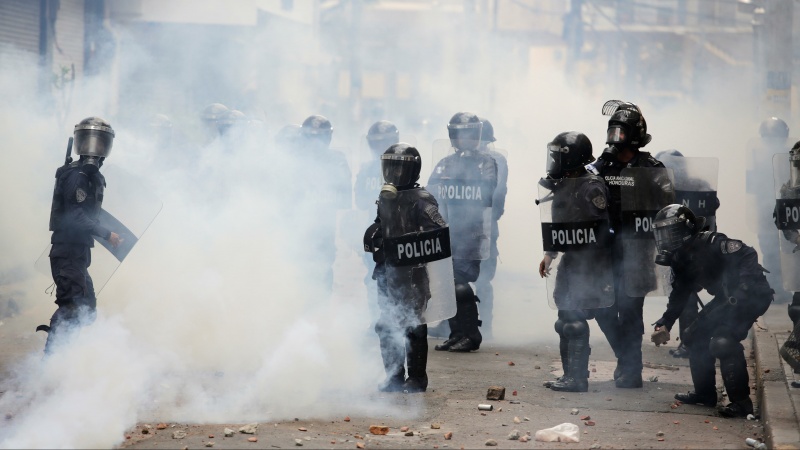
The resistance in Honduras fought off further privatization of health care and education in a struggle that left piles of students shot and scores of people killed, as well as resulting in the political imprisonment of a young man who is accused of fueling a fire at the U.S. Embassy in the capital. Romel Valdemar Herrera Portillo, 23, sits in a military-run prison, designed by the United States, called La Tova alongside political prisoners Edwin Espinal and Raúl Álvarez.
The history of the past decade in Honduras is among the most telling examples of US-backed regime change in the Western Hemisphere. A powder keg for the migrant crisis that popped up under Barack Obama and worsened under Donald Trump, the military operation that deposed leftist reformer Manuel Zelaya from the presidency informs Honduran life at every level today.
MintPress News traveled to Honduras around the 10-year anniversary of the coup d’etat, speaking to a range of leaders of the resistance against the National Party, which has dominated politics in the country since the coup. The National Party is led by President Juan Orlando Hernandez (JOH), a widely reviled neoliberal leader believed to be involved in drug trafficking, electoral fraud and death squads.
The post-coup neoliberal policies ramped up under JOH’s reign have rendered Honduras a playground for the business elite and drug cartels and brought the poverty rate to levels unrivaled in the region. Disappearances and lethal violence from police, private mercenaries and drug cartels have also skyrocketed.
Revelations that JOH has been under investigation by the Drug Enforcement Administration (DEA) since 2013, according to U.S. federal court documents released this year, came as little surprise to many in the resistance; JOH’s brother is himself in prison in the U.S. on drug trafficking charges. But it did pour salt on fresh wounds, as the United States backed JOH’s re-election in 2017, even though the Honduran constitution explicitly forbids second terms.
While in Honduras, MintPress examined the effects of the coup from multiple angles, including: cuts to education; repression against students and teachers; cuts to the healthcare sector; the political development of Hondurans; electoral fraud; death squads linked to big business; the conditions of political prisoners and the plight of human rights workers; and the effects of neoliberalism on the healthcare sector. MintPress also looked at the role of creative culture in the resistance.
As MintPress previously reported, staff journalist Alex Rubinstein was detained immediately upon landing in the capital, Tegucigalpa. It was “a testament to the government’s unease” around the anniversary of the coup and in the face of more than 50 days of active uprising. He said: “I was just let out of detainment at the airport in the capital of Honduras. They didn't explain why the detained me, just asked a bunch of questions.”
MintPress spent nearly a week in the capital, Tegucigalpa, a city that is both militarized and yet ruled by crime at night, a dynamic that makes the often cozy relationship between the state and organized crime palpable throughout much of the city. The prevalence of anti-JOH and anti-National Party graffiti appears as a glimmering of an uprising in a city otherwise divided into quarters of poverty and opulence: from poor, Libre strongholds like El Carrizal to areas where Burger King and Little Caesar’s are second and third only to Juan Orlando. United States colonialism is, basically, omnipresent. American fast-food restaurants, mostly a luxury for the country’s tiny middle class, operate tax-free in the country, while those who can’t afford a Big Mac get squeezed on their electricity, for example.
The streets of Tegucigalpa tell the story of the resistance, to a degree. One tag in the city refers to the use of graffiti as a means of communicating a message: “When justice is silenced, the walls speak.”
What follows are excerpts of MintPress News interviews from a range of leaders of the resistance against JOH.
Karen Spring, a Canadian citizen and member of the Honduran Solidarity Network, is imminently familiar with repression by the government. Her husband is veteran human rights defender Edwin Espinal, who was arrested during protests against Juan Orlando Hernandez’ unconstitutional re-election. The circumstances around Raúl Álvarez and Espinal’s arrests are startlingly suspicious — as were those of Romel Valdemar Herrera Portillo. Professor Adrienne Pine has characterized the incidents as potential false flags.
MintPress spoke at length with Karen Spring about the situation of her husband and other political prisoners. She described Espinal’s past work as an activist: being close with Berta Caceres; having witnessing a murder with his previous partner, who herself was later killed during a protest; being tortured by police; and eventually being held at a military-run prison designed by the United States, without trial and without a date set for it.
She said: “Edwin and Romel share a cell in the third cell block inside La Tova, a US style maximum security facility.”
Karen Spring has seen what she described as “neoliberalism on steroids” in her 10 years in the country. One measure that she highlighted was the “security tax” that was implemented with backing from Hillary Clinton. It’s a tax on transactions and businesses and funds JOH’s “security model.”
She said: “It’s a semi-private security tax that is controlled by the government but can receive international funding from the development banks. All the remittances that are sent from the United States to Honduras, there is a percentage that is taken out of that. In other words, migrants who come to the United States to send money to their families in Honduras even pay a price through the security tax, which has fueled the “militarization of Honduras and the construction of the prison where Edwin is being held.”
Spring described La Tova, where she said medication is hard to come by and food is scarce. Sunlight can be allowed for one hour every two weeks. No books, no pens; one television for maybe 200 people.
The prison, she says, is designed to provoke conflict. And “because Edwin and Raul and Romel [are] associated with the opposition,” prisoners are “blaming them” for the protests, increased prices and roadblocks over the course of the current uprising, while the government has taken away privileges and “basic rights” of prisoners during the uprising.
Karen Spring thinks that attacks against the three are being encouraged: “They are facing serious death threats. They’re in a prison that was built to hold and imprison the most dangerous people in Honduras, so people linked to organized crime… in the harshest conditions that you can place anyone in pre-trial detention… We believe that the fact that they’re in there and the authorities won’t move them even though they are aware of the death threats is because the orders to keep them there are coming from the highest level of the government — Juan Orlando Hernandez.”
Spring also told the story of another prisoner by the name of Gustavo Caceres. He sits in what Spring described as a “normal Honduran jail.”
His case is probably the best example of the cruel nature of the Public Prosecutor’s Office. He has a developmental disability and he can’t read, he can’t write and he can’t speak.
He’s not able to learn how to talk because of his developmental issue. He can say words here or there. He can say ‘comida’ [food]. But he can’t form a sentence, let alone defend himself. When he was arrested, they picked him up in a police patrol car and they took him to the station and they laid out a police shield and bags of marijuana and put it in front of him, and accused him of having police gear and having drugs when he was arrested even though they planted it on him.”
When Caceres was arrested, he “was selling bags of water to support his family,” around a protest taking place on a bridge, Spring said, adding: “They were just arresting people in massive numbers as part of a fear and terror campaign… Because he couldn’t defend himself properly, he has been in jail. He’s the longest imprisoned political prisoner.”
Today, Gustavo “washes clothes” for other prisoners for a small amount of money, which is sent to his family to help pay for food.
That was the first part of a 3-part article, titled: “US Got Scared – Voices of Resistance in Post-Coup Honduras”.
AS/SS
Tags