US got scared – voices of resistance in post-coup Honduras (3)
Jul 27, 2019 12:26 UTC
Members of the resistance in Honduras tell MintPress how a US-backed coup and the neoliberalism it brought with it have negatively impacted their country by plunging it a host of insoluble problems and trapping the people in misery.
Stay with us for the last part of a 3-part report by Washington-based journalist Alexander Rubinstein, who formerly worked for Sputnik, titled: “US Got Scared – Voices of Resistance in Post-Coup Honduras”.
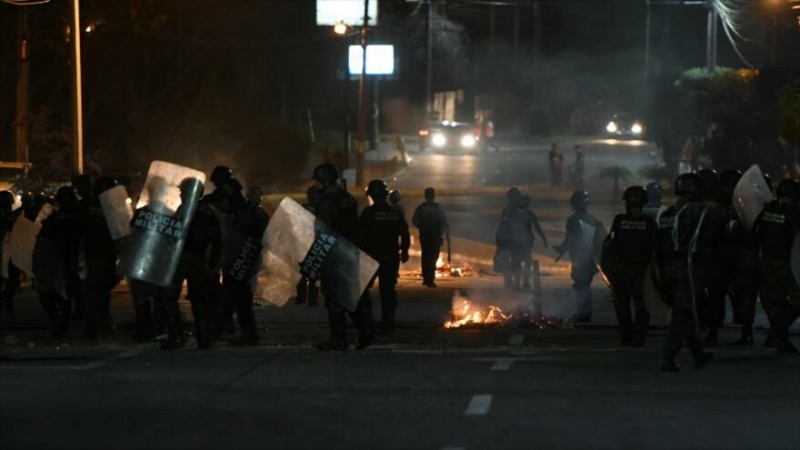
On June 24, some 40 military police invaded the National Autonomous University of Honduras (UNAH), which is supposed to have “autonomy” from the military since 1957, meaning it can’t be raided. Police had claimed that students had kidnapped a soldier, but activists say the students were just planning protests. Five students were shot with live rounds and eight students were injured in total. One professor also had a cardiac episode because of the tear gas, activists said.
In front of a defaced entrance sign at the university, MintPress spoke to Dorian Alvarez Reyes, a sociology student who witnessed the chaos. He explained that the sign — covered in bullet holes painted in red, and with the word “autonomous” crossed out and replaced with “military,” so that it reads “National Military University of Honduras” — was a symbol of the blood spilt by students and a protest against the infringement on the university’s autonomy.
Luisa Cruz, a teacher at UNAH, spoke to MintPress at a concert held on the night of the coup anniversary. She said it made her feel “terrible” that her students were unsafe. She said: Even as a mother of university-aged kids. It’s really a terrible issue about human rights…It also has happened at public high schools and public universities as well. We are a country that is living a really bad time in regard to the human rights issue. The United States is supporting a corrupt narco-dictatorship in Honduras. Why? Because they need a government that says ‘yes’ to anything the U.S. government says because they are interested in having us as a military platform so they can invade whoever they want — Venezuela and Nicaragua.”
Cruz continued to explain the raid on her university: “There was a protest by the students out on the street, and with a very ridiculous excuse…that the students got ahold of a policeman or soldier…they shot bullets and of course tear gas all over; there was about eight students wounded and I guess two of them were very badly wounded.”
Cruz said it wasn’t the first illegal invasion by police, while the university “has hired people to go in and kick students inside the university campus.” That’s why, she said, the university authorities “are really a shame.”
Cruz went on to discuss why the government cracked down so harshly on students: “The government knows that the student movement is really hard; they’re really tough and they’re really numerous — there’s a whole bunch of them. And these guys have lived a coup d’etat and they know what it is to be living under dictatorship.
“That’s why they really are afraid of these students and it’s the only thing that has dignity at the university. Not even the professors are dignified. I really feel ashamed of where I’ve been working for so many years.”
The rising costs of education, which are correlated with the increased influence of gangs and cocaine trafficking since the coup, have led many students to eschew education and turn to drug use and dealing. In order to improve the situation of the youth in Honduras, Cruz told MintPress it would require “hands off by the US” as a first step.”
She said: “They have us like this. We are on our knees in this country. I don’t know if you know about all those migrants heading off to Mexico and the U.S. border. Well, it’s no wonder. I mean there’s a whole bunch of people here that don’t have anything to eat or that live on a dollar a day. What are you going to eat with a dollar a day? Not even in this country can we eat with a dollar. So there’s a lot of people leaving the country because they have no hope.”
Walking through the crowd at a resistance concert on the 10-year anniversary of the coup, a man went from trash barrel to trash barrel picking through them for food. After Univision (a news station deeply distrusted by the Honduran resistance) broadcast footage of Venezuelans picking through garbage earlier this year, it sparked an international incident. Yet establishment media has almost entirely ignored the plight in Honduras, which has become the poorest country in the continental Americas since the US-backed coup.
And on the night of the anniversary of the military operation that changed everything, the Honduran resistance was celebrating with a concert at the center of town. The band Café Guancasco played their anti-JOH anthem, which translates roughly to “The place you’re going is out, JOH!”
In an effort to understand how Hondurans could find joy despite the neo-liberalization of their economy and incredible repression, I asked a translator recommended by an expert to MintPress News how it was possible:
This band is called Café Guancasco. Café Guancasco is a word that means gathering — to celebrate something. And we’re celebrating that we’re still alive…We are celebrating that we are doing a resistance against JOH and we’re celebrating that he is going to get the hell out of here.”
Pedro Joaquin Amador, a human-rights worker in Honduras, talked to MintPress News about what it’s like for human-rights workers in this country. “It’s very difficult,” he said, adding: “You have a lot of obstruction of justice in Honduras, and the military and police. We have a lot of difficulties getting information about all the victims of this country — when it happened, the coup, to right now in 2019 with the protest against Juan Orlando Hernandez.”
Amador went on to discuss the repression tactics used by the government during the current uprisings. He decried the use of tear gas and chemicals. “They shoot us with military weapons and there’s a lot of people killed,” he said, adding that international bodies should focus not only on Venezuela and Nicaragua but also Honduras.
Edgardo Florián, a poet and author of seven books, told MintPress that he doesn’t really get involved with politics anymore because of how much it has taken from him, and was driven to tears remembering those killed by the Honduran government in the 10 years since the US-backed coup.
“I’ve been beaten, hit by the gases. But basically the economy of the country is not the same,” Florián said, telling MintPress that it has made it hard for him to get by. JOH “must leave power. People don’t want him. The only people that want him are the people who receive a bag of food, or maybe some bread, 50 lampiras just to go out with a flag [and wave it.]”
JOH has been so desperate for support that the National Party has been caught handing out 50 lempiras ($2 USD) to desperate citizens to protest on his behalf. “We are people who don’t sell out their ideas just for 50 lempiras,” Florián said. Ironically, the JOH supporters participating in what was billed as a pro-peace march wound up viciously beating a student journalist.
Florián said that JOH promises good things but “inside he’s another kind of person. He’s something cold, a dark soul.” He went on to talk about the first person killed in protests against the coup — “our first victim,” as he describes it. “And now it’s a lot of people. Some, we know them. Others we don’t even know.”
The ramifications of the coup and the neo-liberal policies that upheaved Honduran society are felt in each and every sector of it. The business class and organized crime are flourishing, and will soon reap the benefits of yet another law that will come into effect in November, which further criminalizes activists and media while lessening penalties for drug trafficking.
The middle class, the creative class, the working class and poor; the women and elderly and the human rights workers; the left-leaning political class and the families of environmental protectors: all of these groups have had their livelihoods devastated by the coup, and the politically savvy blame Washington.
Ten years after the coup changed everything, the Trump administration is cutting funds from the United States Agency for International Development (USAID) — a US soft-power institution that helped foment the coup in the first place and spark the migrant crisis.
In response to the crisis that was designed to stoke Trump’s base and assert a cold-hearted foreign policy, the White House diverted funds earmarked for Central American countries to Venezuelan opposition leader Juan Guaido. Presumably, the United States wants to back a successful coup d’etat there and begin an even larger-scale privatization process, following in Obama’s footsteps in Honduras.
AS/SS
Tags