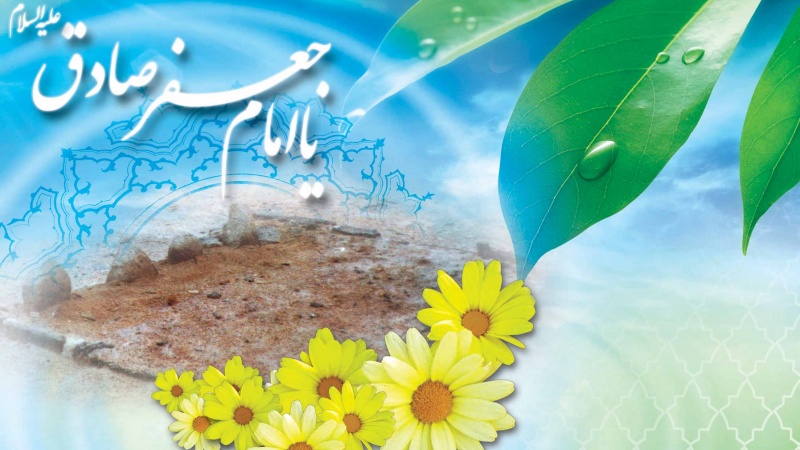
Blessed birthday of Imam Ja’far Sadeq (AS)
Nov 15, 2019 04:18 UTC
Salaam dear listeners and hearty felicitations to you all. Today is a day of double joy. You already listened to an interesting programme on the blessed birth anniversary of Almighty’s Last and Greatest Messenger, Prophet Mohammad (blessings of God upon him and his progeny).
Now we present you an article on the auspicious birthday of his 6th Infallible Heir, Imam Jaf’ar as-Sadeq (AS), who was also born on the blessed 17th of the month of Rabi al-Awwal, and revived in society the pure and pristine teachings of his ancestor the Prophet, despite a gap of 136 years separating their respective birthdays.
Before we proceed, here is Ayah 59 of Surah an-Nisa’ of the holy Qur’an where the Lord Most High commands us:
“O you who have faith! Obey Allah and obey the Prophet, and those vested with authority among you;”
As we said, today is a day of double joy. We are in a festive mood, and along with the celebrations of the birthday of the Seal of all Divine Messengers, to whom the Creator had bestowed the final and most comprehensive heavenly scripture, the Holy Qur’an, as the universal constitution for all mankind, we are marking the birth anniversary in 83 AH of his 6th Infallible Heir, Imam Ja’far as Sadeq (AS).
As is clear by the ayah that we recited, Divine Guidance did not stop after the passing away of the Prophet, or else the holy Qur’an would not have exhorted us to obey “those vested with authority among you.”
The commandment of God is not obedience to the Nimrods, the Pharaohs, the Caesars, or any of the emperors, kings, and dictators, who impose themselves on the people.
Neither does it mean obedience to the ungodly rule of the elected or nominated prime ministers and presidents.
Nor are Muslims obliged to obey the un-Islamic dictates of Sultans feigning religiosity, or for that matter those styling themselves as caliphs.
Then who are we required to obey after Prophet Mohammad (blessings of God upon him and his progeny)?
For those with clarity of vision, the above cited Ayah is self-explanatory. It refers to what the Prophet had explicitly said and done on the commands of God.
One of the most vivid instances when God and the Prophet publicly vested as the person with authority among the Muslims, was the 18th of Zilhijja, 10 AH at the place called Ghadeer-Khom. No one, not even those who hijacked the caliphate, can deny that Imam Ali ibn Abi Taleb (AS) was not proclaimed as vicegerent before a massive gathering of 120,000 Muslims.
The books of hadith and history, including those of our Sunni brethren, are replete with narrations that on numerous occasions, ever since the first public announcement of his mission as the Messenger of God, till his last days when paper and ink had been denied to him, the Prophet had made clear to the ummah the prime position of Imam Ali (AS).
But the question is: Whose authority are Muslims required to obey after Imam Ali (AS)?
The answer is obvious. The Prophet not only referred to his two grandsons, Imam Hasan and Imam Husain (peace upon them) as “Leaders of the Youth of Paradise” and “Leaders who should be followed (in this world) whether they sit or rise”, but he also specified without mincing words that his Divinely-Decreed heirs number exactly TWELVE.
It was thus no coincidence, but Divine Providence, that the Prophet’s 6th Infallible Heir and the Reviver of his pristine “Sunnah” and “Seerah” (behaviour and practice) was born on the anniversary of his birthday, the 17th of Rabi al-Awwal.
Imam Ja’far as-Sadeq (AS) needs no introduction. Born in the year 83 AH on the 136th birth anniversary of the Prophet, he left the world, a martyr, in 148 AH at the age of 65, after serving as God’s authority amongst the ummah for 34 years that could roughly be divided into equal parts in the reigns of the Omayyad and Abbasid tyrants who claimed to be caliphs – although neither God nor the Prophet had vested any authority in them.
The first 18 years of his imamate saw the tyrannical rule of Hisham ibn Abdul-Malik, Walid II ibn Yazid II, Yazid III ibn al-Walid II, Ibrahim ibn al-Walid II, and Marwan II al-Hemar (literally the Donkey) – all of whom had no pretension to religiosity and were notorious for their open violation of the laws of God and the teaching of the Prophet.
During these years, the 6th Imam, despite facing persecution, especially by Hisham, took to new heights the academy of Medina that was founded by his grandfather, Imam Zain al-Abedin (AS) – the Survivor of the Karbala Tragedy – and consolidated by his father, Imam Mohammad al-Baqer (AS).
At its peak, the academy saw 4,000 scholars learning different branches of sciences at the feet of Imam Sadeq (AS) including the Father of Chemistry, Jaber ibn Hayyan, and Abu Hanifa Noman bin Thabet, the founder of the school of jurisprudent known as ‘Hanafi’, who was an offspring of an Iranian Zoroastrian convert to Islam.
In the next 16 years of his imamate, the Prophet’s Sixth Infallible Successor shouldered a graver responsibility. First, after the overthrow of the Omayyads, there was the offer of caliphate by Abu Salma al-Khalla, one of the victorious generals of the uprising, and the Imam whose authority was God-given, burned the sealed envelope of the offer in the flame of a lamp, in order to show to the people and to posterity that the real caliphate of successors-ship to the Prophet, is not a position bestowed by fallible persons, but is a Divine Trust, which he already possessed as the Imam.
Next was the devilish plot of Mansour Dawaniqi, the 2nd self-styled caliph of the usurper Abbasid regime. Originally a follower of the Ahl al-Bayt, he had memorized thousands of hadith on the merits of Imam Ali (AS), but became a turncoat on assuming rule of the Islamic realm. He not only tormented Imam Sadeq (AS), whose God-given authority he had acknowledged in his days as a persecuted fugitive during Omayyad rule, but labeled the Shi’a or devoted followers of the Ahl al-Bayt as “Rafidhoon”, which means rejecters of the caliphate.
In the face of such intricate plots, Imam Ja’far Sadeq (AS), as the Righteous Heir of Prophet Mohammad (SAWA) bequeathed to the seekers of truth the jurisprudence known as “Fiqh al-Ja’fari” which is actually the “Shari’at-al Muhammadi” in its genuine form.
In short, the 6th Imam’s profound knowledge and virtues have been recorded by the historians, included hospitality, charity, the helping of the needy in secrecy, the fair treatment of poor relatives, forgiveness, patience and fortitude.
AS/SS
Tags