Blessed Birthday of the 11th Imam
Dec 05, 2019 09:17 UTC
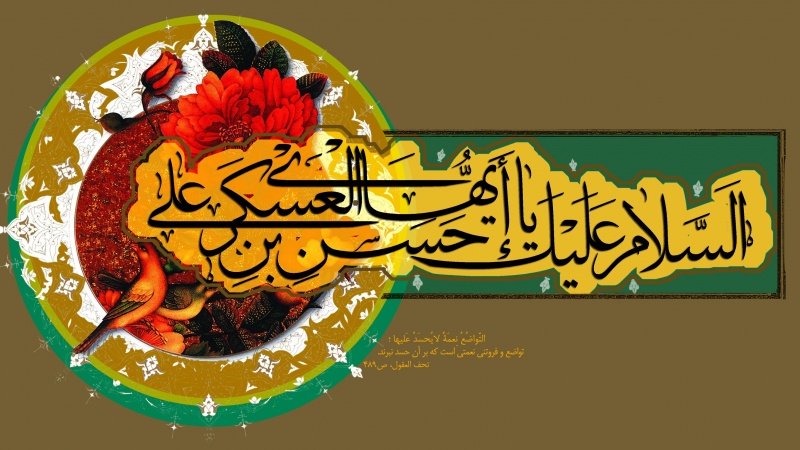
Heartiest congratulations to our dear listeners on an auspicious occasion. We present you a special feature today on the blessed birthday of the 11th Infallible Heir of Prophet Mohammad (blessings of God upon him and his progeny).
First we recite to you an excellent piece of advice, which could be called a blueprint for leading a fruitful, tension-free, and happy life:.
“The most pious of people is he who stops at suspicious matters. The best worshipper is he who performs the obligatory religious affairs duly. The most abstinent of people is he who refrains from the unlawful. The most hardworking of people is he who keeps away from sins.”
The statement which you heard is indeed food for thought. It provides guidelines for all those striving for good in society and standing steadfast against devilish designs.
The person who pronounced these words was none other than the 11th Infallible Heir of the Prophet of Islam, and the Father of the Promised Saviour of mankind, Imam Mahdi (AS), through whom God will grant the final victory to the true believers and make Islam triumphant over all creeds, ideologies, and nations.
To be more precise he was Imam Hasan al-Askari (AS), whose birthday we celebrate every year on the 8th of the month of Rabi al-Akher.
He was born to Imam Ali an-Naqi al-Hadi (AS) in the holy city of Medina in 232 AH (corresponding to 846 AD). He was destined to acquire the epithet “al-Askari”, which means the “soldier”, or more properly the “Soldier of God”, at whose command was an army of angels – as the terrified tyrant Mutawakkel the Abbasid ca0liph, found out when he tried to boast of the power of his mostly Turkic mercenary slave-soldiers, recruited from the wild steppes of Central Asia.
As for the mother of Imam Hasan al-Askari (AS), she was the most virtuous lady of her age, known for her faith in God, her chastity, her purity of thought, and her piety. A native of Nubia between the lands of Egypt and Sudan, she was named ‘Saleel’ or the one purified from error, defect, and impurity. Some historians have referred to her ‘Sowsan’, while others have called her ‘Haditha’, which seem to be her epithets for her outstanding qualities.
In addition to such a glorious lineage that originates from his great ancestress, the Prophet’s Immaculate Daughter, Hazrat Fatema az-Zahra (peace upon her) – the Noblest Lady of all times, he possessed perfect morals, was sincere in all affairs, and was the most knowledgeable person of his age – not only in Islamic sciences, but in all fields of knowledge.
Bakhtshou, a famous Christian physician who was a contemporary of Imam Hasan Askari (AS), once said to one of his disciples named Batriq about the 11th Imam: “He is the most knowledgeable of all those under the sky in our day.”
Even the conscientious courtiers of the usurper Abbasid caliphs have admitted that if their tyrannical rulers had not subjected the Imams of the Ahl al-Bayt to oppression and confinement, they would have filled the world with knowledge and sciences to such an extent that the world had never before seen such wisdom and intellectual development.
A contemporary named Ahmad bin Ishaq relates that when he heard of the martyrdom of the 10th Imam in 254 AH (corresponding to 867 AD) he went to Samarra and asked for whereabouts of the 11th Imam. He was told that the Imam had been imprisoned by Mo'taz Billah. One night, after bribing the guards he was able to visit the Imam. He described the prison as a tunnel under the caliph’s palace. Ahmad says he cried when he saw the Imam’s condition. Food was only one glass of water and a piece of dry bread a day.
He was imprisoned because the caliphs were scared of the Prophet’s famous hadith that his righteous successors will be 12 in number, and the last one will rise as Imam Mahdi al-Qa’em (AS) to rid the world of all vestiges of corruption and tyranny, and to establish the global government of peace and justice.
The life of Imam Askari (AS) stands as a lighthouse of guidance for us. When we reflect on the letters he wrote to his representatives in the various parts of the Islamic realm, and when we ponder on the phrases of his supplications to God Almighty, we discover the dynamism of the person who in spite of the restrictions placed upon him, was an ocean of guidance.
An example in this regard is his expounding of the secrets of the ayahs of the holy Qur’an to not only his disciples, but indirectly to the famous philosopher of the age, Yaqoub al-Kindi. It happened that Kindi had written a book on what he thought of certain contradictions in the holy Qur’an. He would have perished and slipped into the abysmal depths of the eternal inferno, if Imam Askari had not come to his rescue. God Almighty says in Ayah 7 of Surah Aal-e Imran of the holy Qur’an:
“It is He Who has sent down to you the Book. Parts of it are definitive verses, which are the Mother of the Book (Umm al-Kitab), while others are metaphorical. As for those in whose hearts is deviance, they pursue what is metaphorical in it, seeking mischief and seeking its interpretation (to suit their whims). But no one knows its (actual) interpretation except Allah and those firmly grounded in knowledge; they say: “we believe in it; all of it is from our Lord.” And none takes admonition except those who possess intellect.”
The 11th Imam, as the Knower of both the Definitive and the Metaphorical Ayahs of the Holy Qur’an, remarked to his disciples: Doesn’t al-Kindi have the simple common sense to understand that the interpretation of the Divine Meanings could be something other than what has occurred to his mind? One of the disciples of who used to attend the classes of al-Kindi, repeated this rational argument in front of the philosopher. The conscience of al-Kindi was jolted, but knowing the intellectual limitations of his student, he asked him who actually had inspired him to raise such points that had so far eluded the philosophical mind of his master. When he was told it was Imam Askari (AS), the philosopher acknowledged the God-given wisdom of the Prophet’s righteous successor, and decided to burn the blasphemous book he was writing on the Holy Qur’an.
This was one of the examples of the role of Ark of Salvation that Imam Askari (AS) played during his imamate. The 11th Imam’s moving supplications in the Divine Court that believers still recite till this day, his aphorisms, and his strategy in making the system of “wikala” (or representation) foolproof in order to serve the faithful during the crucial days of occultation of his son, stand as testimony to his mission to guide humanity.
Here is a part of a supplication that the 11th Imam used to recite in Qonout with raised hands during the 2nd raka’ah of the ritual prayer:
“O You, Whose light covers darkness, O You, by Whose holiness rugged mountain passes are lit, O You, to Whom all the inhabitants of the earth and the heavens submit, O You, to Whom every insolent tyrant surrenders with obedience, O You the Aware of hidden consciences, You are Merciful to everything and Aware of everything, forgive those who repent and follow Your path, protect them from the torment of Fire, give them soon Your victory that You have promised them of and You do not fail the promise! Devastate the people of evil and take them to the worst abode in the worst punishment and the ugliest retreat.”
During the six years of his Imamate, Imam Askari (AS) guided seekers of truth at every opportunity. Volumes of books and not a brief radio program are required to pen the virtues of Imam Askari (AS). To be brief, here are some more bezels of wisdom from the 11th Imam:
“Reasonless laughter is a sign of ignorance”.
“The worst servants –of God— are those who are two-faced and two-tongued; they praise their present friends and backbite the absent; they envy them for obtaining graces and disappoint them when they suffer a misfortune.
“Anger is the key to every evil.
“The least comfortable of people is the spiteful.
“The heart of the foolish is in his mouth and the mouth of the wise is in his heart.
“The powerful will be definitely humiliated if he ignores the right.
AS/SS
Tags