How Washington found itself with Daesh terrorists
Oct 14, 2017 12:45 UTC
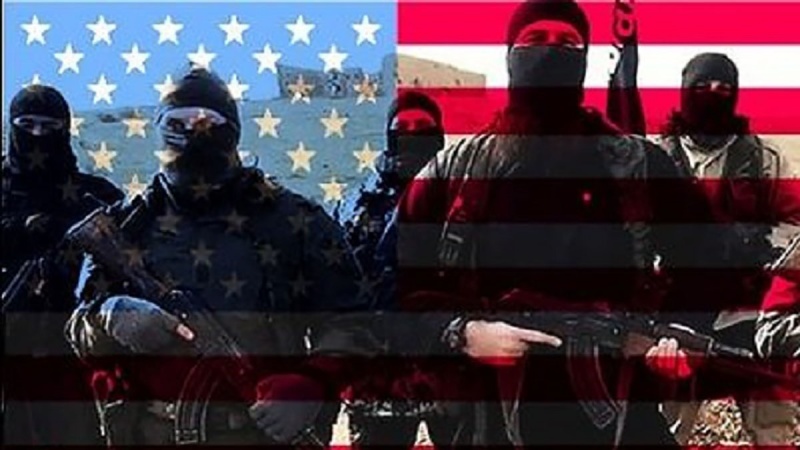
As per the ground realities, the US is in close collaboration with Daesh in Syria and not in fight against the terrorists as they pretend to be.
The US has long been in league with the terrorists trying to destabilize Syria and Iraq, and despite its denials, its actions in Syria in providing arms and air cover to an assortment of terrorists, it is clear that Washington, along with Saudi Arabia and the illegal Zionist entity Israel, serves as godfather of the cannibalistic Tafkiris known by their Arabic acronym Daesh. Here's a report in this regard by Political Scientist, Alexander Orlov.
It is now clear that the unexpected counterattack that the Daesh militants launched near the Deir ez-Zor and Palmyra, forcing Russia’s air group deployed in Syria to take urgent measures to repel it that almost overran positions occupied by Syrian forces was staged by the US and its Kurdish SDF allies. As for the death of Russian General Valery Asapov who was struck dead during enemy shelling at his C2 post, it’s curious that the shot that murdered this high-profile Russian officer was made with such deadly precision. There’s no chance that one could land such a shot without access to satellite and air photos. It’s hardly a secret that the Daesh terrorists have no access to this level of reconnaissance assets, but Washington does.
Moreover, a detachment up to 6.000 militants could not approach Deir ez-Zor from the southeast unnoticed. Such a force would be inevitably detected by US-coalition aircraft and satellites. But Washington appears to have been indifferent in transferring this information to the Russian military command, since the United States was pursuing several goals other than fighting Daesh, including:
First, to ensure that pro-US Kurdish forces would be able to occupy vast oil fields near Deir ez-Zor;
Second, to disrupt the crossing of Syrian army troops to the east bank of the Euphrates via a pontoon bridge built by Russian military engineers and;
Third, to undermine the prestige of Russia’s President Vladimir Putin and the forces he commands on the eve of the 2-year anniversary of the arrival of the Russian air group to Syria.
However, Washington hasn’t simply assisted Daesh by concealing reports about the movements of their forces to Deir Ez-Zor, but also struck a deal with some local tribes ensuring that Daesh can cross their lands unreported and unopposed.
Therefore, Damascus had to urgently transfer sections of its Idlib-Khama front, including some of its best forces, to rapidly organize a defense along the strategic road between Palmyra–Deir ez-Zor.
On the night of September 30, a total of 800 men and 50 tanks of the Syria’s elite Tiger Force arrived to Palmyra. Apparently, the command of the Syrian Armed Forces perceived the threat of a militant assault on the city as inevitable. Daesh had already released a report on its website indicating that its militants managed to destroy two Syrian military jets stationed at the T-4 base.
A brief look at the map of Syria indicates the above mentioned airbase is to be found in the town of Tadmur, only a couple of miles away from Palmyra. That also means that militants were approaching Palmyra from the west. Had they continued to do so, the Syrian government would have little choice but to transfer troops from other fronts, including some of the most battle-capable units, now needed to defend Palmyra, which reduce efforts to restore security nationwide.
This has worked well in the favour of Daesh. Moreover, all US-coalition aircraft for the time being ceased patrols over the Euphrates River, which means that Daesh has the ability to launch offensives in this area as well. By scattering their forces across a narrow 60-miles long front, militants have considerably reduced the effectiveness of air strikes carried out by both Syrian and Russian military aircraft, especially with the Russian air corps being heavily employed near the Idlib area.
Mere days after the launch of a Daesh offensive, the Kurds began seizing oil fields along the east bank of the Euphrates River. It was reported that they occupied the Jafra oil field, heading to the largest oil field in Syria – al-Omar. While the US demonstrates its utter lack of cooperation with its Syrian and Russian “partners” in the fight against terrorism by freezing all military flights across the west bank of the Euphrates River for at least a week, granting Daesh a massive area of operations, the east is occupied by SDF forces, forcing Damascus to abandon its plan of regaining control over its own oil fields and instead focusing on its efforts on eliminating Daesh terrorists.
Simultaneously, Turkey began occupying certain parts of Syria’s Idlib province. Ankara pursues the same goal as before – the creation of a buffer separating Kurdish enclaves in Syria from the Turkish territory. Erdogan appears disinterested in Washington’s plans to balkanize Syria, but at the same time he has no intention to discuss the buffer zone he is now creating in northern Syria.
In the meantime, in the south, Daesh continues attacking Syrian positions in a series of hit and run engagements For instance a small contingent of 100 militants captured the town of al-Qaryatain west of Palmyra three times over the period of just two days. During their first assault they would capture a total of 20 pro-government Syrians and execute them hours later. If one is to take into account the fact that it’s a remote city that is far away from any major engagements, while the group operating in this particular area represents one of the many reactivated sleeper cells Daesh maintains, one can begin to comprehend difficulty Damascus has in coordinating its forces wisely. There’s almost no reports coming from al-Qaryatayn, where Syrian forces are fighting Daesh militants from an elite unit.
It wouldn’t be an exaggeration to state that the situation remains extremely complicated in Deir ez-Zor. Clashes occur both in the outskirts and within the city itself, but Daesh militants are almost exclusively attacking the positions where Russian military advisers can be found. The plan of action is clear, with the terrorist force taking every effort to capture Palmyra in an attempt to relieve Daesh militants surrounded elsewhere. In this difficult situation that Syria and its allies find themselves in due to Washington’s cunning plan, Daesh militants are clearly counting on their luck. Theoretically, Damascus can return the situation under its control if it manages to stall the terrorist offensive in the foreseeable future. But in order to achieve this goal, Damascus has to manage whatever forces it has wisely.
Military experts argue that the Kurds will reach the Khabur River and stop there to take a better look at what the Syrian military will be able to achieve on the west bank of the Euphrates.
Apparently, they are waiting for when the government forces to head for Mayadin. After all, Washington has made it clear to the Kurds that it doesn’t simply want them to occupy oil fields, but also prevent Damascus from establishing control of the Syrian-Iraqi border and block the route along which Iran could send troops and equipment to Syria. This is by far the most important goal in Syria today from Washington’s point of view. The US is eager to cooperate with any force, including Daesh, in a bid to prevent the Syrian army from securing the border with Iraq.
There can be hardly any difference of opinions about what the US is trying to do in Syria. In fact, it’s trying to stab its partners in the fight against terrorism in the back simply because it somehow fits Washington’s own immediate interests. Western attempts to get Moscow drawn even deeper into the Syrian war is a part of ongoing attempts to undermine Russia’s economic situation, all on the eve of upcoming presidential elections.
AS/EA
Tags