IAEA neutrality: Iran’s main demand on nuclear issue
-
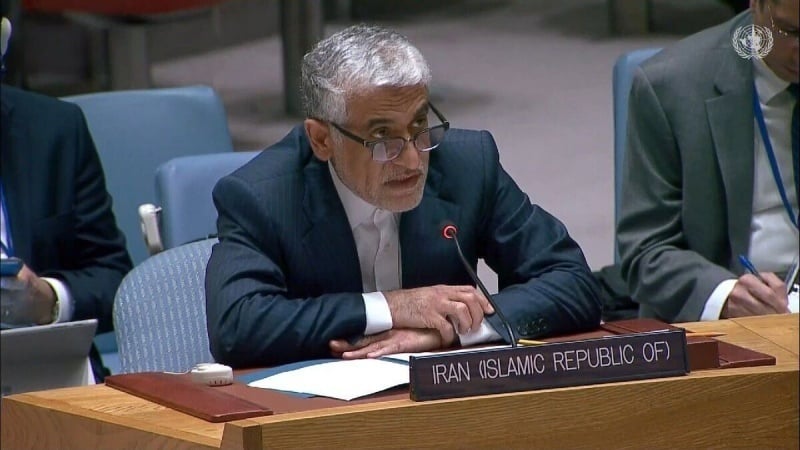
Amir Saeed Iravani, Iran’s Ambassador and Permanent Representative to the United Nations
Pars Today — Iran’s Ambassador and Permanent Representative to the United Nations, regarding the report by Rafael Grossi, Director General of the International Atomic Energy Agency (IAEA), stated that such reports must always remain professional, fact-based, and free from any political influence.
Amir Saeed Iravani, Iran’s Ambassador and Permanent Representative to the United Nations, said at the UN General Assembly session on the IAEA report:
“While some countries systematically restrict developing nations’ access to peaceful nuclear technology, they simultaneously provide weapons and military assistance to the Israeli regime, which is not a member of the Nuclear Non-Proliferation Treaty and possesses a concealed arsenal of weapons of mass destruction.”
Iravani added: “The transfer of nuclear knowledge and technology, guaranteed under Article IV of the Nuclear Non-Proliferation Treaty and the IAEA Statute, is not a privilege but an inherent and inalienable right.”
The Ambassador and Permanent Representative of the Islamic Republic of Iran to the United Nations emphasized: “The world witnessed a deeply criminal and aggressive act in June 2025. Just hours after a politically motivated resolution was passed in the Board of Governors, the Israeli regime launched extensive and heavy attacks on Iran’s safeguarded nuclear facilities, which are under full IAEA supervision. These criminal attacks targeted Iranian scientists and their families, killing or injuring thousands, and caused massive material damage.”
Iravani continued: “The United States, as a permanent member of the UN Security Council and a NPT depositary, directly targeted IAEA-supervised facilities by joining this aggression on 22 June. These actions constitute a blatant violation of international law, the UN Charter, the IAEA Statute, and Security Council Resolution 487 (1981), which explicitly prohibits any attack on safeguarded nuclear facilities.”
The Islamic Republic of Iran has consistently regarded IAEA reports as biased because the United States and some European countries use the agency for their political objectives against independent nations. Instead of focusing on technical issues, they turn these reports into tools for imposing sanctions and diplomatic pressure on Iran.
Iran has repeatedly warned that the United States and the European Troika (the UK, France, and Germany), by submitting anti-Iran resolutions to the Board of Governors, have effectively diverted the review of Iran’s file from a technical path to a political one. IAEA reports, especially after the U.S. withdrawal from the JCPOA, have been used as a pretext to escalate economic and political pressures against Iran.
Iranian officials say that the IAEA, in its reports, ignores or downplays Iran’s extensive cooperation, even though Iran has repeatedly stated that its activities are peaceful and under safeguards. Iran emphasizes the neutrality of IAEA reports, arguing that the agency’s credibility and legitimacy can only be maintained if its reports remain professional, fact-based, and free from political pressure.
The European Troika, consisting of France, Germany, and the UK, has prepared a draft resolution against Iran, which is set to be presented at the IAEA Board of Governors meeting from 19 to 21 November (28 to 30 Aban). These anti-Iran actions by the U.S. and the European Troika are taking place while Iran continues diplomatic engagement and cooperation with the IAEA, emphasizing that it is ready to revive the agreement if the other parties return to their commitments.
The recent agreement between Iran and the IAEA in Cairo to resume technical inspections, along with diplomatic talks in Geneva, Muscat, and Rome, all demonstrate Tehran’s willingness to resolve the issue through diplomacy, provided there are genuine guarantees for sanctions relief. Iran has repeatedly emphasized that it is ready to reach a stable and reliable agreement that guarantees the lifting of sanctions and prevents future misuse.